Introduction
Every water utility eventually faces the same problem: tying in a new subdivision, relocating a fire hydrant, or connecting an industrial customer to an existing main.
Shutting that main down means dewatering the line, retesting for bacteria, and sometimes issuing a boil-water notice to every household downstream.
That's not a small inconvenience. The EPA found that 3,221 boil-water advisories, or 80% of all identified events in 2021, traced back to main breaks, distribution repairs, or pressure-loss events. Crews want to avoid adding to that number every time they need a routine tie-in.
Wet tapping solves this. It lets crews cut into a live, pressurized main and install a new connection without stopping flow to a single customer.
This guide covers what wet taps are, how the process works, how they compare to hot and dry taps, and the equipment that separates a clean tap from a failed one.
Key Takeaways
- Wet tapping adds fittings to live, pressurized mains with zero service interruption
- Traditional shutdowns force dewatering, bacteria retesting, and sometimes boil-water orders
- Matched equipment rated to exact pipe size and pressure drives a clean, reliable tap
- Taps up to 72 inches need heavier hydraulic machines and precision-built cutters
What Are Wet Taps?
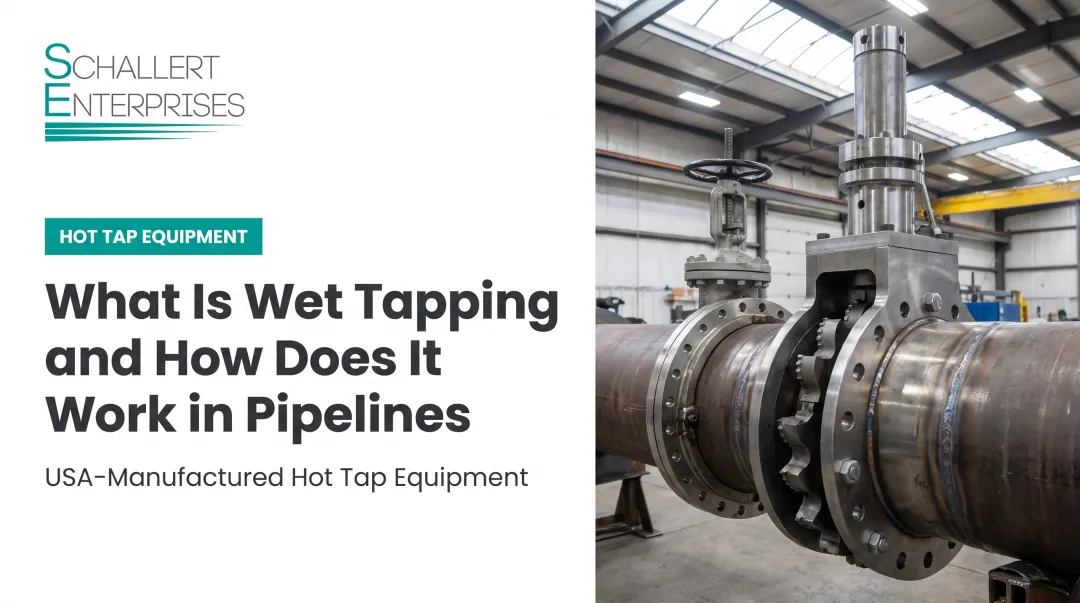
A wet tap is the process of installing a new connection or fitting onto a water main while it stays live and under pressure. No shutoff. No drop in service. The main keeps flowing to every customer downstream while crews cut the new opening.
Three components make this possible:
- Tapping fitting or sleeve: clamps around the main and creates a sealed branch outlet
- Tapping valve: bolts onto the fitting and stays fully open during the cut
- Tapping machine: mounts on the valve and drives the cutter through the pipe wall
Each piece has to seal against full line pressure the entire time. That's the real difference between a wet tap and simply drilling a hole in a pipe.
Wet Tapping vs. Traditional Shutdown Taps
Before live-tapping equipment became standard, connecting to a main meant shutting it down first. That older method still shows up on scheduled construction jobs, and it carries real costs:
- Draining and dewatering the affected section
- Retesting the water for bacteria before service can resume
- Issuing boil-water notices when regulators require them
Wet tapping skips all of that. Crews work during normal business hours, and pressure never drops for customers on that main. That matters a lot when the main serves a hospital, a school, or a busy commercial corridor.
Wet tapping isn't limited to drinking water, either. It's standard practice across:
- Municipal water mains
- Wastewater and sewer force mains
- Industrial and utility pipelines carrying process fluids
How the Wet Tapping Process Works
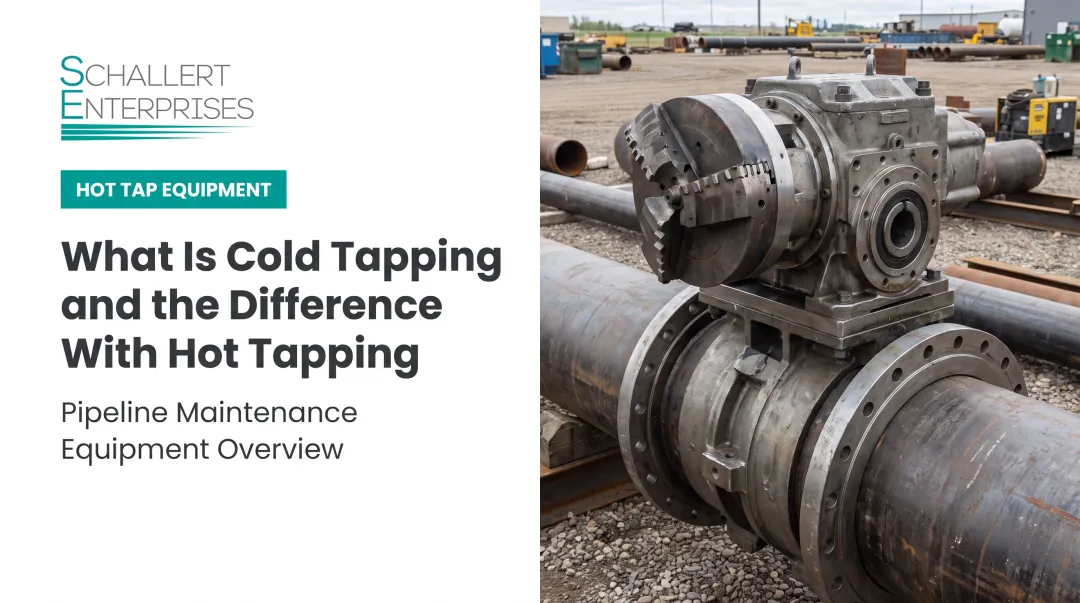
The setup starts before the first cut. Crews secure a tapping fitting to the main, seal it, and pressure-test the joint. A gate or ball valve then bolts onto that fitting and stays fully open. The tapping machine mounts on top, ready to drive the cutter down through the valve and into the pipe wall.
The Step-by-Step Tapping Sequence
- Install the fitting. Secure the tapping sleeve or branch fitting around the live main and confirm the seal holds under pressure.
- Attach the tapping valve. Bolt the valve to the fitting outlet and verify it's fully open before proceeding.
- Mount the tapping machine. Connect it to the valve using a matched adapter and gasket.
- Advance the cutter. Feed the boring bar through the open valve until the cutter meets the pipe wall, then rotate with a steady, controlled feed.
- Retain the coupon. The pilot drill's catch wire holds the coupon—the cut pipe section—so it doesn't drop into the flow as debris.
- Withdraw the cutter. Retract the boring bar and coupon back through the valve under full line pressure.
- Close the valve, remove the machine. Shut the tapping valve, disconnect the tapping machine. The new connection is live.
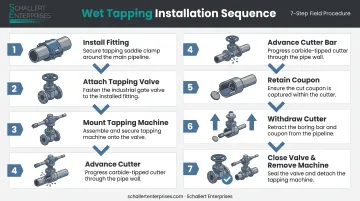
Every joint in that stack, from fitting to valve to machine, has to stay pressure-tight from step one through step seven. Any gap means a pressure loss, or worse, an uncontrolled water release mid-cut.
Older, corroded pipe can suffer burn-through during cutting—a weakened wall gives out under pressure before the cut completes. Pipe in that condition is often a better candidate for replacement than tapping. No cutter, however well built, can compensate for a wall that's already too thin to hold pressure.
Wet Tap vs. Hot Tap vs. Dry Tap: Understanding the Differences
These three terms get used loosely, but each describes a distinct scenario.
- Wet tap: A live connection made on a pressurized water main. No service interruption. Standard for municipal water utilities.
- Hot tap: A live connection on pressurized lines carrying gas, steam, oil, or industrial fluids. Same core equipment as a wet tap, used on process piping instead of drinking water.
- Dry tap: A connection made after the line is shut down and drained. Triggers dewatering, bacteria retesting, and often a boil-water order that live tapping avoids.
| Factor | Wet Tap | Hot Tap | Dry Tap |
|---|---|---|---|
| Service continuity | Uninterrupted | Uninterrupted | Line shut down |
| Typical application | Municipal water and wastewater | Oil, gas, steam, industrial fluids | New construction, scheduled tie-ins |
| Complexity and cost | Higher — pressure-rated gear, skilled crew | Highest — hazard controls on live process lines | Lower — open access, easier inspection |
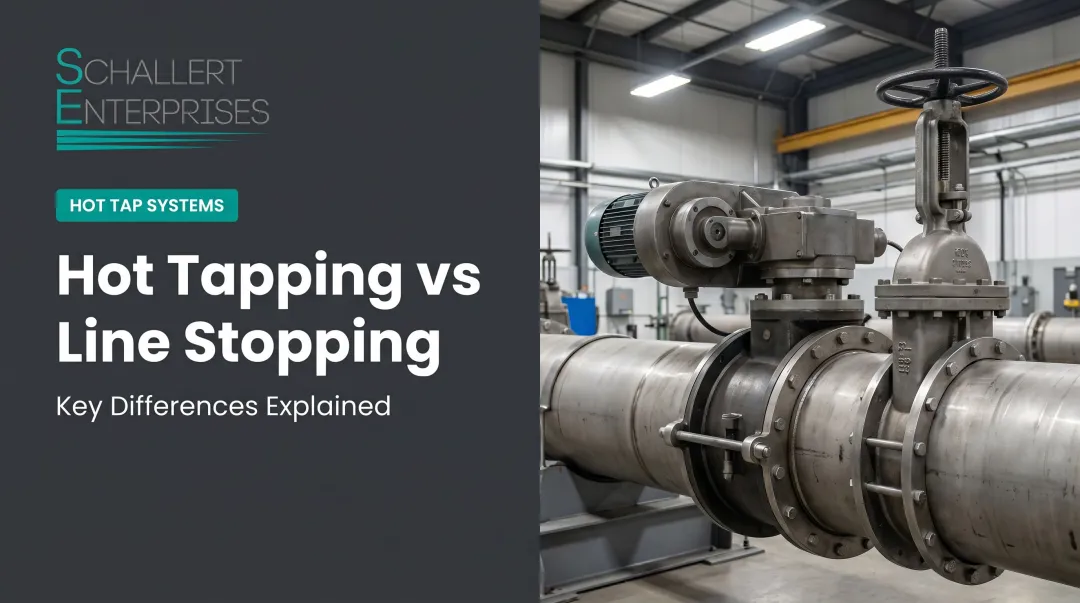
Wet and hot tapping share nearly identical hardware: a fitting, a valve, and a tapping machine. The real distinction is what's inside the pipe. Water carries different risk than a live gas or oil line, which is why hot tapping demands additional hazard controls around welding and pipe fitness.
Essential Equipment for a Successful Wet Tap
Every wet tap depends on five pieces of equipment working together:
- Tapping sleeve or fitting: seals around the main
- Tapping valve: opens and closes the branch
- Tapping machine: drives the cutting operation
- Cutting head or hole saw: removes the coupon
- Pilot drill: centers the cut and retains the coupon
Why Matched Components Matter
Using same-manufacturer, compatible parts isn't a minor preference. On larger-diameter taps especially, a mismatched valve-to-machine adapter can cause misalignment, poor sealing, or a stuck boring bar mid-cut. The bigger the tap, the less room there is for tolerance error.
Equipment also has to match the pipe itself. That means checking:
- Diameter: a wrongly sized cutter won't fully separate the coupon
- Material: steel, PVC, and concrete-lined pipe each need different cutter tips
- Pressure rating: the whole assembly needs to hold the line's operating pressure with margin to spare
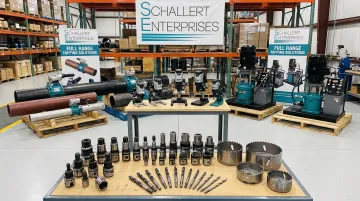
Schallert Enterprises, a USA-based manufacturer in Lake Elsinore, California, builds tapping machines spanning ¾ inch to 72 inches, along with tapping adapters, pilot drills, and large-diameter hole saws. That includes diamond segment cutters up to 72 inches for concrete-lined pipe.
Their lineup runs from the compact, electric TM100 for small service-line taps up to the hydraulic TM6120, sized for 24-inch to 72-inch municipal mains.
One detail solves a real field headache: Schallert custom-fabricates tapping adapters and cutter housings to fit exact pipeline specifications, built to mount on any tapping machine brand, not just their own. That flexibility cuts down on the mismatches that cause failed taps—crews aren't forced to mount an incompatible adapter on a valve it was never designed for.
Standards, Compatibility, and Avoiding Common Wet Tap Failures
Tapping sleeve-to-valve connections aren't left to guesswork. The Manufacturers Standardization Society publishes MSS SP-60, which standardizes the flange interface between tapping sleeves and tapping valves using a positioning recess and mating raised face.
That standard governs alignment, but it doesn't guarantee every valve, adapter, and cutter combination downstream of that flange will interface correctly.
Most failed wet taps trace back to three causes:
- Inexperienced crews unfamiliar with the specific machine or fitting
- Incompatible equipment, particularly mismatched valve-to-machine adapters
- Attempting to tap unsuitable pipe, such as severely corroded or thin-walled sections
A few field-tested habits reduce that risk considerably:
- Hydrostatically test the sleeve and valve assembly before mounting the tapping machine
- Block and support the entire assembly so it can't shift under cutting torque
- Verify shaft travel and clearance measurements against the machine's spec sheet before the crew arrives on site
Skipping these checks is how a routine tap turns into a stuck boring bar or a pressure release nobody planned for.
Benefits of Wet Tapping for Utilities and Pipeline Operators
The core benefit is simple. Customers never lose service. Water, gas, or process fluid keeps flowing through the entire connection process, with no pressure drop and no outage notice to send.
That translates into real regulatory and labor savings. Utilities skip:
- Dewatering the line before work begins
- Bacteria retesting after the system is restored
- Paperwork and notices tied to a boil order
The EPA's Natural Gas STAR program modeled this tradeoff for gas utilities. A hypothetical 320 hot taps per year produced $80,160 in annual benefit against roughly $79,200 in combined equipment and operating costs, yielding about a 12-month payback on the tapping equipment itself.

That model dates to 2003 and isn't a current water-sector quote, but the underlying logic still holds: avoided downtime and avoided product loss add up fast.
Wet tap fittings and machines do carry a higher upfront cost than shutdown-tap tools. But equipment built for decades of service, properly matched and maintained, keeps paying that cost back tap after tap, long after cheaper alternatives have worn out.
Frequently Asked Questions
What are wet taps?
A wet tap connects a new pipe or fitting to a live, pressurized pipeline without shutting off service. The main stays pressurized and flowing throughout the entire installation.
What is the difference between a hot tap and a wet tap?
Wet tapping typically refers to water lines, while hot tapping applies to pressurized gas, oil, or industrial fluid lines. The equipment and cutting process are nearly identical between the two.
Can any pipe material be wet tapped?
Most common pipe materials, including ductile iron, steel, and PVC, can be tapped safely. Severely corroded or structurally weak pipe often needs replacement rather than tapping.
How large can a wet tap be?
Taps range from under an inch to over 70 inches in diameter, depending on the tapping machine and cutter capacity used. Schallert's lineup alone spans ¾ inch up to 72 inches.
Is wet tapping safe to perform on older pipelines?
Yes, when the pipe passes a pre-tap inspection. Sections that cannot support the tapping fitting should be replaced instead of tapped.
How long does a typical wet tap take to complete?
Most wet taps finish within a single work shift. Exact timing depends on pipe size, material, and site access conditions.