This guide is written for pipeline contractors, municipal water utility crews, and industrial pipeline operators who need operational clarity, not textbook definitions. "Tapping" gets used loosely on job sites, and mismatched methods lead to leaks, service interruptions, or contamination risk that shows up months later as a callback.
We'll cover the three core tapping methods, the factors that actually determine which one to use, and where advanced equipment like line stops fits into larger jobs.
TL;DR
- Direct, saddle, or sleeve taps cover most water main jobs—match the method to pipe and site conditions
- Wet taps dominate the field because they avoid water loss and service disruption
- Pick the method by pipe material, tap size, operating pressure, and project specs
- Larger taps and section repairs standard on hot tapping with line stop equipment
- Defaulting to one method regardless of pipe condition is a common, costly field mistake
What Is Water Main Tapping?
Water main tapping is the controlled drilling or cutting into an existing pressurized main to install a corporation stop, valve, or branch connection. The goal is a leak-tight, code-compliant connection made without draining or shutting down the line.
Tapping is not the same thing as line stopping. Tapping creates a new branch or connection point. Line stopping isolates a section of existing pipe so crews can perform maintenance or replacement while upstream and downstream flow stays active. A tap is often the first step that gives access for a line stop, but the two serve different purposes entirely.
The Three Water Main Tapping Methods Pipeline Contractors Use
Method selection comes down to three options: Direct Tap, Saddle Tap, and Sleeve Tap. Each has distinct equipment, size limits, and use cases, and none of them are interchangeable across every pipe type.
Direct Tapping
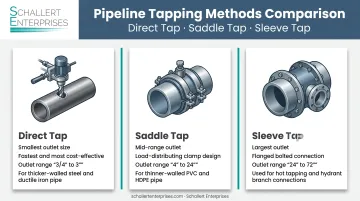
Direct tapping threads directly into the pipe wall to install a corporation stop. It's typically limited to smaller diameters, and outlet size is generally capped well below main diameter regardless of how large the main itself is.
- Can run as a dry tap on new, unpressurized lines or a wet tap on an in-service main
- Generally the fastest, most cost-effective method when pipe material and size allow it
- Capacity depends on main diameter, wall thickness, and material—not a single outlet size
Skip the assumption that "2 inches" applies everywhere. DIPRA's installation guide permits a 2-inch direct tap on all ductile iron pressure classes only at 24-inch mains and larger; smaller mains need size- and thickness-specific tables. That figure is an upper limit for large-diameter ductile iron, not a blanket rule.
Saddle Tapping
A metal or composite saddle wraps around the pipe, and the corporation stop threads into the saddle rather than the pipe wall itself. This distributes load across a wider fitting instead of relying on the pipe wall's thread capacity.
Saddle tapping is preferred for:
- Pipe with thinner walls or lower hoop strength, such as certain PVC or HDPE classes, where direct threading risks cracking or thread stripping
- Situations where the pipe material can't reliably hold threads under pressure
- Retaps or services on older mains when wall condition makes a direct thread a poor bet
Sizing varies by material. Uni-Bell's PVC guidance limits direct taps to 1 inch on PVC, with saddle taps extending through 2 inches before a sleeve is required.
That 2-inch ceiling shows up often in manufacturer and utility standards. Always confirm against the pipe class and local code before you treat it as universal.
Sleeve Tapping
When the outlet needs to exceed what direct or saddle taps allow, contractors move to a tapping sleeve (also called a tapping saddle sleeve or full-circle sleeve). A split sleeve bolts around the main and provides a flanged or threaded outlet so the corporation stop or valve mounts to the sleeve, not the pipe wall.
Sleeve taps are the standard choice when:
- Branch or service size pushes past the ~2-inch direct/saddle limit
- You need a larger flanged outlet for valves, hydrant branches, or main extensions
- Pipe material or condition won't support threaded outlets at the required diameter
Wet sleeve taps are common on in-service mains: the sleeve and valve go on first, then the tapping machine cuts through the valve into the main under pressure. Outlet capacity scales with sleeve design and machine range, which is why larger branch work depends on having the right cutter, adapter, and pressure-rated setup—not just a bigger bit.
Sleeve Tapping and Hot Tapping for Larger Connections
A tapping sleeve bolts around the main, sealing against it and providing a mounting point for a larger valve and tapping machine. That setup supports branches that exceed standard direct or saddle tap limits.
Sleeve tapping is the go-to method for:
- Hot tapping large-diameter mains where service can't be interrupted
- Oil and gas pipelines and industrial lines with continuous-flow requirements
- Municipal projects needing branch sizes that exceed 2-inch saddle limits
AWWA C223 covers fabricated steel and stainless-steel tapping sleeves on host pipe from 4 through 48 inches, with branch outlets through 36 inches, according to the ANSI-published standard. That's a construction and application standard, not a universal size trigger, so sleeve requirements still depend on the owner's specs and pipe material.
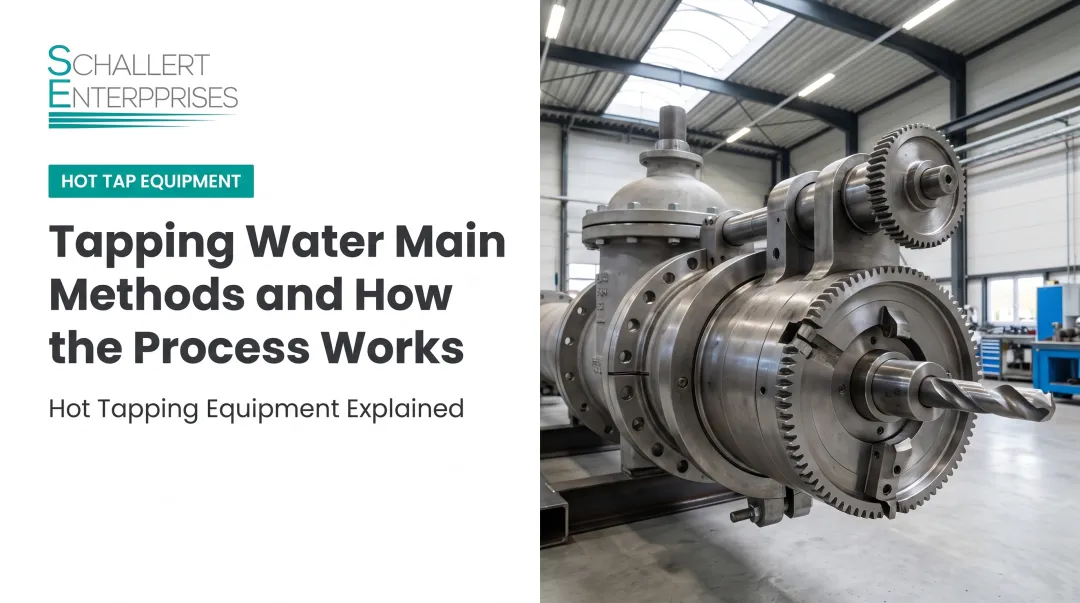
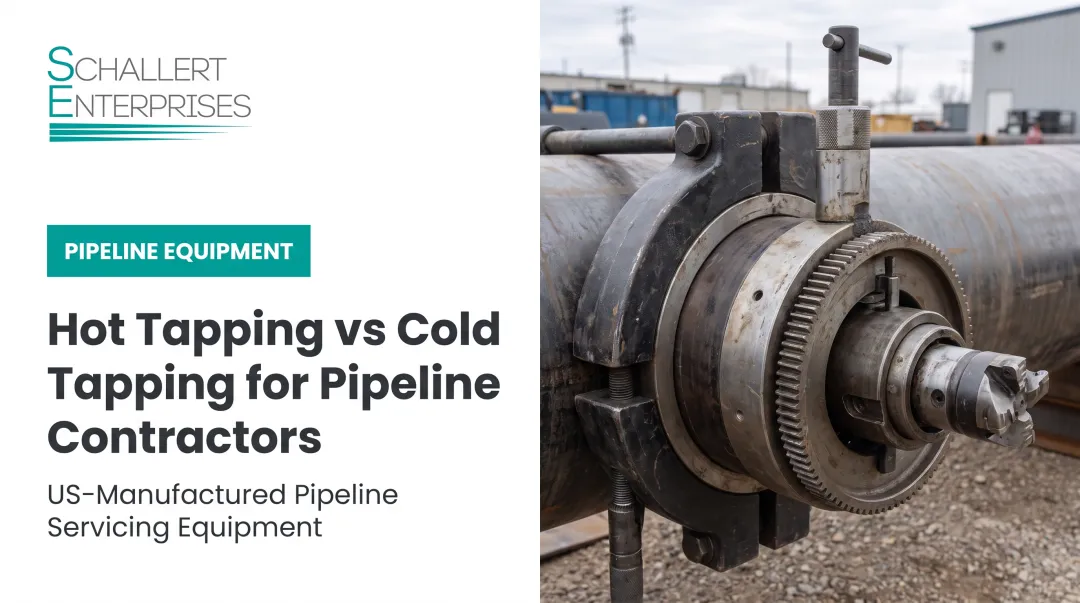
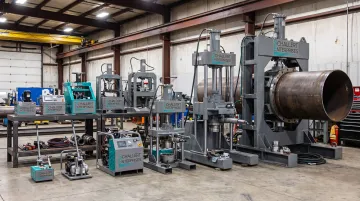
Equipment quality matters more at this scale. Reliable hot tapping on large-diameter mains depends on tapping machines, cutter housings, and hole saws rated for the job.
Schallert Enterprises manufactures a line of US-made tapping machines from the ¾-inch to 3-inch capacity TM100 up through the TM6120, which handles taps up to 72 inches in diameter. Intermediate models (TM200, TM250, TM300, TM400) fill steps in that range, so contractors aren't stuck forcing a small machine onto large-diameter work.
Cutter material matters too:
- Carbide-tipped cutters handle most standard ductile iron and PVC mains
- HSS-tipped cutters are built for steel line applications
- Diamond segment cutters, available up to 72 inches, cut concrete-lined pipe that would destroy a standard multi-tooth hole saw
The trade-off is cost. Sleeves and hot tapping add material and labor expense compared to a direct or saddle tap. But once pipe size or service continuity rules those methods out, sleeve tapping is the only reliable option left.
Key Factors That Affect Tap Method Selection
Choosing between direct, saddle, and sleeve isn't a preference call. Five factors drive the decision on every job:
- Pipe material and wall thickness — ductile iron, PVC, and HDPE respond differently to threading or cutting; thinner-walled pipe often forces a saddle or sleeve regardless of tap size
- Tap size relative to main diameter — AWWA and manufacturer limits force a shift from direct or saddle to sleeve methods once you exceed rated outlet capacity
- Live vs. isolated main — a wet tap keeps water flowing but carries higher operational risk than a dry tap on a shut-down line
- Tapping machine type and crew training — electric machines (TM100, TM200) suit smaller taps; hydraulic units (TM300, TM400, TM6120) handle larger-bore work. Crews need procedure-specific training, not general tapping familiarity
- Project specs and utility standards — a municipal spec sheet may mandate a specific method regardless of what the crew would otherwise choose
Get any one of these wrong, and the job either fails inspection or fails in the field weeks later.
Common Issues and When Standard Tapping Isn't Enough
Misconception #1: Direct tapping works on any pipe material or size. It doesn't. Exceeding rated limits causes pipe wall failure, thread stripping, or leaks that show up under pressure cycling, not necessarily on day one.
Misconception #2: Tapping and line stopping are the same thing. They're not. Tapping adds a connection. Line stopping isolates a section of pipe so a valve or section can be repaired or replaced. A tap is often the entry point used to insert line stop equipment, but the objectives are different.
Field error: Skipping disinfection, gaskets, or thread and pitch matching. Mismatched threads or an overlooked gasket between the tapping tool and the valve compromises the connection even when the tap itself was cut correctly.
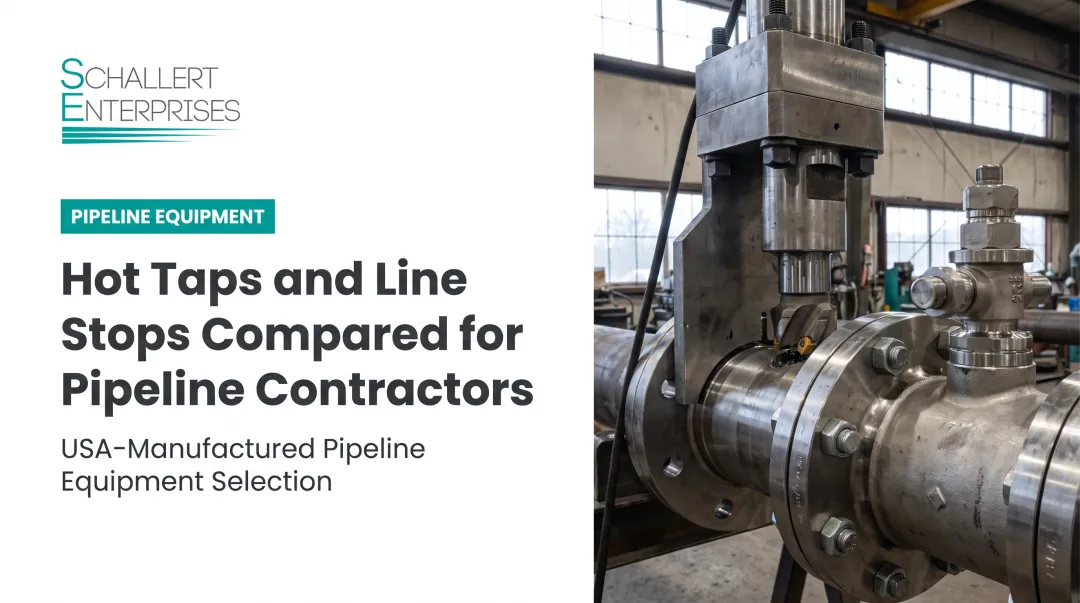
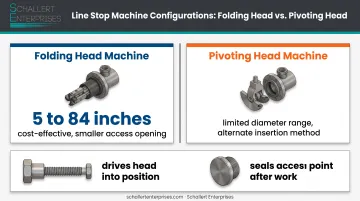
When work moves past typical service-tap range—larger repairs, replacements, or full valve and section maintenance—contractors pair hot tapping with line stop equipment to keep the system live. Two configurations dominate:
- Folding head machines — cost-effective for 5-to-84-inch lines; inserted through a reduced branch so smaller taps and fittings work
- Pivoting head machines — cover a more limited diameter range with a different insertion mechanism
Schallert Enterprises builds line stop products across that full 5-to-84-inch range, plus the jackscrews that drive the heads into position and completion plug setters that permanently seal the access point once work is done.
Conclusion
Water main tapping breaks down into three core methods, each suited to different pipe materials, sizes, and pressure conditions.
- Direct tapping — fast and low-cost when the pipe wall can take it
- Saddle tapping — spreads the load for thinner-walled pipe
- Sleeve tapping — often paired with hot tapping equipment; handles everything beyond those limits
Choosing the right method protects against leaks, service interruptions, and rework that costs far more than the job itself. Match the method and equipment to the pipe in front of you—not whatever is familiar. That choice is the difference between a connection that lasts decades and one that generates a callback.
Frequently Asked Questions
Should the main water tap be fully open?
A corporation stop or main tap valve should generally be fully open during normal operation to avoid restricting flow. Partial closure is typically reserved for controlled shutoffs or testing, not day-to-day use.
What is the main water tap called?
The fitting connecting a service line to the main is commonly called a corporation stop, or "corp stop." The main-side connection is the inlet; the service-side connection is the outlet.
What is the difference between a wet tap and a dry tap?
A wet tap connects to a main while it remains pressurized and in service. A dry tap is performed on a shutdown or new, unpressurized line.
What is the maximum size for a direct water main tap?
Direct taps are commonly limited to around 2 inches, but that upper limit applies mainly to specific ductile iron classes on larger mains. Smaller mains and materials like PVC often have lower limits.
Do contractors need a permit to tap a water main?
Most municipalities require a permit and inspection for water main taps. Requirements vary by city, since improper connections affect system pressure, water quality, and public infrastructure.
What is the difference between tapping and line stopping?
Tapping creates a new branch connection into a live main. Line stopping temporarily isolates a section of pipe so valves or sections can be repaired or replaced without shutting down the whole system.