Introduction
A water main needs a new service line. A gas distribution valve is failing after 30 years underground. In both cases, the pipe stays pressurized, flow keeps moving, and a full shutdown isn't the first option any contractor wants on the table.
This is where hot tapping and line stopping come in. Both let crews work on a live pipeline without draining it, but they solve different problems. Pick the wrong one, and you risk blown budgets, extended downtime, or a repair that doesn't hold.
The stakes are real. A full system shutdown can mean days of lost service, regulatory headaches, and steep revenue loss for whoever's footing the bill. Water utilities face their own version of that risk, including boil orders, water hammer, and lost fire protection during planned outages.
This guide breaks down how hot tapping and line stopping actually work, where each fits a contractor's workflow, and how equipment choice—cutter type, head style, and pressure rating—changes the outcome on the ground.
Key Takeaways
- Use hot tapping to add a branch connection on a live line without stopping flow
- Use line stopping to isolate a section with a plugging head for repair or valve work
- Match the method to pipe diameter, pressure rating, and whether you need a branch or full isolation
- Folding heads cut costs on smaller taps; pivoting heads handle higher pressure and hazardous media
- Quality cutters and pilot drills protect coupon retention and keep the job safer
Hot Tap vs Line Stop: Quick Comparison
Both methods start the same way, with a hot tap into a live pipe. Where they diverge is scope and purpose. Here's how they stack up across the factors contractors weigh on a bid:
| Factor | Hot Tap | Line Stop |
|---|---|---|
| Primary Purpose | Adds a new branch or service connection to a live line | Fully isolates a pipe section for valve, fitting, or repair work |
| Equipment Required | Fitting, isolation valve, tapping machine with cutter and housing | Same setup, plus a line stop actuator, housing, plugging head, and completion plug |
| Pipe Size/Pressure Range | Commonly ¾" up to 72" in diameter, depending on machine | Needs a larger cutter to admit the plugging head; pivoting heads to ~48", folding heads up to 84" |
| Downtime/Disruption | Zero flow interruption; brief connection window | Isolates only the section being worked; rest of the system stays live |
| Relative Complexity | Single continuous cutting operation | Multi-stage: tap, actuator install, plug insertion, completion plug set |
Contractors sizing a job for either method need to match pipe diameter and pressure to the machine, not the other way around. Schallert Enterprises builds tapping machines spanning ¾ inch to 72 inches in diameter, with pressure ratings from 150 to 500 psi by model, alongside folding head line stop machines that extend serviceable range up to 84 inches.
That overlap matters. A crew equipped for both methods can move from a routine tap straight into a full isolation job without renting a second machine.
What Is a Hot Tap?
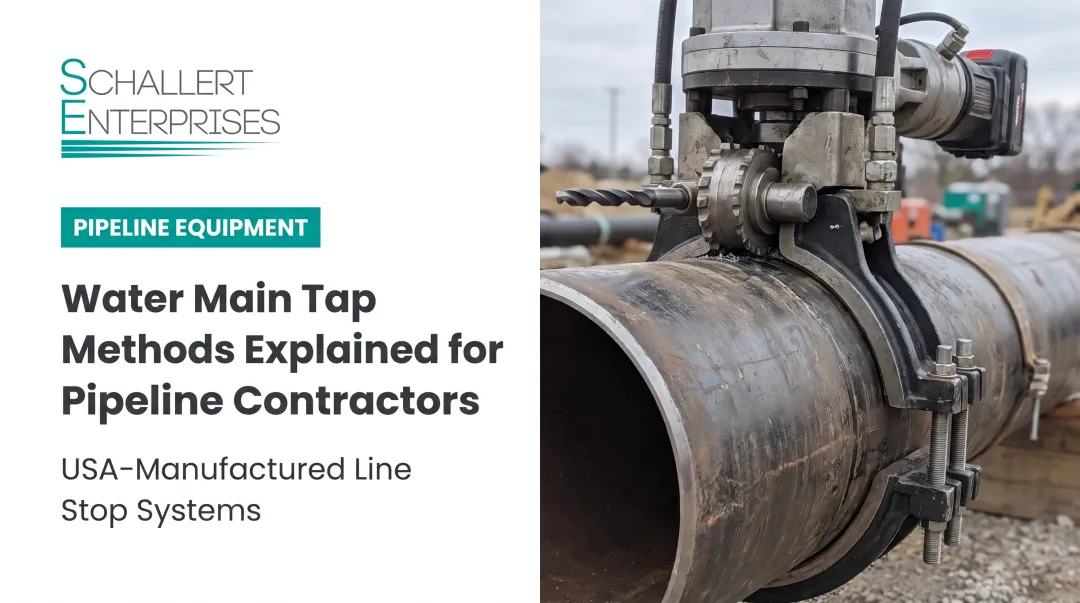
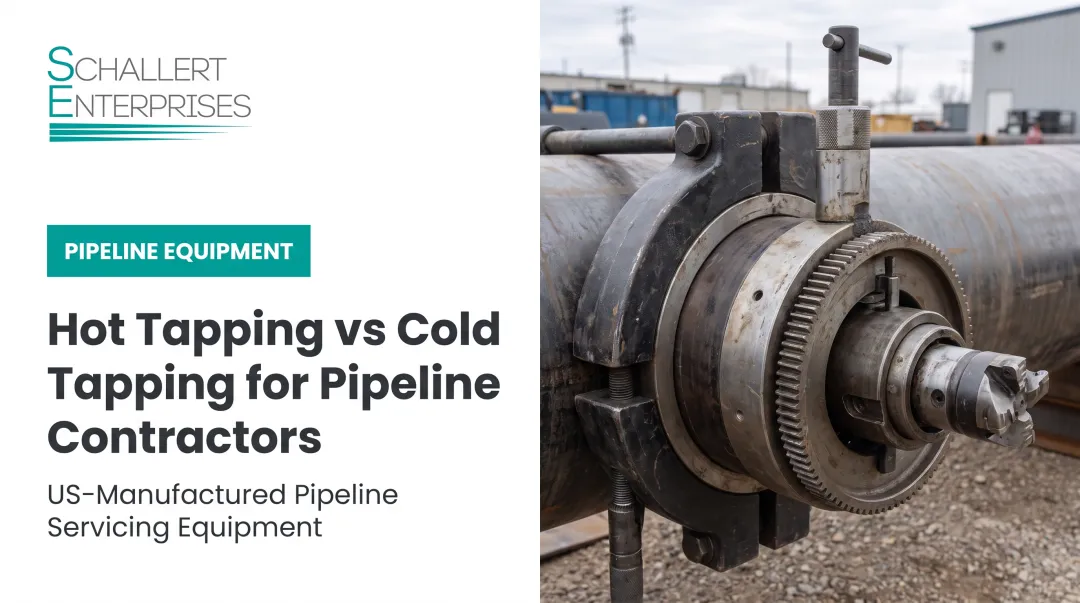
Hot tapping is drilling or cutting into a pressurized, in-service pipe to add a connection, without shutting the system down or venting product to the atmosphere. For contractors, that translates into real, measurable savings on every job:
- Eliminates production or service loss during the connection
- Avoids the purge, depressurize, and re-pressurize cycle that eats up a shutdown schedule
- Cuts environmental exposure from venting gas or product
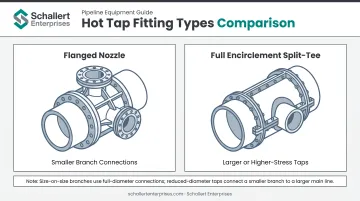
Two main fitting variations cover most jobs. A simple flanged nozzle works for smaller branch connections, while a full encirclement split-tee wraps the entire pipe for larger or higher-stress taps. Contractors can also run size-on-size, where the branch matches the main diameter, or cut a smaller hole on a larger main when full flow isn't needed.
The Equipment Stack-Up
Every hot tap relies on the same three-part setup: a fitting welded or bolted to the pipe, an isolation valve, and a tapping machine fitted with a cutter and housing. Cutter and pilot bit quality determine whether the coupon, the disc of pipe removed during the cut, gets retained cleanly or drops into the line.
Manufacturers like Schallert Enterprises build USA-made tapping machines, cutters, and adapters engineered for specific pipe and pressure requirements. Deep-tooth cutter profiles and pilot drill catch wires are designed to keep that coupon secured through the cut.
Common Hot Tap Applications
Hot tapping shows up anywhere a contractor needs to add flow capacity without touching the rest of the system:
- New branch connections and service taps for growing developments
- Bypass piping installed ahead of planned maintenance
- Tie-ins connecting new pipeline segments to existing mains
Municipal water utilities, refineries, chemical plants, and gas distribution networks all rely on it regularly.
In one vendor example reported by the EPA's Natural Gas STAR program, connecting to a 36-inch gas transmission line at 1,000 psig by shutdown would have required roughly four days and cost an estimated $1.5 million in forgone revenue. A hot tap kept the line in service throughout.
That gap—days of lost throughput versus a few hours of live cutting—is why hot tapping stays the default whenever the job is simply adding a connection.
What Is a Line Stop?
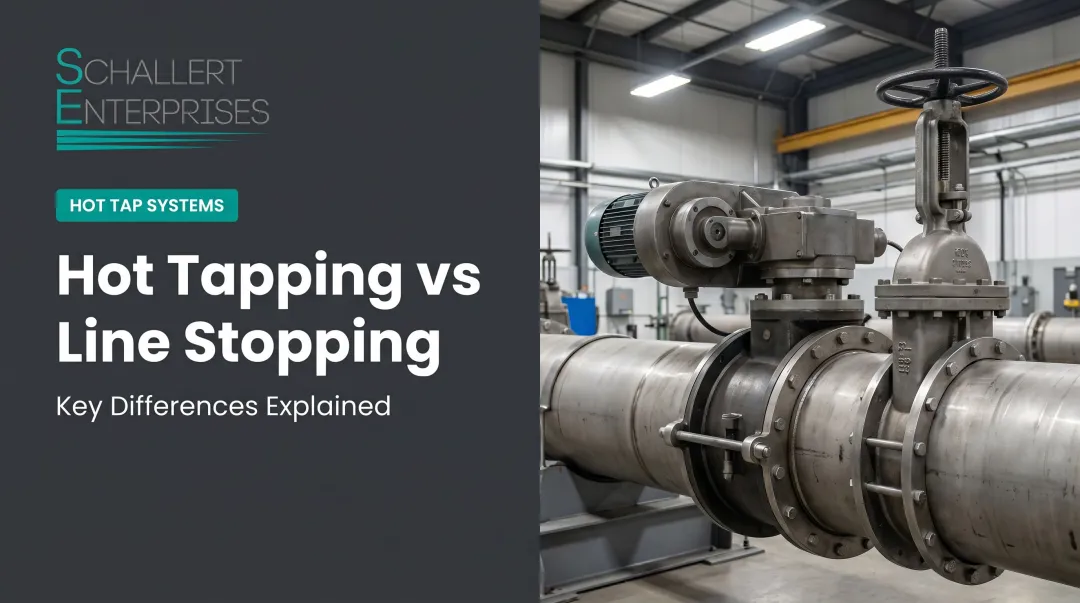
Line stopping starts with a hot tap, then goes a step further. Once the cutter withdraws, a plugging head inserts through that same access point to fully stop flow in the section. That's what makes valve replacement, fitting repair, or damaged pipe removal possible without depressurizing the entire system.
Two head styles cover most jobs:
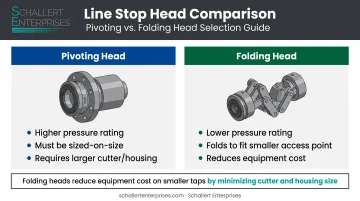
- Pivoting head: handles higher pressure applications but must be sized-on-size with the pipe, meaning a larger cutter and housing
- Folding head: works at lower pressure and folds down to fit through a smaller access point
That difference has a direct cost impact. Folding head machines can reduce costs on smaller taps, valves, and fittings by avoiding the oversized cutters and housings a pivoting head demands.
Added Equipment for Isolation
Line stopping brings extra hardware into the stack-up beyond a standard hot tap setup:
- Line stop actuator
- Housing
- Sandwich valve
- Completion plug and flange system
That last piece lets the temporary valve come out once the repair is finished, leaving a permanent, sealed closure behind.
Common Line Stop Applications
Line stopping fits any job where a section, not the whole system, needs to come offline:
- Replacing aging or failed valves without a system-wide shutdown
- Isolating a damaged or contaminated pipe section for cutout and repair
- Permanently abandoning a pipe segment being taken out of service
Municipal water and wastewater systems, gas distribution operators, and industrial pipeline operators running valve replacement programs rely on line stops for this work.
A documented case from Water & Wastes Digest illustrates the payoff. In Salem, Oregon, crews isolated and stopped a 48-inch transmission main for repair while the rest of the system stayed operational throughout.
In a looped distribution network, two line stops can isolate a repair zone entirely, so customers downstream never lose water service.
Hot Tap vs Line Stop: Which Is Better for Your Project?
Neither method wins by default. The right call comes down to a handful of factors:
- Job purpose - Are you adding a connection, or isolating a section for repair?
- Pipe diameter and pressure rating - Larger diameters and higher pressures narrow which heads and cutters will work
- Available downtime window - Some jobs tolerate a short live-cut window; others need a section fully dead for hours
- Budget - Oversized cutters and housings add cost fast; folding heads that reduce access size save it
- Condition of existing valves and fittings - Failing hardware often forces a line stop regardless of other factors
Choose hot tapping when the goal is a new connection and flow can't stop. Choose line stopping when a valve, fitting, or damaged section has to come out entirely.
Equipment selection often matters as much as the method itself. A pivoting head sized wrong for the pressure class, or a cutter that doesn't match the housing, can turn a routine job into a multi-day delay.
Real-World Example
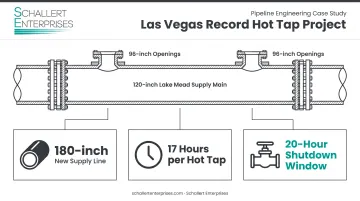
Las Vegas offers one of the more dramatic examples of what live-line work can accomplish under a tight operational window. To connect a new 180-inch supply line serving an ozone treatment plant, crews needed to cut two openings, each 96 inches in diameter, into a live 120-inch Lake Mead supply main.
According to WaterWorld's coverage of the project, each hot tap took 17 hours to complete, with associated planned shutdown windows capped at 20 hours to avoid disrupting the city's water supply.
For smaller contractors, the real lesson is discipline, not diameter. Even at record-setting scale, the project succeeded because the crew matched the tapping machine, cutter, and housing to the exact pipe size and pressure class before cutting. The same principle applies whether you're tapping a 6-inch water main or a 96-inch transmission line.
If your next job calls for a hot tap or line stop, start with equipment sized correctly for the pipe you're working on. Schallert Enterprises manufactures tapping machines, cutters, and line stop components built to exact diameter and pressure specifications, giving contractors the flexibility to handle both routine taps and demanding isolation work without guessing on fit.
Conclusion
Hot tapping and line stopping solve different problems. One adds a connection to a live line. The other fully isolates a section so a valve or fitting can come out safely. Neither is universally better; the right choice depends on what the job actually requires.
Pipe size, pressure rating, and budget all factor into that decision, but so does the condition of the equipment doing the work. A cutter that can't retain a coupon, or a folding head sized wrong for the pressure class, turns a routine job into an expensive delay.
Contractors who keep flexible, correctly sized equipment on hand give themselves the option to choose the right method every time. That means tapping machines that scale from small branch connections through large-diameter mains, and line stop heads built for both low- and high-pressure conditions.
Frequently Asked Questions
What is the main difference between hot tapping and line stopping?
Hot tapping creates a new branch connection on a live, pressurized pipe. Line stopping inserts a plugging head to fully halt flow in a section so a valve or fitting can be replaced.
What is hot tapping in a pipeline?
Hot tapping is drilling or cutting into a pressurized, in-service pipeline to add a branch connection. The system stays online the entire time—no shutdown or depressurizing required.
What are the steps involved in the line stop procedure?
- Perform a hot tap on the live line
- Mount the line stop actuator and housing
- Insert the plugging head to stop flow
- Complete the repair or replacement
- Set a completion plug and remove the equipment
Can a hot tap be converted into a line stop mid-project?
Not directly. A hot tap cutter is typically smaller than what a line stop plugging head needs to pass through, so contractors usually have to re-cut with a larger cutter rather than convert mid-job.
What size pipelines can be hot tapped or line stopped?
Equipment covers pipelines from about 3/4 inch up to 84 inches in diameter. Very large diameters usually need specialized machines and an engineering review before work starts.
How long does a typical hot tap or line stop take to complete?
Timing depends on pipe size and pressure, but most jobs finish within a single continuous operation lasting a few hours. Compare that to days or weeks for a full system shutdown.