Introduction
Picture this: a gate valve on a 16-inch water main has failed. It won't close fully, and a section of pipe needs repair. Shutting down the entire distribution system means thousands of customers lose service, the utility faces complaints, and the crew burns hours on a depressurization and purge procedure before the first wrench turns.
This scenario plays out regularly across water utilities, oil and gas pipelines, and industrial process facilities. Isolation valves are supposed to prevent it — but only when operators choose the right type, maintain them correctly, and know what to do when they fail.
This guide covers:
- What pipeline isolation valves are and how they work
- The main valve types and when to use each
- How to select the right valve for your application
- What to do when a valve isn't there or won't close — including how line stopping lets crews isolate a pressurized section without any service interruption
Key Takeaways
- Isolation valves operate only in fully open or fully closed positions — they are not flow control devices
- Gate, ball, butterfly, plug, and knife gate valves each suit different pressures, media types, and pipe sizes
- Choosing the wrong valve type accelerates wear and increases long-term maintenance costs
- Line stopping creates a temporary isolation point when valves are absent or failed — without interrupting service
- Valve exercising, clear labeling, and full-open/full-closed discipline are the most critical maintenance habits
What Is a Pipeline Isolation Valve and How Does It Work?
A pipeline isolation valve is a mechanical device designed to create a hard stop in a pipeline — fully open or fully closed, nothing in between. Per European standard EN 736-1, as summarized by Spirax Sarco, an isolating valve is intended only for the closed or fully open position — not for any intermediate setting.
The Difference Between Isolation, Regulating, and Control Valves
These three valve categories are frequently confused, and the distinction matters operationally:
| Valve Type | Function | Operating Position |
|---|---|---|
| Isolation valve | Creates a hard on/off stop | Fully open or fully closed only |
| Regulating valve | Adjusts flow rate manually | Any position between open and closed |
| Control valve | Modulates flow in a process-control system | Continuously variable via actuator signal |
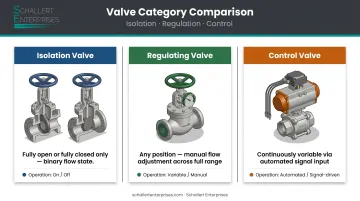
Using an isolation valve for throttling — partially open to reduce flow — erodes seats, creates turbulence, and destroys sealing integrity. The valve may still cycle, but it won't seal reliably when isolating a pressurized line for maintenance.
How the Closure Mechanism Works
Understanding the throttling risk makes the underlying mechanics clearer. Every isolation valve uses a closure element that moves into or out of the flow path to create a physical seal — and that motion follows one of two patterns:
- Linear movement — The closure element travels perpendicular to flow (gate valves, globe valves, piston valves)
- Rotary movement — The closure element rotates 90 degrees (ball valves, butterfly valves, plug valves)
Linear valves offer tight shutoff but take longer to operate. Rotary valves open and close faster, making them better suited for frequent cycling and automation.
Role in Pipeline Safety
OSHA 29 CFR 1910.147 explicitly includes line valves in its definition of an energy-isolating device — a mechanical device that physically prevents energy transmission. That classification ties isolation valves directly to lockout/tagout (LOTO) compliance.
Their safety functions include:
- Defining safe work boundaries before maintenance begins
- Protecting downstream equipment during abnormal pressure events
- Supporting compliant startup and shutdown sequences
- Enabling LOTO compliance in industrial and utility environments
They are critical across water distribution, oil and gas transmission, industrial process piping, power generation, and chemical processing.
Types of Pipeline Isolation Valves
No single valve type works everywhere. Each has mechanical characteristics that suit specific pipeline conditions, flow media, operating frequency, and size ranges.
Gate Valves
A gate valve uses a wedge-shaped or parallel slide gate that rises perpendicular to flow when opened, retracting fully into the bonnet. When fully open, flow resistance is minimal — the bore is unobstructed, making gate valves ideal for large-diameter, full-bore pipelines where pressure drop matters.
Best for: Large-diameter water mains, oil and gas transmission lines, infrequent operation Standards: AWWA C500 (metal-seated), C509 and C515 (resilient-seated), API 600 (steel gate valves) Not suitable for: Throttling or frequent cycling
Ball Valves
A quarter-turn rotary valve with a spherical closure element containing a bore. Align the bore with the pipe and flow passes freely; rotate 90 degrees and it seals. Full-port ball valves offer very low pressure drop when open and tight shutoff when closed.
Best for: Frequent operation, automation, gas distribution, chemical pipelines, smaller service connections Standards: AWWA C507 (6-inch to 60-inch), API 6D (pipeline and piping valves)
Butterfly Valves
A rotating disc mounted on a shaft swings parallel to flow when open and perpendicular when closed. Compact and cost-effective at large diameters — ANSI/AWWA C504 covers rubber-seated butterfly valves from 3 inches through 72 inches for raw water, potable water, wastewater, and reclaimed water service. AWWA C516 extends coverage to 78 inches and larger.
Standard butterfly valves have lower shutoff performance than ball or gate valves. Design variants address this across a range of pressure and temperature requirements:
- Standard (concentric): Cost-effective for water and wastewater; limited to lower pressures
- Double-offset (high-performance): Reduces disc-to-seat rubbing for higher pressure and temperature service
- Triple-offset: Metal-to-metal seating with 90-degree non-rubbing rotation; achieves zero-leakage isolation for upstream oil and gas and severe-service applications
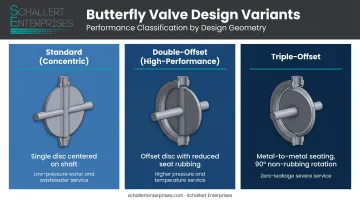
Best for: Large-diameter water, wastewater, and reclaimed water pipelines; triple-offset for high-pressure or high-temperature service Standards: AWWA C504 (3"–72"), AWWA C516 (78" and larger)
Plug and Knife Gate Valves
Plug valves use a tapered or cylindrical plug that rotates to open or block flow. They handle liquids, gases, sludge, and slurries across both clean and dirty service conditions. AWWA C517 covers resilient-seated eccentric plug valves for water and wastewater service.
Best for: Water and wastewater systems, moderate-solids service, applications requiring simple, low-maintenance operation Standards: AWWA C517
Knife gate valves use a thin gate with a sharpened edge that cuts through slurry, pulp, and fibrous materials. AWWA C520 covers sizes from 2 inches to 96 inches — purpose-built for low-pressure, high-solids applications.
Best for: Wastewater treatment, mining pipelines, pulp and paper Standards: AWWA C520 (2"–96")
How to Choose the Right Pipeline Isolation Valve
Match Material to Media
Body and seat materials must be compatible with what flows through the pipe:
- Water and utility lines — Ductile iron, brass, or bronze
- Oil and gas pipelines — Carbon steel or alloy steel per API specifications
- Corrosive or aggressive media — Stainless steel or PTFE-lined construction
Getting this wrong causes accelerated corrosion at the seat or body, shortening valve life and increasing leak risk.
Confirm Pressure and Temperature Ratings
Verify the valve's pressure class against maximum operating pressure. Valves conforming to ASME B16.34 carry pressure-temperature limits that depend on component materials — what seals reliably at ambient temperature may not hold at 300°F or in cryogenic service.
For oil and gas applications, additional certifications often apply:
- Fire-safe ratings — API 607 or API 6FA
- Fugitive emission control — ISO 15848-1
- Inspection and testing — API 598
Match Valve Type to Pipe Size and Operating Frequency
| Application | Recommended Valve | Notes |
|---|---|---|
| Small service connections (<6 inch), frequent cycling | Ball valve | AWWA C800, API 6D |
| Large water mains (6–72 inch), infrequent operation | Gate or butterfly valve | AWWA C500, C504 |
| Very large diameter (78 inch+) | Large butterfly valve | AWWA C516 |
| Low-pressure slurry and solids | Knife gate or plug valve | AWWA C520, C517 |
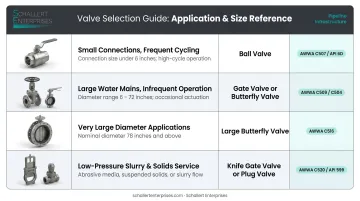
At very large diameters, actuation method — manual, pneumatic, or electric — significantly affects both cost and operability. Buried installation adds additional requirements around actuator design and access.
Follow the Applicable Standard
Using non-compliant valves in regulated environments can result in failed inspections, voided warranties, and direct liability if a valve failure causes a service disruption or environmental incident:
- Water utilities — AWWA C500, C504, C507, C517, C520, and AWWA M44 for selection and installation guidance
- Oil and gas — API 600, API 6D, API 598 for inspection and testing, API 607 and 6FA for fire testing
- Industrial process — ASME B16.34 for pressure-temperature ratings
Evaluate Total Cost of Ownership
A cheaper valve that fails after three years, requires specialized maintenance, or leaks past the seat during a pressure test costs far more than its purchase price suggests. Consider:
- Spare parts availability
- Actuator compatibility for future automation
- Whether standardizing valve types across a system simplifies maintenance programs
- Downtime costs if the valve fails during an emergency isolation event
Pipeline Isolation Without Shutting Down Service
Sometimes the valve isn't there. Sometimes it fails. Sometimes an aging gate valve corrodes open and won't close under pressure. In water distribution, oil and gas, and industrial pipelines, the traditional answer — depressurize, purge, repair, recommission — means lost service, lost product, and significant operational cost.
Line Stopping: Isolation on a Live Pipeline
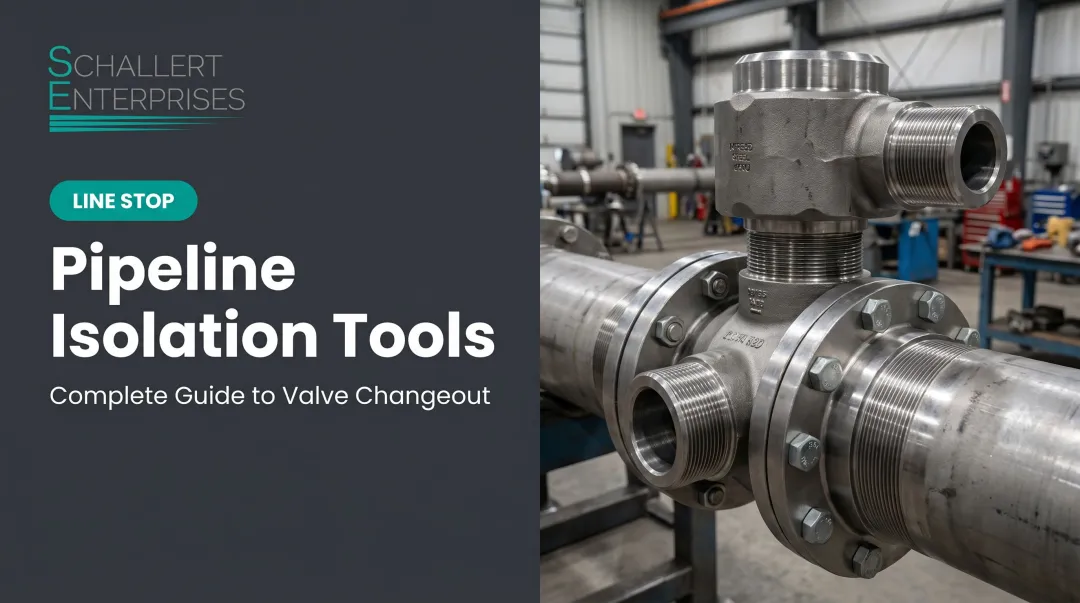
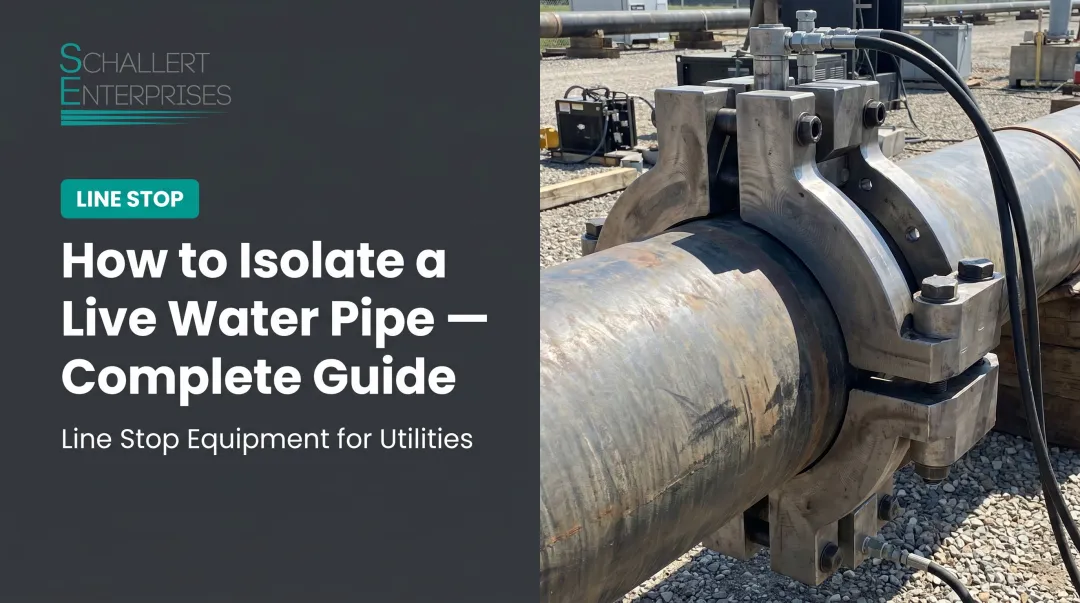
Line stopping (also called line plugging) solves this. The process uses hot tapping to cut into a live, pressurized pipeline and insert a temporary plugging head that creates an isolation point — while the pipeline stays in service.
EPA Natural Gas STAR documentation describes how transmission and distribution companies historically shut down, isolated, and purged pipelines for new connections — and how hot tapping eliminates that requirement. The same logic applies to line stopping for maintenance and valve replacement.
The process sequence:
- Install a saddle fitting on the pressurized pipe at the required location
- Hot tap the live pipe using a tapping machine and cutter to create the access opening
- Insert the plugging head through the access point into the pipe bore
- Establish bypass flow if required to maintain service downstream
- Complete the work: valve replacement, pipe repair, or new connection
- Install a permanent isolation point — a completion plug or sandwich valve — before removing the line stop equipment
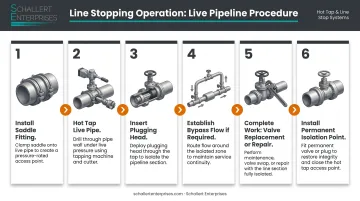
That last step leaves something behind. After the operation, the pipeline has a permanent, functioning isolation point it didn't have before — adding long-term maintainability without additional downtime.
Schallert Enterprises Line Stop Equipment
Schallert Enterprises manufactures the full equipment range required for this process — all made in the USA. Their line stop product line covers pipelines from 5 inches to 84 inches in diameter and includes:
- Folding heads: Cost-effective for water and sewer systems; inserted through reduced branch fittings; rated to 150 psi using polyurethane sealing elements; compatible with out-of-round and mortar-lined pipes via cheater plates
- Pivoting heads: Size-on-size design rated to 450 psi at 250°F for high-pressure applications involving hazardous gases or chemicals in refineries and mills
- Housings: Heavy-duty flanged units for integration with both folding and pivoting head machines
- Jackscrews/actuators: Five models covering 8-inch through 84-inch pipe; stroke lengths from 48 to 192 inches; remote drive on models for 14-inch pipe and larger
- Completion plug setters: Three compact models (4-inch through 36-inch plugs) that set permanent plugs without a full tapping machine
- Line stop flanges: Standard sizes from 4 to 36 inches; installed as part of a saddle or welded directly to the pipe
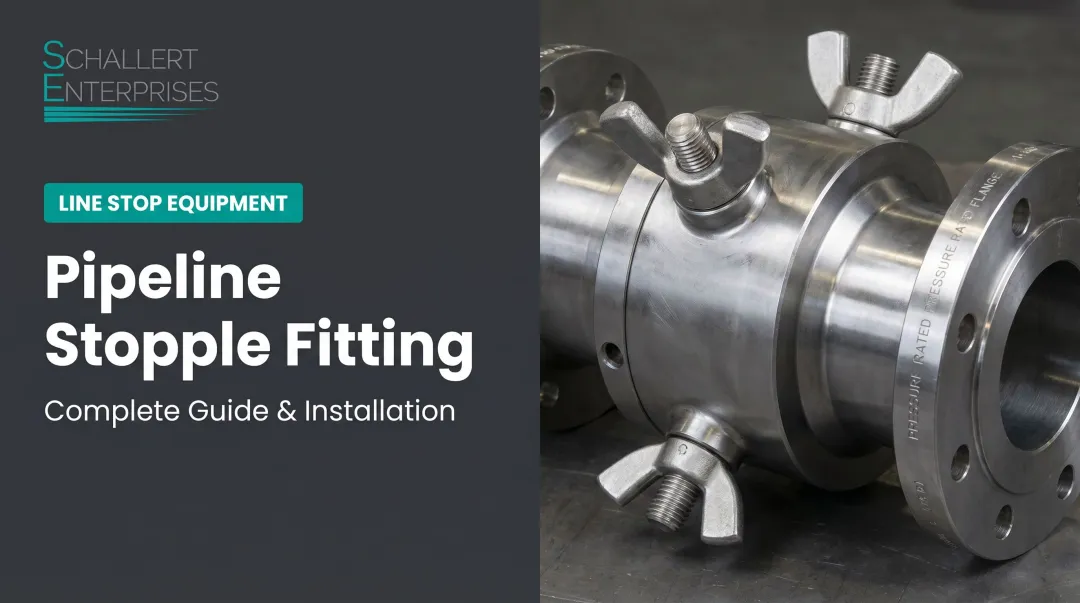
- Sandwich valves: Carbon steel or aluminum, 4-inch to 36-inch diameter, tested to 300 psi; left in place as a permanent isolation point after operations are complete
Schallert's hot tapping machines — the TM200 through TM6120 — cover the tap sizes required to access pipelines across this full diameter range, from 3-inch taps up to 72-inch taps.
Important: OSHA's hot-tap exception under 29 CFR 1910.147 applies only when continuity of service is essential, shutdown is impractical, documented procedures are followed, and special equipment provides proven employee protection. Line stopping is engineered work, not a shortcut around planned maintenance.
Best Practices for Isolation Valve Maintenance
Operate Only Full Open or Full Closed
This is the single most important discipline rule. Using an isolation valve for throttling causes:
- Turbulence that erodes seats and gate edges
- Partial sealing that fails when a full shutoff is needed
- Accelerated wear that shortens valve service life
Open the valve fully before putting the line back into service. Leaving it partially open because flow seemed acceptable is exactly how seats get damaged before an emergency shutoff is ever needed.
Implement a Valve Exercising Program
ACWA JPIA's water-industry risk management guidance identifies the inability to locate or operate valves during emergencies as a significant utility risk. Valves that sit unused develop corrosion, mineral buildup, or seat sticking that prevents operation precisely when it's needed most.
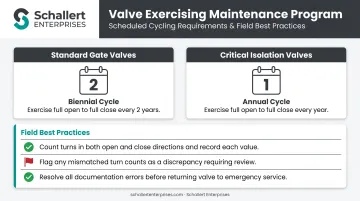
AWWA guidance recommends cycling gate valves from full open to full close and back at least once every two years. Critical valves (those serving major system segments or high-consequence isolation points) warrant annual exercising.
During each exercise cycle, count turns in both directions. Mismatched counts in either direction indicate incomplete travel or a documentation error. Both are worth resolving before that valve is called on for an emergency isolation.
Label, Document, and Verify Position
Every isolation valve should carry:
- Pipeline system reference (which line, which segment)
- Normal operating position (normally open or normally closed)
- Valve type and size
Consistent labeling isn't just good housekeeping — in industrial facilities, it directly supports LOTO compliance. OSHA requires documented energy-control procedures and labeled lockout/tagout devices identifying the employee applying them. An unlabeled valve in a maze of piping is a liability during maintenance.
Visual position indicators (where installed) should be verified against the documented normal operating position regularly. A valve showing "open" that is actually closed, or vice versa, creates serious hazards during planned maintenance.
Frequently Asked Questions
What is an isolation valve in piping?
A pipeline isolation valve is a mechanical device that completely stops or allows flow through a pipe, operated only in the fully open or fully closed position. It creates safe work boundaries during maintenance, repair, or emergency shutdowns — not for regulating or throttling flow.
How does an isolation valve work?
A closure element — gate, ball, disc, or plug — moves into or out of the flow path to physically seal off flow. The movement is either linear (gate, globe) or rotary (ball, butterfly, plug). Either way, the valve achieves complete physical separation of the pipeline upstream and downstream.
What is the difference between an isolation valve and a shut-off valve?
The terms are largely interchangeable, but "isolation valve" typically refers to industrial pipeline applications where the valve defines a safe work zone or LOTO boundary. "Shut-off valve" is a broader term used across plumbing, HVAC, and utility systems without the same regulatory or safety-standard context.
What is the most common type of isolation valve used in water pipelines?
Gate valves remain the standard for large-diameter water mains (AWWA C500/C509/C515 cover metal-seated and resilient-seated variants). Butterfly valves are increasingly common at large diameters due to compact size and lower cost, with AWWA C504 covering up to 72 inches. Ball valves dominate smaller service connections.
How do you isolate a pipeline section without shutting down service?
Line stopping via hot tapping allows operators to insert a temporary plugging head into a pressurized pipeline, creating an isolation point without depressurizing or interrupting downstream flow. After the work is complete, a permanent completion plug or sandwich valve is installed to leave a lasting isolation point in the pipeline.
What are common signs that a pipeline isolation valve needs to be replaced?
Watch for these warning signs:
- Visible leakage past the seat when the valve is fully closed
- Inability to fully open or close due to corrosion or internal buildup
- Excessive operating torque compared to original specifications
- Mismatched turn counts during routine exercising
- Internal leakage (passing) detected during pressure testing per MSS SP-61