Picking the wrong one gets expensive fast. A 2017 analysis of 20 large-diameter U.S. water main failures found utilities absorbed about 41% of failure costs directly, while the public bore the other 59% through property damage and traffic delays. Those costs climb quickly when a pipe stays offline longer than planned.
This guide breaks down what cold tapping and hot tapping actually mean, compares them side by side, and helps you decide which one fits your next project.
TL;DR
- Cold tapping is done on a shut-down, depressurized line; hot tapping is done on a live, pressurized one
- Hot tapping avoids service interruption entirely and is preferred for critical infrastructure
- Smaller lines, incompatible materials, or non-critical systems often favor cold tapping
- Both methods require specialized machines and trained technicians to run safely
Cold Tapping vs Hot Tapping: Quick Comparison
Here's how the two methods stack up across the factors that actually matter on a job site:
| Factor | Cold Tapping | Hot Tapping |
|---|---|---|
| Pipeline Status | Shut down, isolated, and depressurized before work begins | Stays pressurized and flowing throughout the process |
| Downtime & Cost | Requires a planned shutdown; adds lost-service costs | Near-zero downtime; more cost-effective for high-demand systems |
| Safety | Lower pressure risk, but longer labor exposure during shutdown | Pressure risk exists but is managed with sealed cutter housings |
| Equipment | Mechanical drills/cutters, isolation valves, sometimes freezing gear | Hot tap machines, tapping adapters, hole saws, pilot drills |
| Best Suited For | Smaller lines, incompatible materials, non-critical systems | Large-diameter mains, critical infrastructure that can't tolerate shutdown |
Cold tapping trades convenience for simplicity; hot tapping trades equipment cost for continuity. The right choice depends on what your pipeline can tolerate.
What Is Cold Tapping?
Cold tapping means creating a connection on a pipeline section that's been shut down and fully depressurized before any cutting begins.
You'll sometimes see the term used loosely—some sources apply it to freeze-plug isolation, where a section of pipe is frozen solid to act as a temporary valve. For this article, cold tapping means any tap on an isolated, non-pressurized line, regardless of how that isolation is achieved.
The core benefit is straightforward. With no pressure in the pipe, there's no pressure-related risk to manage. Crews don't need sealed cutter housings, pressure-rated tapping adapters, or specialized live-tapping equipment. Safety protocols simplify to standard hazardous-energy-control procedures: isolate, verify zero energy, then work.
That simplicity comes at a cost. Taking a line offline means customers lose service, a plant pauses output, or a system runs on backup capacity until the tap is finished. For infrastructure that needs to stay live around the clock, that's a real trade-off.
Use Cases of Cold Tapping
Cold tapping tends to show up where a short interruption won't cause major disruption:
- Smaller-diameter or low-pressure branch lines where a brief outage is manageable
- Municipal branch connections scheduled during low-demand periods
- Plant maintenance windows when a section is already shut down for other work
- Sections already offline for repairs, where adding a tap costs no extra downtime
Duration matters here. Historical EPA guidance on conventional shutdown connections for steel natural gas lines puts outage time at one to three days or more, depending on scope. That's the window a utility or plant needs to plan around, communicate to customers, and staff for.
What Is Hot Tapping?
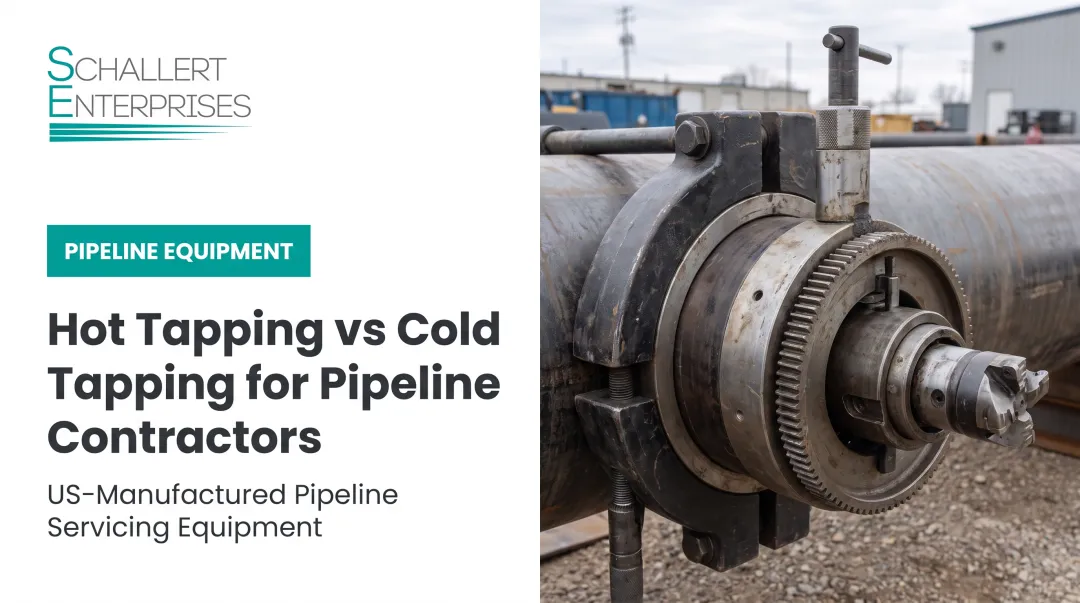
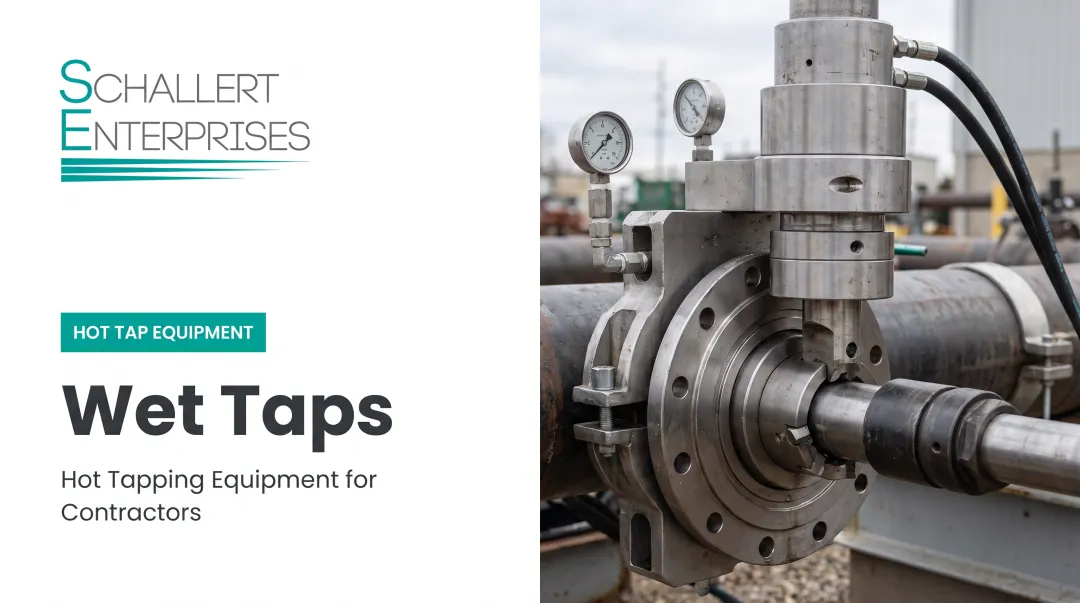
Hot tapping, also called pressure tapping or live tapping, creates a branch connection or new tie-in on a pipeline while it stays fully pressurized and in service. A hot tap machine bolts onto the pipe through a tapping adapter and sealed cutter housing, drills through the wall, then retracts the cutter, all without ever opening the line to atmosphere.
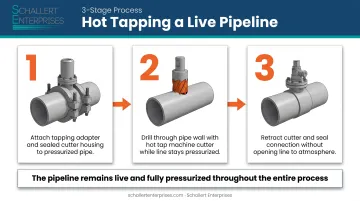
The core benefit: service never stops. No draining, no venting, no shutting down customers or downstream processes. That directly reduces revenue loss, customer disruption, and the safety and environmental risk tied to draining a live system.
Equipment variation is what lets hot tapping scale from a small service connection to a 72-inch transmission main. Companion folding-head line stop machines fold flat to pass through a smaller access opening, then unfold once inside the pipe, so one setup can handle a bigger job than its access diameter suggests.
Cutter choice matters too:
- Carbide and HSS multi-tooth cutters for most steel and general-service lines
- Diamond segment cutters for concrete-lined pipe, where a standard tooth wears down fast
Schallert Enterprises' lineup covers this range, with tapping machines from ¾-inch service taps up to 72-inch mains, paired with cutters and tapping adapters sized to match.
Use Cases of Hot Tapping
Hot tapping fits anywhere continuity of service matters more than upfront equipment cost:
- Adding new service connections to a live water main without cutting off customers
- Installing or replacing valves on a pressurized line during normal operation
- Tying in new infrastructure to an existing transmission or distribution main
- Supporting 24/7 industrial processes where a shutdown means lost production
Municipal water utilities, oil and gas pipeline operators, and continuous-process industrial plants all lean on hot tapping for this reason. API RP 2201 backs this pattern directly, noting hot tapping is typically used when shutting down, purging, or conventionally cleaning the pipe isn't feasible or practical. For many operators, it is the only realistic path.
Cold Tapping vs Hot Tapping: Which Is Better?
There's no universal winner. The right method depends on a handful of practical factors:
- Pipe pressure and criticality – can the line go offline without major consequences?
- Material compatibility – is the wall suited to live cutting, or does it need depressurizing first?
- Budget – can you justify the higher upfront cost of hot tap equipment?
- Project timeline – is a multi-day shutdown window realistic?
- Available equipment and expertise – do you have the right machine for the job?
Choose cold tapping when the line can safely go offline, the material isn't suited for live drilling, or the system isn't critical enough to justify hot tap equipment costs.
Choose hot tapping when service continuity is non-negotiable, or when downtime costs outweigh the equipment investment.
Most utilities and pipeline operators default to hot tapping whenever feasible on critical infrastructure. It protects revenue and keeps service reliable. OSHA's own hot tap exception reinforces this: live tapping is permitted when continuity of service is essential and shutdown is impractical. Documented procedures and proven protective equipment still have to be in place.
Real-World Case Study
The Rangeline Group, a pipeline construction and infrastructure contractor, faced this exact decision on a project requiring isolation of a 30-inch pipeline section. Taking that size of main fully offline would have meant an extended outage window and added coordination with everyone downstream.
Instead, the crew ran a line stop operation. They used Schallert Enterprises' PS1836 completion plug setter to finish the isolation and seal the tapping fitting without mobilizing a full tapping machine for that final step. The crew positioned the assembly with power-tool-assisted controls, braced it with wood, and worked inside a barricaded zone under standard PPE.
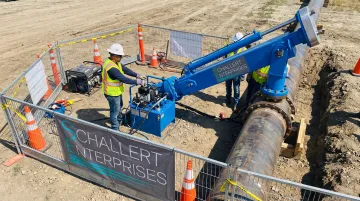
The decision came down to the same factors that drive most hot tap and line stop choices:
- Avoid customer disruption
- Keep the schedule tight
- Match equipment to the pipe's real size—not force a smaller tool onto a bigger job
The takeaway: matching equipment capability to a pipeline's real-world demands, not just its diameter on paper, is what separates a smooth tie-in from an expensive, drawn-out shutdown.
Need service continuity on your next project? Contact Schallert Enterprises at 951-674-6773 for USA-made hot tapping and line stop equipment sized to your line—from ¾-inch service taps to 84-inch mains.
Frequently Asked Questions
What is the difference between hot tapping and cold tapping?
Hot tapping creates a branch connection on a pipeline while it stays pressurized and in service. Cold tapping requires shutting the line down, isolating it, and depressurizing it first.
What does "cold tapping" mean?
Cold tapping means making a connection on a section of pipe that's been isolated and depressurized. It's used when live tapping isn't safe or practical for the pipe material or size involved.
Which side should the cold tap be on?
This question usually refers to household faucets, not industrial pipelines. Plumbing codes place hot water on the left and cold on the right for standard two-handle fixtures.
Is hot tapping more expensive than cold tapping?
Hot tap equipment costs more upfront, but it often saves money overall by eliminating shutdown-related losses. Cold tapping skips the specialized live-pressure gear but adds outage and lost-service costs.
Can any pipe material be hot tapped?
Most metals and many plastics can be hot tapped with the right cutter and procedure. Some brittle, thin-walled, or poor-condition pipe sections may need cold tapping instead for safety.
Do I need a professional service for hot or cold tapping?
Yes. Both methods need trained technicians, proven procedures, and gear matched to the pipe's size and pressure rating. Hire a qualified contractor and source machines built for your diameter and pressure range.