Water-main breaks alone cost North American utilities dearly. The US and Canada combined see 260,000 water-main breaks every year, adding up to $2.6 billion in annual repair costs, according to a 2025 Journal AWWA analysis. Every one of those breaks puts pressure, literally and figuratively, on contractors to get in, fix the problem, and get out without draining a system dry.
Line stopper fittings solve this by isolating flow in a live, pressurized pipe. No draining. No customer notifications. No revenue lost to downtime.
This guide covers what line stopper fittings are, how the process works step-by-step, the main plugging head types, and how to choose reliable equipment for your next job.
Key Takeaways
- Line stop fittings isolate live-pipe flow so crews can repair valves or add tie-ins without cutting downstream service
- Folding heads use reduced taps for smaller jobs; pivot heads need size-on-size taps for higher pressure and steam
- Equipment spans pipe diameters from under 2 inches to more than 80 inches
- Match the fitting to pipe material, pressure class, and media—water, gas, oil, or steam
What Are Line Stopper Fittings?
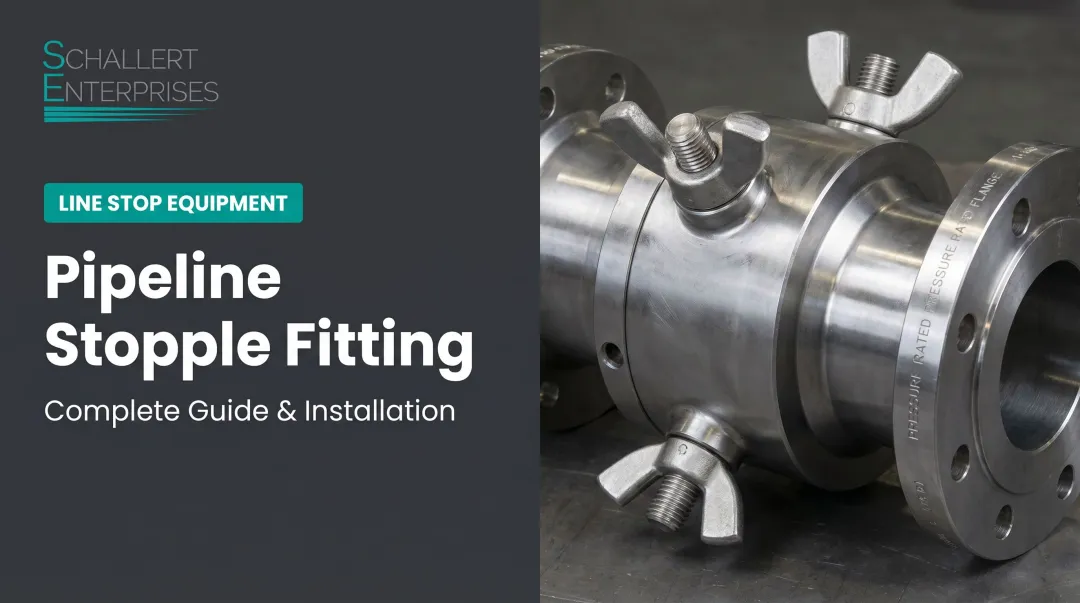
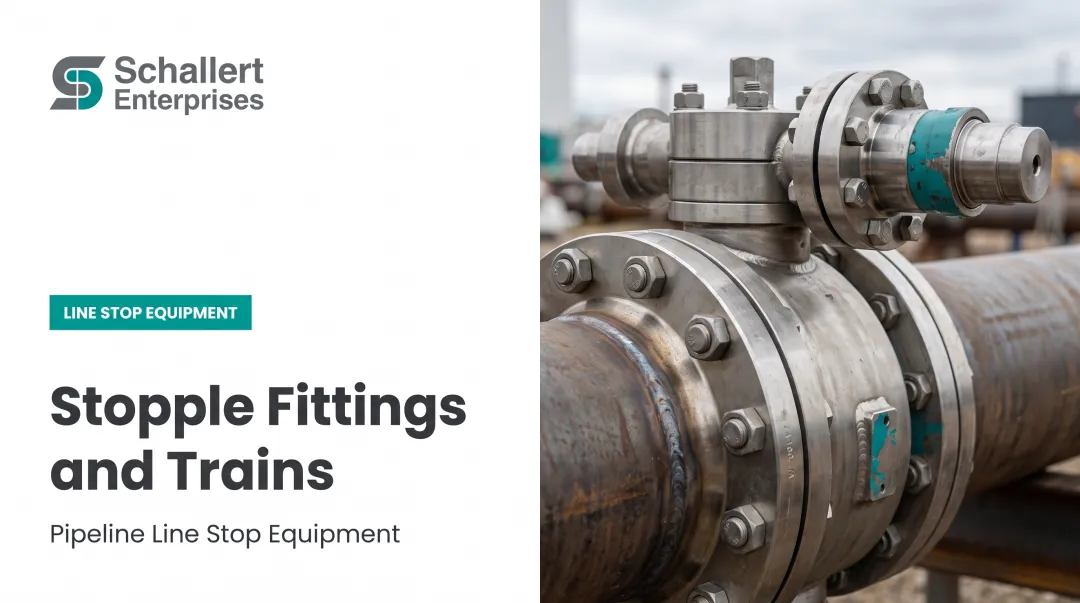
A line stopper fitting is the mechanical housing crews weld or mechanically clamp onto a section of pipe. It creates a permanent access point where a plugging head can be inserted, seated, and later removed while the line stays fully pressurized.
Hot Tapping vs. Line Stopping
Contractors often use these terms interchangeably, but they describe two different stages of the same job.
- Hot tapping cuts a controlled opening into a live pipeline to create a new connection or access point
- Line stopping inserts a plug or seal through that opening to fully halt flow and isolate a section
Every line stop starts as a hot tap. Not every hot tap becomes a line stop. Rangeline's breakdown of the two processes covers the distinction in more detail.
Built for Repeat Access
Temporary hot tap tooling gets removed once the branch connection is complete. A line stop fitting works differently. Once the flange is blinded, the housing stays bolted to the pipe permanently. Crews can return to that exact location for future valve swaps or repairs without welding new equipment onto the line again.
Common use cases include:
- Replacing or repairing a failed valve without draining the system
- Adding a new tie-in for a service expansion or connection
- Isolating a damaged or corroded pipe section while the rest of the system stays live
Contractors run into these fittings across nearly every pipe material in the field: steel, ductile iron, PVC, HDPE, and concrete pressure pipe.
Applications span potable water, wastewater, natural gas, and oil service. Fitting design and sealing elements shift with the pipe material and the media being isolated.
How the Line Stopping Process Works
Line stopping follows a defined sequence, whether the pipe is a 6-inch distribution main or a 60-inch transmission line. Here's how a typical job runs from start to finish:
- Install the fitting. Weld or mechanically clamp a saddle or sleeve fitting onto the pipe at the planned work location.
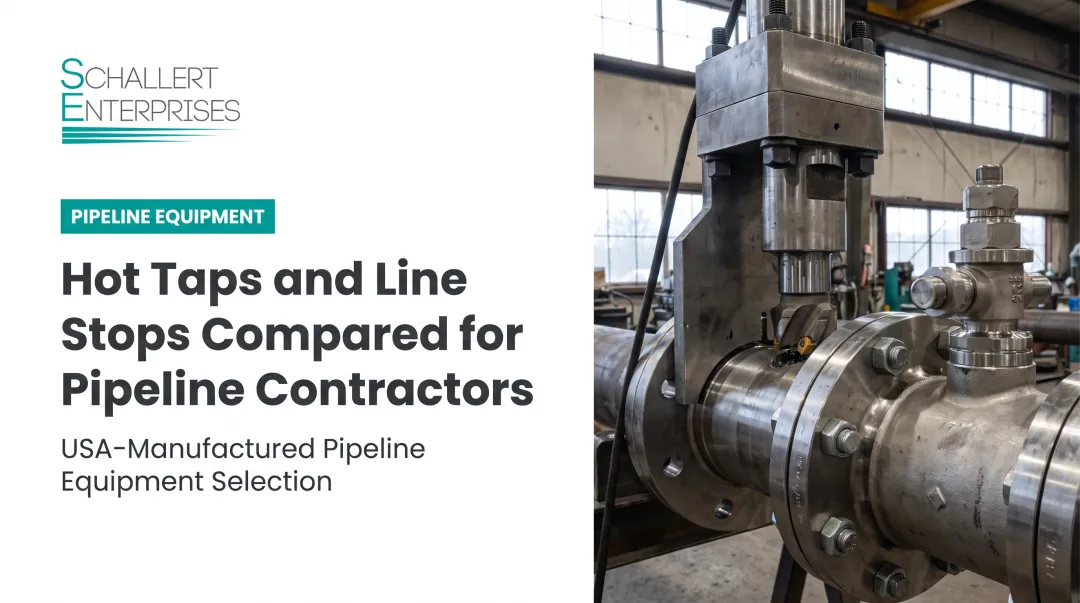
- Make the hot tap. A hot tap machine cuts through the fitting into the live, pressurized pipe and retrieves the coupon without interrupting flow.
- Mount the valve and actuator. Bolt a temporary sandwich valve to the fitting, then mount a line stop actuator to drive the plugging head toward the pipe interior.
- Seat the plugging head. Advance the head until it seats and seals against the pipe wall, stopping flow so downstream repairs or valve work can proceed.
- Lock in the completion plug. Once the work is done, equalize pressure across the head and retract it. Lock a completion plug into the fitting flange to hold pressure permanently, remove the temporary valve and actuator, and close out the job with a blind flange.
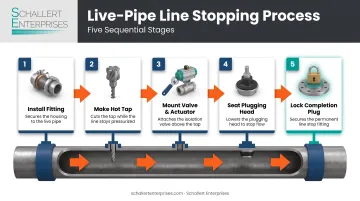
That last step separates line stopping from a simple hot tap: the fitting doesn't just create access, it seals shut in a way that holds indefinitely.
Essential Equipment in a Line Stop Setup
A complete line stop rig involves more than the fitting itself:
- Line stop housing: bridges the actuator and valve, built long enough for the folding or pivot head as it advances into the pipe
- Actuators: mechanical screw-type jackscrews or hydraulic units that push the plugging head into position, sized to pipe diameter and pressure
- Sandwich valves: specialized valves between the fitting and actuator that isolate and control the work area during the stop
Schallert Enterprises manufactures each of these as part of a matched system. Jackscrews are rated to 350 psi, sandwich valves are pressure-tested to 300 psi in 4-inch to 36-inch sizes, and housings pair with specific folding head assemblies. Mismatched equipment from different suppliers is a common reason jobs stall mid-tap.
Types of Line Stop Fittings and Heads
Folding Head Line Stops
A folding head collapses to pass through a smaller branch tap, then unfolds to full size once inside the pipe. That folding action is the whole point: it lets contractors use smaller valves, smaller fittings, and smaller taps than a full size-on-size approach requires, cutting material and labor costs.
Schallert Enterprises builds its folding head machines specifically around this cost advantage, with assemblies covering pipe diameters from 5 inches up to 84 inches.
Most mid-range units (14 to 66 inches) handle up to 250 psi at the head itself, but the polyurethane sealing element that actually contacts the pipe wall tops out at 150 psi across the entire lineup. That sealing element, not the head, is usually the pressure-limiting piece contractors need to plan around.
Pivot Head Line Stops
Pivot heads require a full size-on-size tap: the branch opening has to match the plugging head at full size, with no folding step involved. That makes them the standard choice for higher-pressure and steam applications, where a folding head's sealing element rating wouldn't hold. They also show up frequently in refinery and mill settings isolating hazardous gases or chemicals.
| Head Type | Tap Requirement | Typical Use Case |
|---|---|---|
| Folding head | Reduced branch tap | Lower-pressure water/sewer, cost-sensitive jobs |
| Pivot head | Full size-on-size tap | High-pressure, steam, refinery or mill gas service |
Size Range, Completion Options, and Tandem Stops
Line stop equipment spans a wide range, from small distribution lines under 2 inches up to large transmission mains approaching 84 inches. Two completion locking designs typically finish the job. The standard set pin design locks the completion plug using pins accessible from the flange's outer diameter. O-ring sealing set pins add a secondary sealing barrier at the pin interface for extra leak protection.
For longer sections needing isolation, or repairs too large for a single stop, contractors sometimes deploy tandem line stops. Two or more fittings install together with flow routed around the isolated segment. This shows up most on major valve replacements or new mainline tie-ins where one stop point can't cover the full work area.
Choosing the Right Line Stop Fitting for Your Project
Key Selection Factors
Getting the fitting choice right up front saves a contractor from costly delays mid-job. Three factors drive nearly every decision:
- Size and pressure rating — Match the fitting to the pipe's diameter, material, and operating pressure. Undersized gear risks failure; oversized gear adds cost
- Service being isolated — Potable water, wastewater, natural gas, oil, and steam each need different seal materials and plug designs to stay code-compliant
- Site conditions and access — An indoor mechanical room needs different clearance than a buried municipal main, which often decides folding vs. pivot head
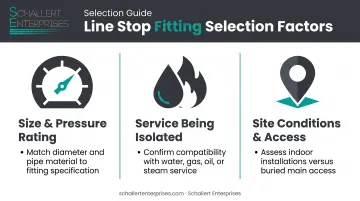
For water and wastewater work, AWWA C223 sets material and dimensional requirements for tapping sleeves on mains from 4 to 48 inches.
Partnering with an Experienced Manufacturer
Equipment from a manufacturer that builds its own gear, rather than reselling someone else's, holds up better under repeat field use.
Schallert Enterprises manufactures its own line stop fittings, folding and pivoting heads, housings, actuators, completion plug setters, sandwich valves, and hole saws. Each unit is custom-built to the contractor's pipe specs from 3/4 inch to 84 inches and made in the USA.
That shows up two ways on the job: safety margins on USA-made equipment are usually better documented, and schedule reliability improves when one manufacturer stands behind every component in the stack.
With proper use and maintenance, well-built line stop equipment can last decades. Weigh that against cheaper, short-lived alternatives when outfitting a season's worth of jobs.
Frequently Asked Questions
What is the difference between hot tapping and line stopping?
Hot tapping only cuts into and taps a live pipe to create a new connection. Line stopping goes a step further, fully halting flow so a section can be repaired or a valve replaced.
What are the different types of gas line fittings?
Common gas line fittings include compression fittings, flare fittings, and threaded fittings, each with material and size restrictions under codes like the IFGC. Line stop and hot tap fittings are a specialized category built for maintenance without service interruption.
What size pipes can be serviced with line stop fittings?
Line stop equipment is available for pipes from under 2 inches up to large-diameter transmission mains of 84 inches, depending on the manufacturer's product range.
Is line stopping safe for high-pressure or steam lines?
Pivoting-head line stops are the standard choice for higher-pressure and steam applications since they require a size-on-size tap for a secure seal against the pipe wall.
How long does a line stop fitting remain on the pipe after the job?
The fitting stays permanently on the pipe once it's blinded, allowing crews to reopen the same location for future maintenance without installing a new fitting.
Can line stop fittings be used on plastic or concrete pipe?
Yes. Line stop techniques are adapted for materials like PVC, HDPE, and concrete pressure pipe, though procedures and fitting designs vary from steel or ductile iron applications.