According to ASCE's 2025 Infrastructure Report Card, US water utilities deal with roughly 240,000 main breaks per year at a cost of approximately $2.6 billion in repairs — most of which require some form of live isolation to execute safely. The stakes are high, and the process is unforgiving of shortcuts.
This guide covers the complete step-by-step hot tap and line stop process, the equipment you need, the variables that determine success, and the mistakes that cause failures in the field.
Key Takeaways
- The hot tap and line stop method allows full pipe isolation without shutting down the distribution system
- Success requires accurate pipe assessment — material, OD, wall thickness, and operating pressure — before any fittings are installed
- Schallert Enterprises' folding head line stop equipment covers pipes from 5" to 84" in diameter — with structural pressure ratings up to 250 psi depending on pipe size
- Sealing elements cap out at 150 psi across all folding head sizes — that's your true operational limit in the field, regardless of structural ratings
- Skipping the pre-tap pressure test and mismatching equipment to actual pipe dimensions are the two most common causes of field failures
How to Isolate a Live Water Pipe: Step-by-Step
Step 1: Assess the Pipeline and Plan the Isolation
Before any fitting touches the pipe, you need confirmed specs — not assumed nominal dimensions.
Identify:
- Pipe material (steel, ductile iron, PVC, HDPE, concrete-lined)
- Outside diameter — measured in the field, not from drawings
- Wall thickness and schedule
- Operating pressure at the isolation point
Confirm that your chosen location has a straight run of pipe with no nearby bends, internal buildup, or fittings that could interfere with line stop head deployment. If maintaining partial flow during the work window is a requirement, plan the bypass now before work begins, not mid-job.
Hudson, Ohio's tapping specification requires contractors to verify pipe circumference by exposing a section of the main before ordering the tapping sleeve and valve assembly — adopt the same standard regardless of what your as-builts say.
Step 2: Install the Line Stop Fitting and Gate Valve
Weld or mechanically clamp a line stop flange fitting (tapping saddle or tapping sleeve) to the pipe at the isolation point. Schallert manufactures line stop completion flanges in standard sizes from 4" to 36", with additional sizes available on request.
Bolt a full-port gate valve onto the fitting. The valve must:
- Be rated for the pipe's operating pressure
- Have a full-bore waterway that accommodates the cutter size
- Remain in place throughout the entire operation
Pressure test before drilling. American Water's standard specifications require a hydrostatic test of the sleeve and valve assembly for a minimum of 15 minutes with zero leakage before any tap is made. Mueller's H-304 instructions specify the same: test with water, not air or compressible gas.
Step 3: Perform the Hot Tap
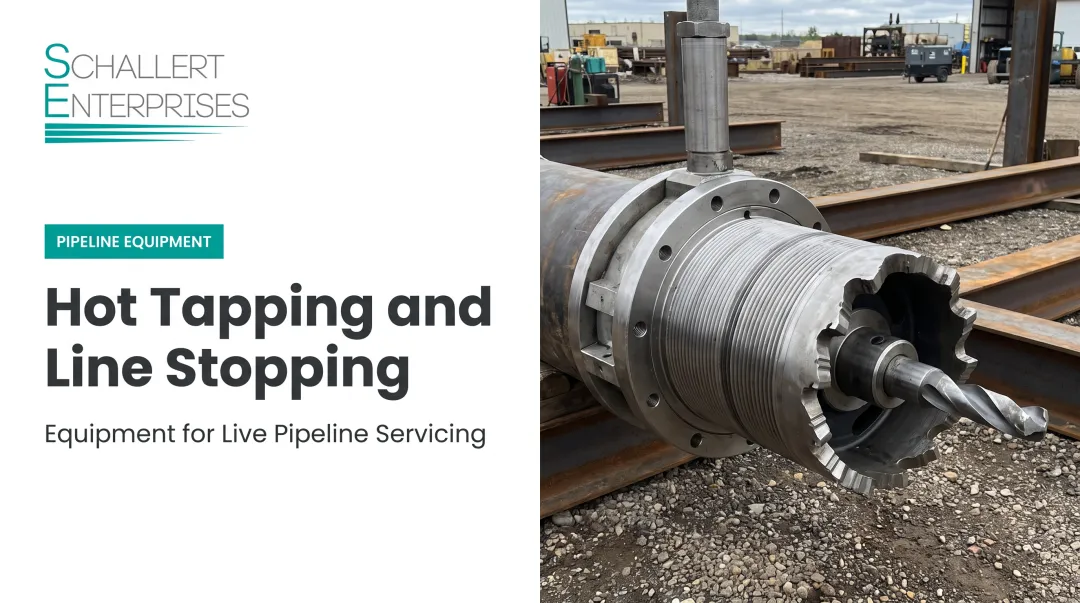
Mount the hot tapping machine onto the gate valve using a tapping adapter sized to match the valve and pipe configuration. Schallert's tapping adapters can be configured to mount to any tapping machine — their cutter line covers multi-tooth carbide and HSS cutters up to 48 inches in diameter, and diamond segment cutters up to 72 inches for concrete-lined pipe applications.
The process:
- Advance the hole saw through the open gate valve under full operating pressure
- The coupon stays captured on the pilot drill inside the pressurized assembly
- Retract the cutter back through the valve
- Close the gate valve under pressure and remove the tapping machine
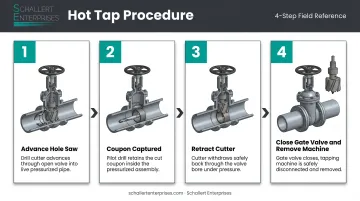
The line is now ready for line stop insertion.
Step 4: Insert and Set the Line Stop Head
Mount the line stop equipment — housing, actuator, and line stop head — onto the gate valve. Head style matters here:
- Folding heads deploy through a reduced branch fitting, allowing a larger pipe to be stopped through a smaller tap (for example, a 16" line stop through a 12" valve)
- Pivoting heads require a full-size tap matching the pipe bore; they're typically chosen for high-pressure or high-temperature applications
Advance the head through the open gate valve and into the pipe bore. Deploy the head so it expands or pivots to fill the pipe interior and seal against flow. Verify isolation by monitoring pressure readings on both sides — a confirmed set shows full pressure differential with no bypass flow.
Equipment selection at this stage depends on pipe diameter and operating pressure. Schallert's folding head line stop equipment handles pipes from 5" to 84" in diameter, with ratings as follows:
| Pipe Size | Structural Head Rating |
|---|---|
| 8"–12" and 72"–84" | 150 psi |
| 14"–66" | 250 psi |
| 36" (standalone) | 225 psi |
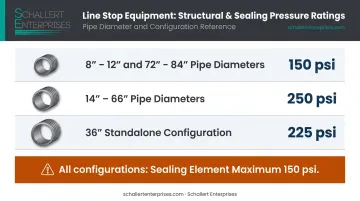
Regardless of head size, the sealing element is rated at 150 psi — that's the operational ceiling across all configurations.
Step 5: Complete the Work and Restore Service
Perform the intended repair, valve replacement, or pipeline modification with the line stop holding back flow.
When work is complete:
- Equalize pressure on both sides of the line stop before retracting the head
- Retract the line stop head back through the gate valve and close the valve
- Install a completion plug using a completion plug setter to permanently seal the tapping hole
Schallert offers three completion plug setter models — the PS0410 (4"–10"), PS0616 (6"–16"), and PS1836 (18"–36") — all rated to 500 psi and designed to operate without requiring the full tapping machine assembly. Re-open flow through the restored section, verify system pressure has returned to normal, and confirm no leaks at the new fitting location.
When to Use the Line Stop Method
The hot tap and line stop method is the right choice when downstream users cannot tolerate a service interruption. That covers municipal water distribution, industrial process lines, and hospital water systems — any situation where a full shutdown creates unacceptable disruption or safety risk.
Typical applications:
- Replacing a deteriorated gate valve with no upstream shutoff available
- Repairing a section of main where an existing isolation valve has failed
- Inserting a new tee or fitting in an active distribution line
- Decommissioning a pipe section while keeping branch connections live
That said, the method has real limitations. It's not the right fit when:
- Pipes with severe internal corrosion or pitting that prevent the head from achieving a full seal
- Locations with no straight run available for fitting installation
- Pipelines where operating pressure exceeds the sealing element's rated capacity at the required pipe size
For healthcare applications specifically, the CDC recommends that facilities develop Emergency Water Supply Plans because construction and maintenance-related water interruptions carry infection control risks — making the no-shutdown capability of line stopping especially relevant in those environments.
Key Variables That Affect a Successful Isolation
Even with the right equipment, field conditions determine whether the line stop holds. Here are the four variables that matter most.
Pipe Diameter and Wall Condition
The line stop head must match the pipe's actual internal bore. An undersized or oversized head won't achieve full contact — bypass flow will continue regardless of how well the head is seated.
Internal corrosion, pitting, out-of-round geometry, or liner deposits reduce the sealing surface and can prevent full head deployment. A pre-job condition assessment — video inspection or pigging data — helps you anticipate this before the fitting is welded on.
Operating Pressure and Flow Velocity
Each line stop head has a rated pressure capacity. Exceed it and you risk mechanical displacement of the head under live pressure.
Schallert's folding head sealing elements are rated at 150 psi across all pipe sizes. Most municipal water systems operate well within this range: a 2023 Utah State/Westlake study of US and Canadian utilities reports average operating pressure of 71 psi and an average maximum of 120 psi.
For higher-pressure industrial or transmission line applications, pivoting head equipment is the right call. Schallert's pivoting head line stops are rated up to 450 psi at 250°F with Buna-N seals.
Pipe Material and Fitting Compatibility
Different pipe materials require different cutter types:
| Pipe Material | Required Cutter Type |
|---|---|
| Steel | HSS-tipped multi-tooth cutter |
| Ductile iron, most pipe | Carbide-tipped multi-tooth cutter |
| Concrete-lined / cement mortar-lined | Diamond segment cutter |
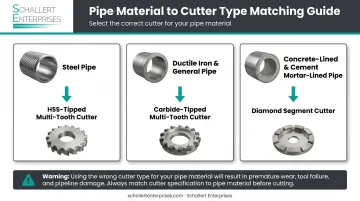
Using a standard bi-metal hole saw on concrete-lined pipe will result in cutter failure mid-tap. Schallert's diamond segment cutters — available up to 72" diameter — are specifically engineered for concrete-lined infrastructure.
Temperature and Elastomer Compatibility
Seal performance depends on matching the elastomer to the fluid temperature. Schallert's pivoting head line stop machines offer three sealing element options:
- Buna-N (standard): rated to 450 psi at 250°F; suitable for general-purpose and petroleum fluid service
- EPDM: suited for water and chemical service
- Viton: designed for high-temperature and chemically aggressive environments
Confirm the elastomer selection against the actual operating temperature and fluid chemistry before specifying equipment.
Common Mistakes When Isolating a Live Water Pipe
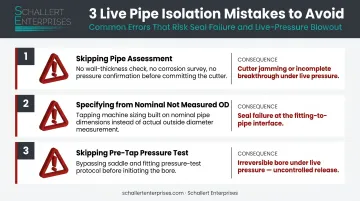
Three errors account for most failed isolations on live systems:
Skipping the pre-job pipe assessment. Proceeding without confirmed wall thickness, internal condition, or actual bore diameter leads to cutter jamming, incomplete breakthrough, or an inability to fully deploy the line stop head. Document review and field measurement belong before any fitting is installed — not after problems appear mid-tap.
Specifying equipment from nominal diameter instead of measured OD. Nominal and actual bore can differ on older distribution systems — a "12-inch" pipe may run undersized relative to the spec sheet. This mismatch is one of the most common causes of seal failure. Always confirm actual OD and wall thickness before ordering equipment.
Skipping the pre-tap pressure test. Any leak in the fitting or valve connection will only be discovered after the pipe has been bored through — at which point the tap cannot be reversed. This test takes about 15 minutes. The time saved by skipping it is not worth the risk.
Alternatives to Live Line Stop Pipe Isolation
The hot tap and line stop method handles the majority of live pipe isolation work. But three alternatives apply in specific circumstances.
| Method | When to Use | Key Limitation |
|---|---|---|
| Freeze plug (cryogenic line stop) | Hot tap cannot be performed due to structural or access constraints; flow is at or near zero. Liquid nitrogen chills the pipe to form a solid ice plug. | Requires near-zero flow — active flow prevents plug formation via convective heat transfer. Not suitable for elevated-temperature fluid. |
| Mechanical isolation plug | Pipe section is already shut down and drained. Suited for out-of-service integrity testing or localized repair barriers. | Cannot be used on in-service (live) pipes. |
| Live insertion valve | A permanent isolation point is needed where no valve currently exists — rather than a temporary line stop. Products like Mueller's PermaSeal install as permanent, exercisable gate valves. | More costly and complex than a line stop. Requires engineering review before use in high-pressure critical service. |
Frequently Asked Questions
What is the isolation valve on a water pipe?
An isolation valve (also called a service valve or shutoff valve) lets a specific section of pipeline be shut off independently without affecting the rest of the system. In distribution networks, this includes gate valves and line stop fittings — used on large-diameter pressurized mains where no working valve exists.
Can you isolate a live water pipe without shutting down the entire system?
Yes. Through the hot tap and line stop process, a fitting is installed on the pressurized pipe, and a line stop head is advanced into the bore to block flow locally. The rest of the system remains in service throughout the isolation and the subsequent repair work.
What is the difference between a hot tap and a line stop?
A hot tap is the process of boring into a pressurized pipe while it remains in service to create a new branch connection. A line stop uses that same connection point to insert a temporary blocking device — the line stop head — that seals off flow. The two operations are sequential steps in the same procedure.
How long can a line stop remain in place?
Line stops can remain in place for hours to weeks — short-term isolations under three days are most common. For longer periods, mechanical heads are preferred, and a permanent completion plug is always installed when the head is retracted.
What pipe sizes can be isolated using the line stop method?
Schallert Enterprises' folding head equipment covers pipes from 5" to 84" in diameter, with purpose-built head models for every size in that range. Custom configurations are available for non-standard geometries.
When should a freeze plug be used instead of a line stop?
A freeze plug is appropriate when a hot tap cannot be performed and flow in the target section is at or near zero. It is not suitable for active flow and requires continuous monitoring, so it is typically a fallback when line stop equipment cannot be deployed.