Introduction
You can't shut down a water main serving 20,000 homes just to swap a valve. You can't halt a gas distribution line because a section needs repair. Pipelines carrying water, gas, or oil are built to run continuously, and taking them offline means lost revenue and disrupted service.
According to TEAM Industrial Services, hot tapping lets crews create branch connections on live piping so they can avoid the cost of a shutdown. Stopples and isolation trains are what crews use next to block and control flow through that live access.
Field techs use these two words constantly, but rarely see them defined side by side. A stopple is the fitting-and-plug system. A train is how that equipment gets arranged and sequenced during the job.
This guide breaks down both, walks through stopple tees, and covers the isolation configurations you'll actually run into on a job site.
Key Takeaways
- A stopple isolates a live pipeline section without shutting off flow to the rest of the system
- The train is the fittings, valves, housings, and actuators linked to complete that isolation
- Configurations range from single-plug setups to multi-valve, bypass-equipped arrangements
- Match components to pipe diameter, pressure class, and how long the section stays isolated
- Schallert Enterprises builds USA-made folding heads, housings, actuators, and completion plug setters for line stops
What Is a Stopple Fitting?
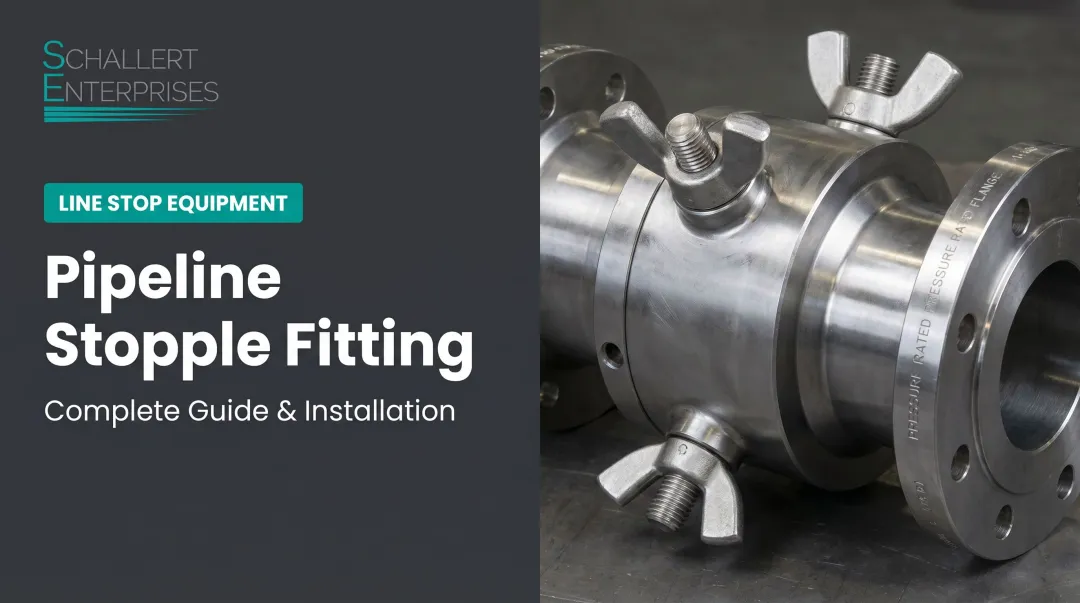
A stopple is the procedure and equipment assembly used to isolate a section of live pipeline when there's no shutoff valve nearby. It works by cutting a hot tap access point, then inserting an expanding plug through that opening to physically block flow.
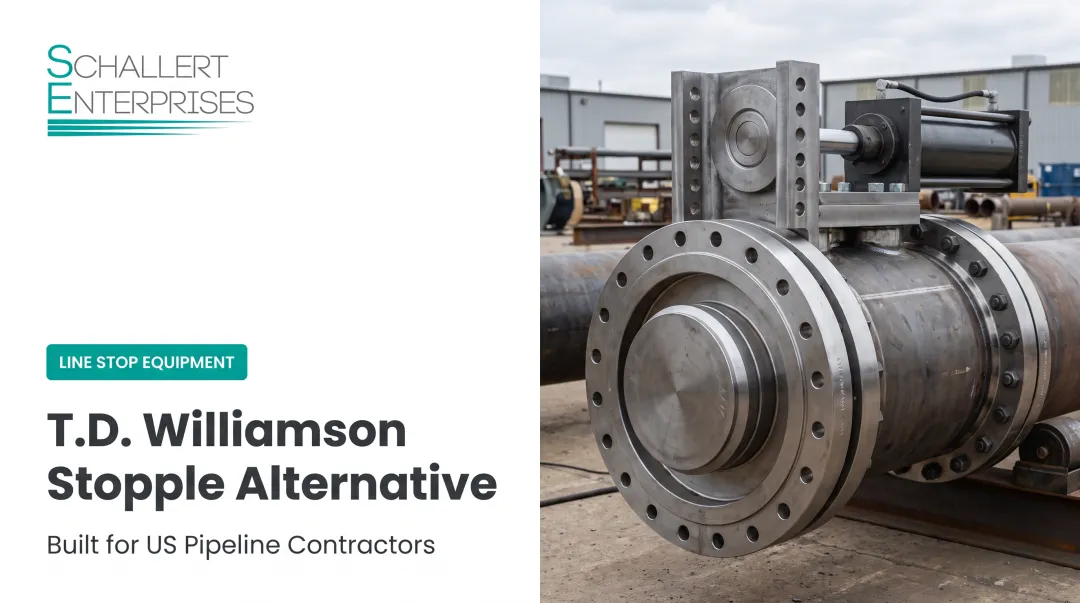
"Stopple" is a registered trademark, owned by T.D. Williamson under U.S. Registration No. 874197, first granted in 1969. Despite the trademark, technicians across the industry use the word informally to describe line stop fittings and equipment in general, much the way "hot tap" gets used loosely across brands.
Core Components of a Stopple Assembly
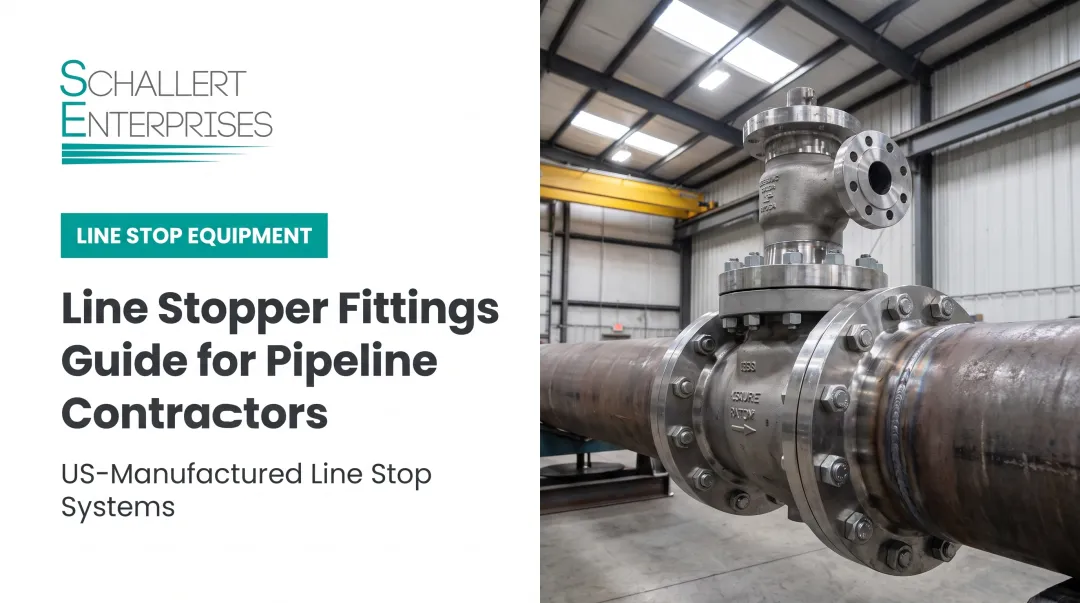
Every stopple setup relies on a handful of matched parts working together:
- Full-encirclement fitting (saddle/split tee) — welded onto the pipe to create the branch access point
- Isolation valve — a temporary valve mounted on the fitting that closes once the hot tap cutter is withdrawn
- Housing — holds the plugging machine in place and acts as a temporary block valve
- Actuator — drives the plugging head into position, typically a hydraulic cylinder or jackscrew
- Plugging head — lowers through the valve and seats to seal off flow
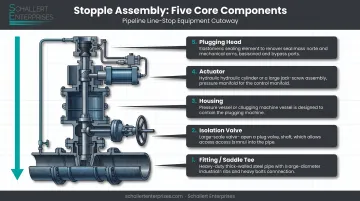
Installation follows a set order that mirrors what T.D. Williamson documents in its STOPPLE Plugging Machine bulletin: weld the fitting, mount the tapping valve, cut the tap, withdraw the cutter, close the valve, then install the plugging machine.
The Hot Tap Connection
A stopple cannot exist without a hot tap. The tap creates the access point; the stopple equipment uses that opening to insert the plug. No tap, no stopple.
Schallert Enterprises manufactures the equipment that goes in after the tap is cut: folding heads, pivoting heads, housings, jackscrews, and completion plug setters, matched to work together across a wide diameter range. Sourcing these components from one manufacturer means less guesswork about whether a housing fits a particular head.
That hot tap plus line stop setup shows up in jobs such as:
- Municipal water main valve replacement
- Gas distribution maintenance
- Oil and gas tie-ins
- Industrial process piping changes
What Is a Stopple or Line Stop "Train"?
The word "train" gets used two ways in the field. Techs often switch between them mid-conversation.
Sometimes it means the physical string of bolted equipment (fitting, valve, housing, actuator) assembled in a fixed order. Other times it means the arranged sequence of tees and valves that make up an entire isolation setup, including any bypass piping.
T.D. Williamson uses "STOPPLE Train" as the specific name for its double-block-and-bleed plugging machine, which inserts two independent heads through a single fitting. That's a defined product term. In everyday field usage, "train" more broadly describes any connected run of isolation gear, and that broader usage is what this guide focuses on.
Why "Train" Makes Sense as a Name
Think of a train of railcars. Each piece bolts onto the next in a set order. Pull one car out of sequence, or try to skip a step, and the whole thing doesn't work. Line stop equipment behaves the same way:
- Install the fitting — weld it to the pipe
- Mount the valve — set it on top of the fitting for the hot tap
- Insert the actuator and plugging head — drive the plug into sealing position
- Swap in the completion plug — once repair work finishes, replace the temporary plug with a permanent one
Single-Point vs. Multi-Point Trains
A single-point train uses one stopple and one valve, with no bypass. A multi-point train links multiple tees and valves together, often with bypass piping running between them.
Train length scales with the job. A quick repair on a low-priority line might need nothing more than a single stopple. A valve replacement on a critical main, where flow absolutely cannot stop, calls for a full multi-valve train with bypass built in.
Stopple Tees Explained
A stopple tee is the full-encirclement branch fitting, often called a split tee, welded onto the pipe to create the access point. It serves double duty: first for the hot tap, then later for inserting the plugging head.
The 3-Way Tee Variant
A 3-way tee adds a third connection point specifically to support a permanent bypass. This variant matters when downstream flow needs to keep moving while the isolated section stays out of service. Split tee selection often comes down to whether the job needs that bypass capability or not.
Material and Size Considerations
Fitting selection depends on the line medium, pressure, and diameter. Common options include:
- Carbon steel grades such as A36 for standard pipeline applications
- Type 304 stainless steel for water and wastewater service
- Nominal sizes from 2 to 60 inches, depending on manufacturer and product line
Schallert Enterprises manufactures the equipment that operates downstream of the tee: folding heads, housings, actuators, and plug setters. Tee fittings themselves are typically sourced separately and matched to the rest of the train.
Isolation Train Configurations: From Single Plug to Multi-Valve Bypass
Isolation setups are categorized by how many stopples and valves they use, and whether they include a bypass. A 2025 Pipeline Technology Conference paper frames this as a progression from one isolation point up through five-step configurations.
Single Isolation (No Bypass)
One stopple plug blocks flow completely. Nothing continues downstream during the work. This suits short, low-impact jobs where a brief interruption is acceptable.
Double Isolation with Bypass
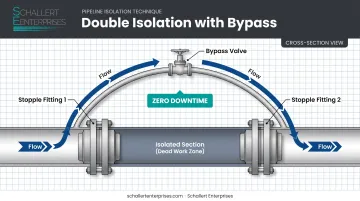
Two stopples work together, with bypass piping routed between them. Flow continues around the isolated section while crews work inside the dead zone. This is the standard setup wherever service continuity matters — most municipal and industrial jobs fall here.
A TDW case study on a Singapore gas isolation project used exactly this approach: six 24-inch fittings, controlled hot taps, and dedicated bypasses, completing the work with zero downtime and no supply disruption.
Four-Isolation Configuration
Longer pipeline sections or full segment replacements often need four isolation points. The additional tees and valves create a bigger, safer work zone for extended repairs.
Five-Step Configuration
Industry technical literature describes a five-step approach built around an existing equipment fleet rather than requiring entirely new tooling for every job. A 3-way tee frequently serves as the permanent bypass point within these larger setups.
Choosing the Right Train for Your Pipeline Job
Configuration choice comes down to three questions:
- Does downstream flow need to stay uninterrupted?
- How long will the work take?
- What's the pipe's diameter and pressure class?
Matching Components Before You Start
Every piece in a train — fitting, valve bore, actuator capacity, plugging head — needs to match the pipe's exact diameter and pressure rating. A mismatched jackscrew or an undersized housing stalls the entire sequence, sometimes mid-job.
Pressure ratings vary by component. Match these figures to your line's operating pressure as carefully as you match diameter:
- Folding head line stop machines: typically 150 to 250 psi (varies by pipe size)
- Completion plug setters: commonly rated to 500 psi
- Jackscrew actuators: typically 350 psi
Why Sourcing from One Manufacturer Helps
Compatibility issues between fittings, actuators, and completion plug setters cause more field delays than almost anything else. Sourcing a matched set from a single manufacturer avoids this.
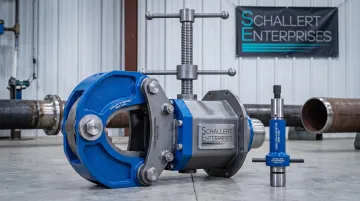
Schallert Enterprises supplies folding head line stop systems spanning 5 to 84 inches in diameter, with compatible housings, jackscrews, and completion plug setters engineered to work together. Each folding head model, from the FH0806 up through the FH7248, has specific matched components. A technician isn't left guessing whether a given housing will fit the head being installed.
Frequently Asked Questions
What is a stopple on a pipeline?
A stopple is a fitting-and-plug assembly used to isolate a section of live pipeline without a shutoff valve. It uses a welded saddle, a hot tap, and an expanding plug to block flow.
What is a stopple tee?
A stopple tee is the full-encirclement split tee fitting welded onto the pipe. It creates the branch access point used for both the hot tap and later plug insertion.
What is a stopple bypass?
A stopple bypass is piping connected around an isolated section of pipe. It keeps flow moving to downstream customers or processes while repair work happens in the isolated zone.
What's the difference between a stopple and a line stop train?
A stopple refers to the fitting-and-plug assembly itself. A train refers to the full connected sequence of equipment, or the arrangement of tees and valves, used to complete the isolation.
How many isolation train configurations are commonly used?
Common setups range from single isolation with no bypass, to double isolation with bypass, up to four- or five-point trains for longer sections or when crews reuse equipment across jobs.
How long do stopple fittings and equipment last?
With proper installation, regular maintenance, and correctly matched components, stopple and line stop equipment can remain in service for decades.