The reality is that isolation covers a broad range of approaches. Line stopping keeps systems live while you work. Blind flanges require full depressurization. Mechanical plugs suit open-ended applications. Each method has a defined performance envelope, and selecting outside that envelope is a primary cause of seal failure and unplanned downtime.
This guide walks through the main pipeline isolation methods, what differentiates them, and the operational factors that determine which approach is right for a given job.
Key Takeaways
- Pipeline isolation creates a verified physical barrier inside a pipe — not just a closed valve
- Main methods include line stopping, mechanical plugs, blind flanges/spectacle blinds, double block and bleed, and freeze plugging
- Line stopping via hot tap is the only method that maintains live service during repairs
- Method selection hinges on pipe diameter, operating pressure, media type, and service continuity requirements
- Under-rated plugs or seals are a leading cause of blowout — always verify equipment ratings before deployment
What Is Pipeline Isolation?
Pipeline isolation is the process of creating a verified physical barrier inside a section of pipe to prevent flow — enabling safe maintenance, repair, equipment replacement, or pressure testing without exposing workers to residual pressure or hazardous media.
This is a meaningful distinction from simply closing a valve. OSHA's permit-required confined space standard states that a single line valve is not sufficient isolation — valves can leak, seals can fail, and pressure can reaccumulate downstream. Mechanical isolation provides a confirmed physical barrier that a valve closure cannot.
Common operational triggers for pipeline isolation:
- Valve replacement or insertion
- Pipe section repair or replacement
- Pressure testing of new or modified sections
- Adding branch connections to existing mains
- Emergency shutdowns on active transmission lines
- Decommissioning or abandonment of pipeline segments
Once you've confirmed that isolation is necessary, the next decision is which method fits your pipe size, pressure, and media — each with different equipment requirements and tradeoffs.
Main Types of Pipeline Isolation Methods
No single isolation method covers every scenario. Each addresses a specific combination of pressure rating, access point, pipe size, and service continuity requirement.
Line Stopping (Hot Tap and Line Stop)
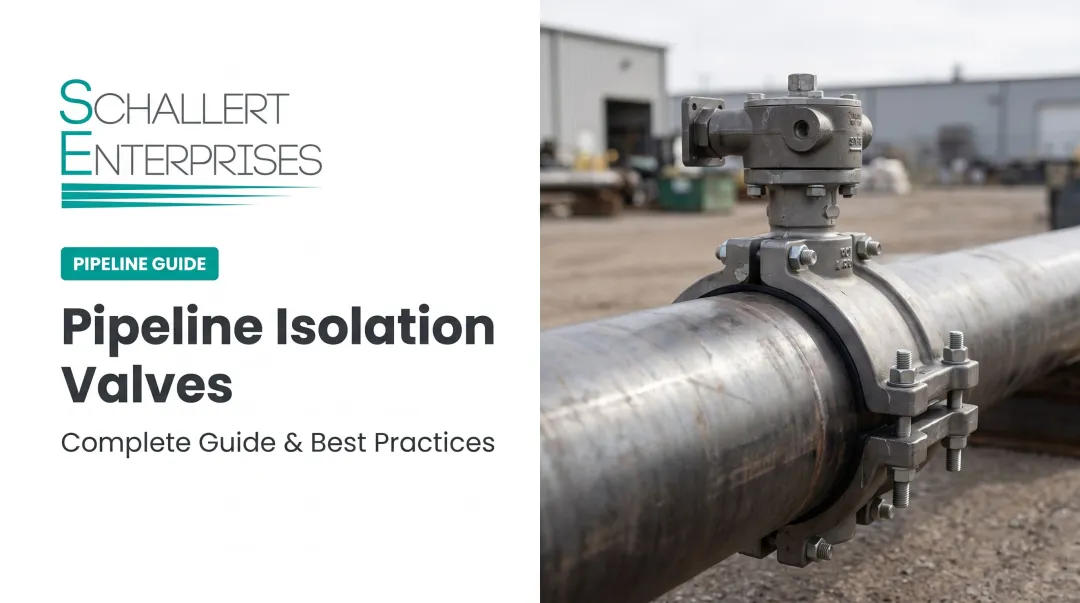
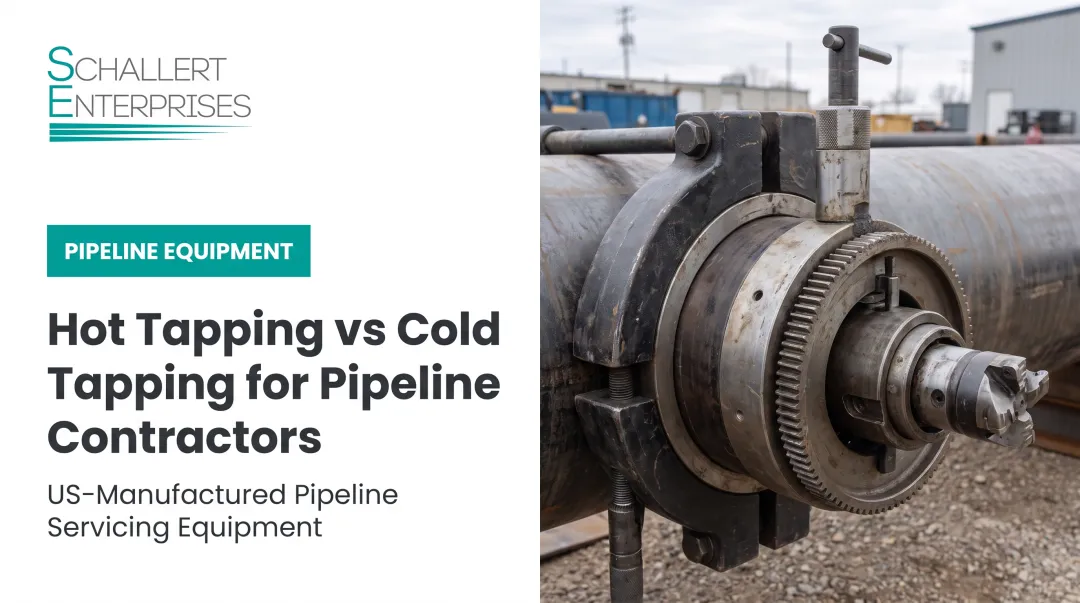
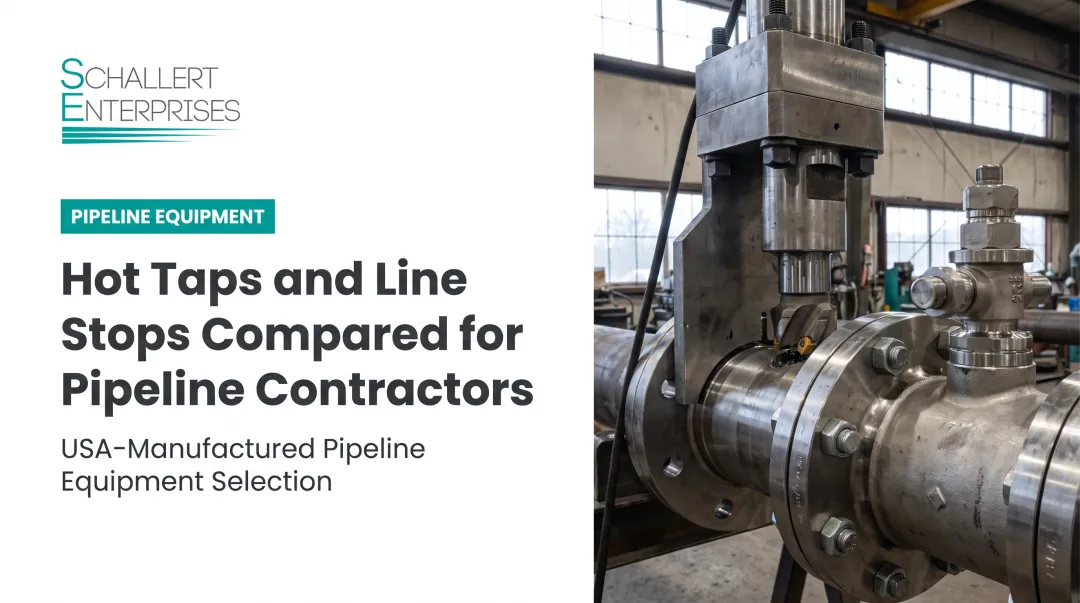
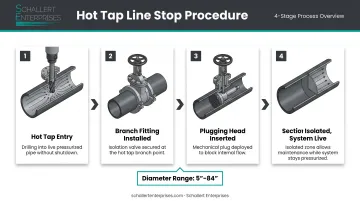
Line stopping is the method of choice when taking a system offline isn't an option. The process involves hot tapping into a live, pressurized pipeline — drilling a branch connection without disrupting flow — then inserting a plugging head through the tap fitting to create a seal inside the pipe. The isolated section can be worked on while the rest of the system stays pressurized and in service.
The EPA's Natural Gas STAR program identifies the key operational benefits: continuous system operation, no gas released to atmosphere, and no cutting, realignment, or rewelding required. For water utilities and gas distribution operators who run connections many times per year, this matters.
Folding head and pivoting head configurations extend line stopping capability across a wide diameter range. Schallert Enterprises' folding head line stop systems, for example, cover pipelines from 5 to 84 inches in diameter — with folding head designs that insert through a reduced branch fitting, which reduces tap size, valve size, and overall cost compared to full-bore access.
Mechanical Pipe Plugs
Mechanical pipe plugs are inserted into an open pipe end to block flow temporarily — typically for testing, repair, or rehab work on depressurized systems. They come in inflatable and non-inflatable configurations depending on pressure and pipe condition.
The critical safety note: plug failure under pressure is not a minor incident. OSHA documented a 2017 fatality where an inflatable plug in a 24-inch storm-water line failed at 35 psi, fatally injuring a worker from the sudden expulsion of pressure. Preventing plug dislodgement or rupture requires:
- Correct plug sizing for the pipe's internal diameter
- Pressure rating verification before insertion
- Strict confined-space entry and safety protocols
Blind Flanges and Spectacle Blinds
Blind flanges and spectacle blinds create an absolute physical barrier by inserting a solid plate between pipe flanges — what OSHA defines as "blanking or blinding." The system must be fully depressurized before installation, making this method best suited for planned shutdowns rather than in-service work.
ASME B16.48 governs operational line blanks installed between ASME B16.5 flanges, covering NPS 1/2 through 24 in pressure classes 150 through 2500. For systems within that range undergoing planned maintenance, spectacle blinds are a proven, code-backed isolation approach.
Double Block and Bleed (DBB)
DBB uses two sequential sealing elements with a monitored bleed cavity between them. If the upstream seal fails, the bleed point detects it before product reaches the work zone. OSHA defines this as "closing and locking or tagging two in-line valves and opening and locking or tagging a drain or vent valve between them."
OSHA recognizes DBB as a standard isolation method for permit-required confined spaces and encourages it as a lockout/tagout best practice where hazardous energy can reaccumulate. For flammable, toxic, or high-pressure media — where a single-seal failure is unacceptable — DBB provides the safety redundancy that regulatory programs under OSHA PSM (29 CFR 1910.119) and EPA RMP (40 CFR Part 68) require for opening process equipment.
Freeze Plugging
Freeze plugging uses cryogenic cooling to form a temporary ice plug inside the pipe. ASME PCC-2-2022 documents freeze plugs as an accepted repair method, with Article 302 covering their application.
The method carries real constraints that narrow its application:
- Only works in liquid-filled pipes (no gas lines)
- Flow velocity must be within acceptable limits for plug formation
- Pipe material and wall temperature must tolerate cryogenic exposure
- Premature thaw creates an uncontrolled pressure release
Reserve freeze plugging for situations where heat sensitivity or physical access makes hot tapping or mechanical plugging impractical — not as a general alternative to other methods.
Key Factors When Choosing a Pipeline Isolation Method
All isolation methods can stop flow. What separates a safe, effective isolation from a costly failure is matching the method to the actual conditions. Each factor below interacts with the others — evaluate them together, not in sequence.
Pipe Diameter and Material
Diameter directly determines equipment compatibility. Mechanical plugs and hot tap line stop heads must match the pipe's internal diameter precisely. Pipe material — steel, ductile iron, concrete-lined, plastic — affects cutter type, seal compatibility, and fitting selection.
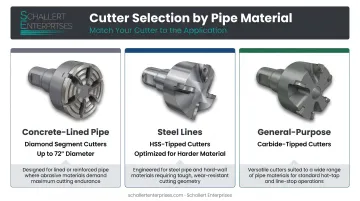
For concrete-lined pipe, standard carbide or HSS cutters aren't sufficient — diamond segment cutters are required. Cutter selection by pipe material generally follows this pattern:
- Concrete-lined pipe: Diamond segment cutters (available up to 72" diameter)
- Steel lines: HSS-tipped cutters optimized for harder material
- General-purpose applications: Carbide-tipped cutters
For large-diameter pipes above 24 inches, folding head designs become particularly valuable because reduced branch fitting access means smaller taps and valves, which lowers cost without compromising the seal.
Operating Pressure and Temperature
Every isolation device has a rated pressure threshold. Using an under-rated plug or fitting in a high-pressure line is a primary cause of blowout.
The pressure ranges across common pipeline types vary considerably:
| Pipeline Type | Typical Operating Pressure |
|---|---|
| Municipal water distribution | 60–80 psi (min 35 psi) |
| Natural gas transmission | 500–1,400 psi |
| Hazardous liquid transmission | 500–1,000 psi |
Equipment ratings must be verified against actual operating pressure before any isolation proceeds. Folding head line stop sealing elements, for example, are typically rated to 150 psi, making them well-suited for municipal water mains. Tapping machines generally carry ratings up to 350 psi. Gas transmission and hazardous liquid lines operating above those thresholds require pressure-rated equipment specifically designed for those conditions.
Temperature also matters. Elastomer seal performance degrades outside rated ranges. According to Parker's O-Ring Handbook, fluid compatibility and operating temperature are primary seal-selection factors, and improper selection can cause death, injury, and property damage.
Media Type and Service Continuity
Media type determines material compatibility for seals, plug bodies, and fittings:
- Potable water lines require NSF/ANSI/CAN 61-compliant components
- Hydrocarbons and aggressive chemicals demand corrosion-resistant or chemically compatible materials
- Flammable or toxic media typically mandates DBB or full depressurization before access
Service continuity is often the most operationally decisive factor. If a water main, gas distribution line, or industrial process cannot be interrupted, line stopping via hot tap is the only method that maintains service. The alternative — planned shutdowns — carries costs that compound quickly: lost product, customer notifications, regulatory reporting, and restart procedures.
For municipal operators and pipeline contractors, that downtime calculus often drives the method selection as much as any technical specification.
Duration, Scope, and Regulatory Compliance
Isolation duration shapes equipment and configuration choices. A few-hour valve replacement calls for a different setup than an extended repair window or permanent decommissioning. Completion plugs or permanent fittings may be required once the work is done.
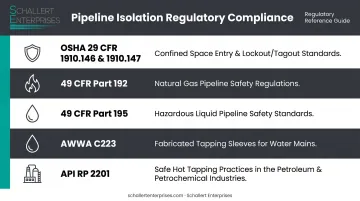
Regulatory compliance is non-negotiable. Pipeline isolation procedures fall under multiple federal and industry frameworks:
- OSHA 29 CFR 1910.146 and 1910.147 — confined space entry and lockout/tagout
- 49 CFR Part 192 — gas pipeline safety (requires hot taps by qualified crews)
- 49 CFR Part 195 — hazardous liquid pipeline safety
- AWWA C223 — tapping sleeves for water mains
- API RP 2201 — safe hot tapping in petroleum and petrochemical industries
Non-compliance can void liability coverage and trigger regulatory action. Written procedures, trained personnel, and documented risk assessments are required before any isolation begins — regardless of method.
How Schallert Enterprises Supports Pipeline Isolation
Schallert Enterprises manufactures hot tapping and line stopping equipment for the full range of pipeline isolation requirements — from 3/4-inch service connections up to 84-inch transmission mains — with all equipment built in the USA.
The product line covers every step of the line stop process as matched, compatible components:
- Folding heads — 5" to 84" pipe diameter, polyurethane sealing elements, reduced branch fitting access
- Pivoting heads — dynamic positioning applications, compatible with 3" through large-diameter pipes
- Housings, jackscrews, and actuators — cross-referenced for compatibility with specific head configurations
- Completion plug setters — rated to 500 psi, available for 4" to 48" plugs
- Line stop flanges and sandwich valves — standard sizes from 4" to 36"
- Tapping adapters — manufactured to fit any tapping machine in the world
For concrete-lined pipe, Schallert's diamond segment cutters extend to 72 inches, covering the concrete-lined transmission mains that carbide and HSS cutters can't handle. For contractors already running third-party tapping machines, the adapter compatibility means Schallert's cutter and line stop equipment integrates without requiring full equipment replacement.
Customers including The Rangeline Group, Koppl Pipeline Services, Water Services Group, and TapMaster rely on this equipment across municipal water, sewer, and industrial pipeline applications. The equipment is built for repeated field use — contractors report line stop components remaining in service for decades with proper maintenance.
Contact Schallert at sales@schallertenterprises.com or 951-674-6773 to discuss equipment specifications for a specific application.
Conclusion
The right pipeline isolation method comes from matching operational conditions — pressure, pipe size, media type, and service continuity — to the performance envelope of each method. Defaulting to the most familiar or lowest-cost option often means mismatched equipment, failed seals, or unnecessary shutdowns.
Those consequences compound over time. As systems age and expand, the decisions made today affect safety and efficiency for years. Equipment rated to actual operating conditions — covering the full diameter range you work on — pays for itself by avoiding failures, not just enabling maintenance.
For high-pressure, large-diameter, or hazardous-media applications, consult with an experienced manufacturer before finalizing method selection. Seal material compatibility, pressure-rating margins, and cutter geometry are the variables that determine whether an isolation holds — and they're worth verifying before the line is pressurized.
Frequently Asked Questions
What is pipeline isolation?
Pipeline isolation is the process of physically blocking flow within a section of pipe to enable safe maintenance, repair, or modification. Unlike valve closure, it creates a verified mechanical barrier — OSHA explicitly states that a single closed valve is not sufficient isolation for permit-required confined spaces.
How do you isolate a pipe?
Select the appropriate method based on pressure, media, and service continuity requirements. For live pressurized lines, this typically means hot tapping and inserting a plugging head. For depressurized systems, options include blind flanges, mechanical plugs, or inflatable plugs. Verify the seal before beginning work.
How should pipelines taken out of service be isolated?
Pipelines being decommissioned are typically isolated using blind flanges, mechanical plugs, or completion plugs set at the conclusion of a line stop procedure. Verify that no residual product or pressure remains in the abandoned section before sealing the access point permanently.
What is the difference between line stopping and pipe plugging?
Line stopping is an in-service technique performed on live, pressurized pipelines via hot tap, with the system remaining operational throughout. Pipe plugging typically refers to inserting a mechanical or inflatable plug into a depressurized or open pipe end.
Can pipeline isolation be done without interrupting service?
Yes. Line stopping via hot tap allows isolation of a section while the rest of the pipeline remains pressurized and in service. It's the standard approach for water utilities, gas operators, and industrial facilities that require uninterrupted service.
What is double block and bleed isolation?
Double block and bleed (DBB) uses two sequential sealing elements with a monitored bleed point between them. It applies primarily to hazardous or high-pressure media lines where a single seal failure poses a safety or environmental risk. OSHA recognizes DBB as a best practice for lockout/tagout in those conditions.