
Introduction
Get the cutter size wrong on a hot tap, and there's no graceful recovery. The machine is mounted, the pipeline is live, and now the tool won't retract into the valve.
T.D. Williamson's own equipment documentation describes tapping configurations from 1/2 inch all the way to 108 inches.
Correct diameter is the decision that determines whether your line stop, valve installation, or branch connection actually works.
Many crews still confuse nominal pipe size with the actual cutter diameter needed for the job. That mix-up causes failed retractions, damaged valves, and expensive downtime.
This guide breaks down the standard hot tap cutter size chart, the variables that drive sizing decisions, the cutter materials available at each range, and the most common mistakes that derail a job before it starts.
Key Takeaways
- Hot tap cutters range from 3/4 inch for small service taps to 84 inches on major transmission lines
- Match cutter diameter to actual pipe outer diameter, not nominal pipe size
- Choose carbide, HSS, or diamond segment based on pipe composition and lining
- Oversized or undersized cutters can block valve closure and stall the entire line stop
- Verify cutter size against machine stroke, adapter housing, and valve bore before ordering
What Hot Tap Cutter Size Represents in the Tapping Process
Hot tap cutter size refers to the outer diameter of the hole saw used to bore through a pressurized pipeline wall while keeping the line sealed and in service. It's the tool doing the actual cutting, not the finished connection.
Cutter size and tap size are not the same number.
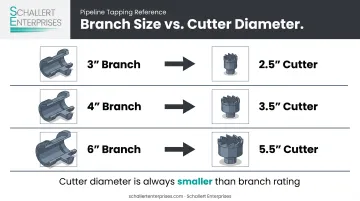
Per Dresser's tapping-sleeve installation instructions, a 3-inch branch pairs with a 2.5-inch maximum cutter, a 4-inch branch with a 3.5-inch cutter, and a 6-inch branch with a 5.5-inch cutter. The cutter is always smaller than the nominal branch rating so it can clear the valve bore on the way back out.
Cutter Size Is Locked In Before the Job Starts
This isn't an adjustable parameter. Once the tapping machine is mounted on the fitting and the line is pressurized, you're committed to whatever cutter you installed.
Cutter size gets selected based on:
- The desired branch connection size
- The valve bore dimensions the cutter must clear
- The adapter housing capacity on your specific machine
That same pre-job decision includes the pilot drill. It centers the main cutter during the bore and retains the cut-out coupon so you can pull it back safely. If the pilot drill doesn’t match the cutter, coupon retention fails and debris stays in the line.
Hot Tap Cutter Size Chart: Standard Diameter Ranges
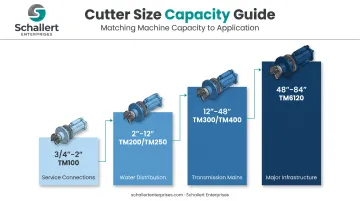
There's no single universal AWWA or API chart that governs every cutter across every manufacturer. Sizing varies by machine model, valve rating, and connection type. Here's the general breakdown most contractors use, by application:
| Category | Typical Range | Common Application | Example Machines |
|---|---|---|---|
| Small diameter | 3/4" – 2" | Service connections, meters | TM100 |
| Medium diameter | 2" – 12" | Water distribution, gas lines | TM200, TM250 |
| Large diameter | 12" – 48" | Transmission mains, industrial pipe | TM300, TM400 |
| Extra-large/custom | 48" – 84" | Major transmission infrastructure | TM6120 |
Small Diameter Taps (3/4 Inch to 2 Inches)
This range covers most service connections and meter installations. Compact tapping machines and smaller pilot drill assemblies handle this work efficiently.
Schallert's TM100 is built for exactly this bracket. Its base kit runs 3/4 inch through 3 inches, with 1/4-inch and 3/8-inch pilot drills and a 22-inch stroke. It's electric-driven, needs only 110V, and carries a 350 psi rating.
Medium Diameter Taps (2 Inches to 12 Inches)
Municipal water distribution and mid-size gas lines fall into this bracket. Cutter housings here need to match the valve flange rating precisely, not approximately.
The TM200 (3"–12" taps, 1-inch pilot drill) and TM250 (4"–14" taps, hydraulic) both fit this range. Adapters typically use the standard ANSI 150# bolt pattern, with double-drilling available for MJ valves.
Large Diameter Taps (12 Inches to 48 Inches)
Transmission mains and heavy industrial pipelines fall in this range. They generally need multi-tooth carbide or HSS cutters built for high cut volume.
Schallert Enterprises produces cutters up to 48 inches for this work. Common machine pairings include the TM300 (12"–30", 3-inch boring bar) and TM400 (16"–48", 4-inch boring bar, 96-inch travel).
Extra-Large and Custom Diameter Taps (48 Inches to 84 Inches)
This bracket is reserved for major transmission infrastructure. Schallert's TM6120 covers 24- to 72-inch taps with an 84- or 120-inch stroke and a 2.5-inch pilot drill. Its line stop equipment extends coverage up to 84 inches for pipe diameter.
Diamond segment cutters, available up to 72 inches, are used for concrete-lined or cement-lined pipe in this upper range where standard carbide teeth won't hold up.
Every bracket above follows the same tolerance rule: cutter diameter must be slightly smaller than the valve bore ID for full retraction, yet large enough to fully clear the intended branch opening. Split that difference wrong in either direction, and the job stalls.
Factors That Influence Cutter Size Selection and Machine Compatibility
Sizing a cutter correctly means looking past the label on the pipe. Here's what actually drives the decision.
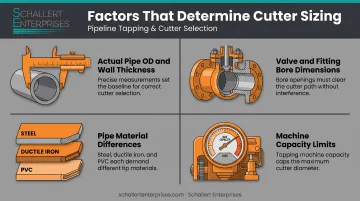
Actual pipe OD and wall thickness, not nominal size. Nominal pipe designations are approximations. The cutter needs to match the pipe's measured outer diameter and account for wall thickness, since that determines minimum coupon retention and how much material the cutter has to clear.
Schallert's cutter travel calculator requires cutter OD, pipe OD, and wall thickness as inputs, then calculates travel from initial tooth contact through breakthrough. Pilot drill protrusion isn't included in that figure and has to be added separately.
Valve and fitting bore dimensions. The cutter and its housing must retract fully inside the valve before that valve can close. If the bore is tighter than expected, even a properly-sized cutter for the pipe diameter can jam on the way back.
Pipe material differences. Steel, ductile iron, cast iron, PVC, and concrete-lined pipe all cut differently:
- Steel and ductile iron generally pair with multi-tooth HSS or carbide cutters
- Concrete-lined pipe calls for diamond segment cutters
- PVC and cast iron often need different tooth geometry than steel
Machine capacity limits. Cutter size has to check out against the tapping machine's stroke length, boring bar diameter, and adapter/housing rating. A TM100 with its 22-inch stroke and 5/8-inch boring bar simply isn't built for a 30-inch cutter, no matter how well the pipe dimensions line up.
Cutter Types and Materials Across Size Ranges
Not every cutter works on every pipe. Material selection depends on what you're cutting through and how many times that cutter needs to perform before it's replaced.
Multi-Tooth Hole Saw Cutters
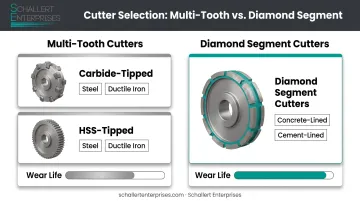
This is the standard choice for steel and ductile iron pipe, available with either HSS or carbide tips depending on hardness and expected service life.
- Carbide-tipped cutters deliver longer wear life on abrasive or hardened pipe, at a higher upfront cost
- HSS-tipped cutters suit standard steel lines and remain the more economical option when extreme wear resistance is not required
Diamond Segment Cutters
Diamond segment cutters are built for concrete-lined or cement-lined pipe. Abrasion-resistant edges hold up where standard teeth wear down fast.
Schallert manufactures these up to 72 inches in diameter, adaptable to any tapping machine that can handle that size.
Deep Tooth Profile Design
A deeper tooth gullet reduces swarf and material buildup during the cut. That matters more as cutter diameter grows—larger cutters generate far more material that needs somewhere to go.
Schallert builds this profile into its carbide, HSS, and diamond cutters across the full size range.
One thing that doesn't change across any of these categories: pilot drill size, cutter diameter, and adapter housing dimensions must all be compatible as a matched set for the specific tapping machine in use. Mixing components from different systems is a fast way to end up with a tool that won't seat correctly.
Common Cutter Sizing Mistakes and Their Consequences
Most sizing failures trace back to one of three errors, and they're all preventable with a five-minute check before ordering.
Treating nominal pipe size as actual outer diameter. Nominal sizing is a label, not a field measurement. Size off measured OD, or the cutter may be too small for a clean bore—or too large to clear the valve on retraction.
Overlooking valve bore clearance. REED Manufacturing's tapping documentation warns operators to confirm the cutter clears the gate valve bore before cutting. Inadequate clearance damages the valve during the bore, not only at retraction.
Skipping machine and adapter compatibility checks. A cutter that doesn’t match the boring bar diameter or adapter housing rating leads to delays, failed taps, or equipment damage on-site.
A wrong cutter size gets worse if the pull-out sequence slips: cut and capture the coupon, fully retract the assembly, close the valve, then remove the machine. Skip or reorder any step and a sizing miss becomes a much larger failure.
Frequently Asked Questions
What are the standard cutter sizes?
Standard hot tap cutter sizes run from 3/4 inch for small service taps to 84 inches for large transmission mains, with common increments in between. Most manufacturers, including Schallert, also offer custom sizing outside those standard increments.
How do I determine what size hot tap cutter I need?
Match cutter diameter to the actual outer diameter of the pipe and the bore of the valve or fitting being installed. Confirm both against pipe specification sheets and your tapping machine manufacturer's compatibility chart before ordering.
Can a hot tap cutter be too large for the job?
Yes. An oversized cutter may fail to retract fully within the valve bore after cutting, which prevents valve closure and jeopardizes the entire line stop or completion plug setting.
What's the difference between carbide and HSS hot tap cutters?
Carbide-tipped cutters offer greater wear resistance and longer life on abrasive or hardened pipe. HSS cutters are more cost-effective for standard steel pipe applications where extreme durability isn't required.
Do cutter sizes differ between water, gas, and oil pipeline taps?
Core sizing principles stay consistent across industries. Oil and gas transmission lines more often call for large-diameter or diamond segment cutters simply because those lines tend to run thicker walls and larger diameters.
What size is the coupon produced by a hot tap cutter?
The coupon is the material inside the cutter's cutting diameter, minus the pilot drill hole. It stays retained in the cutter body for safe removal during retraction. Exact dimensions depend on the manufacturer's specifications.