The scale of the problem is real. The United States sees roughly 240,000 water main breaks every year, close to 658 per day, according to EPA data on water utility infrastructure. Each one demands a repair, and few utilities can afford to shut down an entire system to fix a single section of pipe.
That's where hot tapping and line stopping come in. These two techniques let pipeline operators, utilities, and contractors cut into, isolate, and repair a live line without interrupting flow behind it.
This article covers how each process works, the equipment involved, the key differences between them, the safety standards that govern the work, and why choosing well-built equipment, like the tapping machines and line stop systems manufactured in the USA by Schallert Enterprises, matters for long-term reliability.
Key Takeaways
- Hot tapping adds branch connections on a live line without shutting down flow.
- Line stopping uses a hot tap plus plugging head to isolate pipe for repair with no full outage.
- Work must follow ASME B31.3, B31.4, B31.8, and API RP 2201.
- Equipment quality is what separates a sealed job from leaks and dropped coupons.
- Schallert Enterprises’ USA-made systems cover pipelines from 3/4 inch to 84 inches.
What Is Hot Tapping?
Hot tapping, also called pressure tapping, is the process of cutting or drilling into a pressurized, in-service pipeline to create a new connection without stopping flow. The industry also calls it line tapping, pressure cutting, or side cutting. The EPA defines the same method as making a new connection while the line stays in service and pressurized.
Crews turn to hot tapping to:
- Add branch connections or new service lines on active oil, gas, and water pipelines
- Install bypass piping ahead of a repair or line stop
- Replace corroded or damaged pipe sections without a full shutdown
- Add valves, sensors, or pressure/temperature test points
How a Hot Tap Comes Together
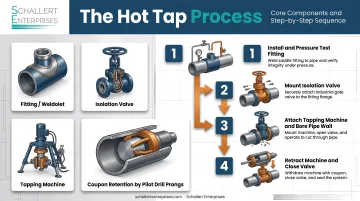
A hot tap setup relies on three core components:
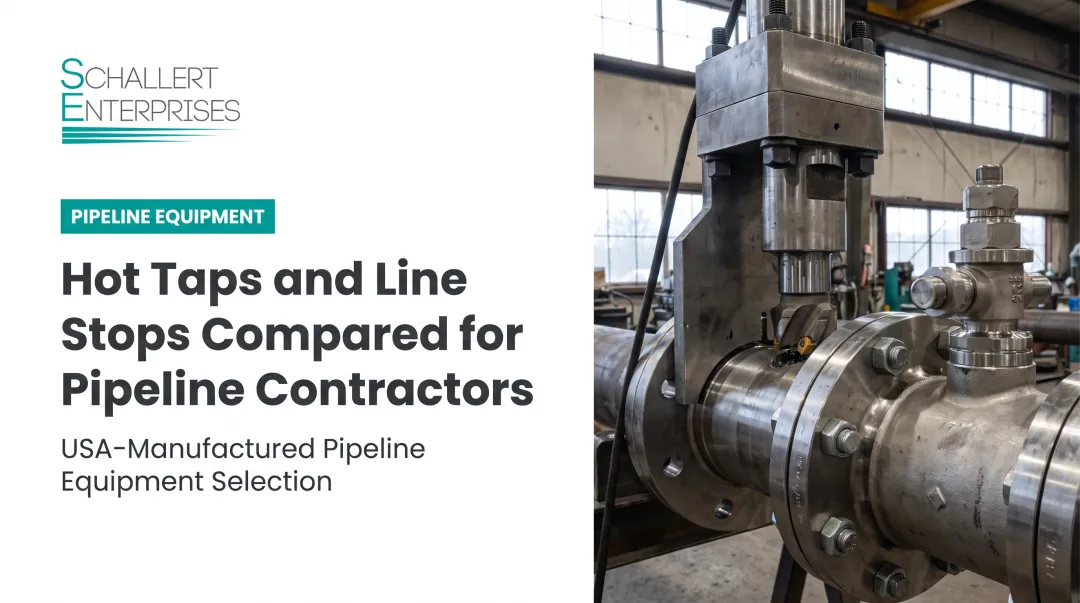
- The fitting - a weldolet, split tee, or reinforcement pad welded or bolted onto the pipe
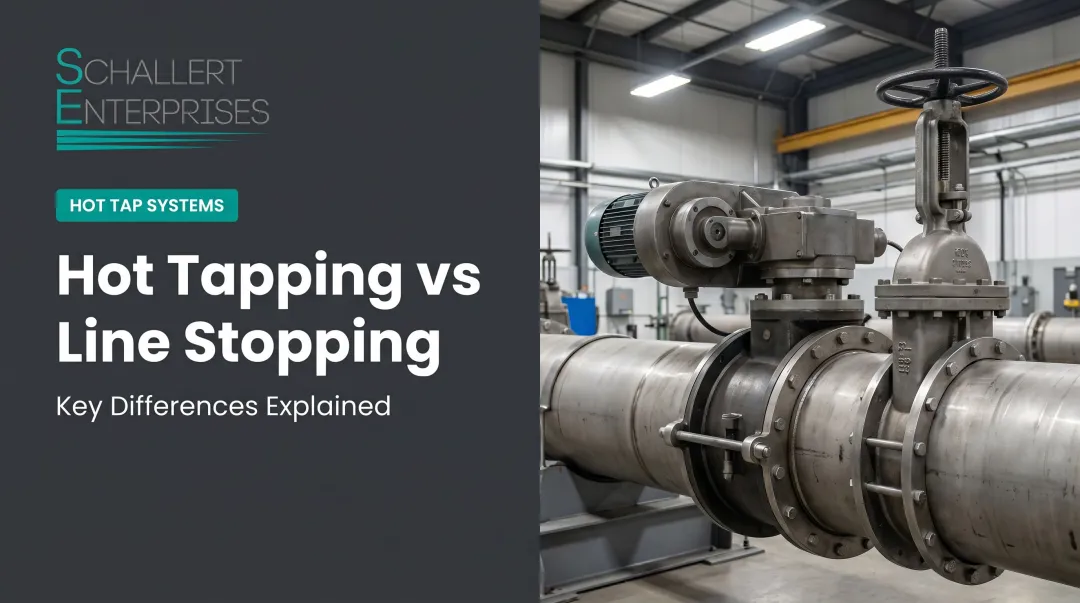
- The isolation valve - mounted to the fitting, open during the cut and closed afterward
- The tapping machine - houses the cutter and pilot drill that bore through the pipe wall
The work follows a fixed sequence:
- Install the fitting and pressure test it
- Mount the isolation valve
- Attach the tapping machine and bore through the pipe wall
- Retract the machine and close the valve
During the cut, the pilot drill's prongs (U-wires) hold the cut-out pipe section—the "coupon"—so it never drops into the flow.
Tapping machines have to handle a wide range of pipe diameters. Schallert Enterprises, for instance, builds a lineup running from the compact TM100, rated for taps as small as 3/4 inch, up to the heavy-duty TM6120, capable of taps up to 72 inches in diameter.
What Is Line Stopping?
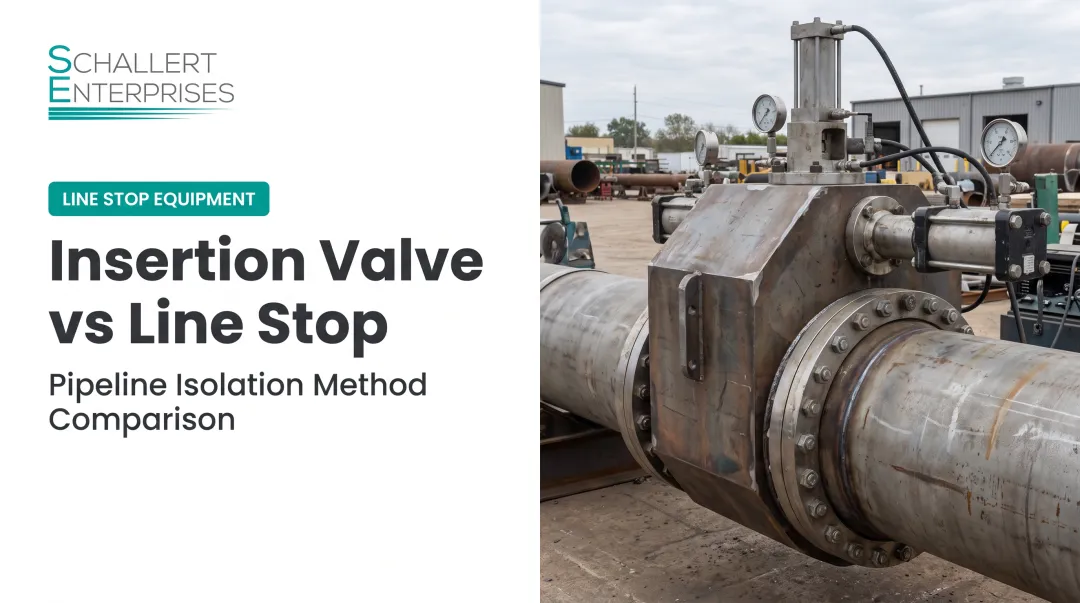
Line stopping picks up where hot tapping leaves off. It temporarily blocks flow in a section of pipe using a mechanical plugging head, so crews can repair a pipe section, replace a valve, or remove a section entirely without shutting down the wider system.
The process starts with a hot tap, but using a larger cutter than a standard branch connection would need. Once that opening exists, a line stop actuator bolts onto the fitting and inserts a folding or pivoting plugging head into the flow path. That head blocks flow through the section being worked on.
You'll often hear the plugging head assembly called a "stopple." It's a term that started as a trademarked product name but gets used generically across the pipeline industry today (see the FAQ below for the full explanation).
Once the repair, replacement, or maintenance work finishes, the crew withdraws the plugging head, sets a completion plug into the fitting, and removes the valve and actuator. What remains on the pipe is the permanent fitting, nothing else.
What a Complete Line Stop Job Requires
A full line stop requires a chain of specialized components:
- Folding heads and pivoting heads
- Line stop housings
- Hydraulic or mechanical actuators
- Completion plug setters
- Line stop flanges
- Sandwich valves
Manufacturers such as Schallert Enterprises build this entire equipment train. That matters, because a mismatched or missing piece can stall a job mid-repair on a live line.
That same equipment train supports jobs from valve replacement to isolating damaged or contaminated pipe. Crews run line stops on everything from small utility lines to large-diameter mains. Schallert's folding head systems, for example, are built to support pipelines from 5 inches to 84 inches in diameter.
Hot Tapping vs. Line Stopping: Key Differences
The two techniques work together often, but they solve different problems.
| Aspect | Hot Tapping | Line Stopping |
|---|---|---|
| Objective | Creates a new connection into a live line | Halts flow so crews can work on an isolated section |
| Core skill set | Drilling and cutting expertise, tapping machine operation | Hydraulic actuator and sandwich valve expertise |
| Governing codes | ASME B31.3, B31.4, B31.8 | Same codes apply |
| Sequence | Always the first step | An extension of hot tapping, not a standalone alternative |
Line stopping doesn't exist without a hot tap first. The plugging head can't enter the pipe until an opening exists for it, which is why most large isolation jobs run both techniques as a single sequence rather than choosing one over the other.
Both methods fall under the same piping codes. Which standard applies depends on what's flowing through the pipe:
- ASME B31.3 — process piping in refineries and chemical plants
- ASME B31.4 — liquid and slurry transportation pipelines
- ASME B31.8 — gas transmission and distribution systems
Whichever base code applies, procedure-specific safety practices come from standards like API RP 2201, covered next.
Essential Equipment for Hot Tapping and Line Stopping Operations
The reliability of any hot tap or line stop job comes down to the equipment. A poorly built cutter, undersized actuator, or fitting that fails to seal can cause leaks, a dropped coupon, or costly downtime—the failures the job was meant to prevent.
Tapping Machines and Cutters
Tapping machines run hydraulically or manually, with controllable feed and speed so operators can match the cut to the pipe material and wall thickness. Tapping adapters, sometimes called cutter housings, mount the cutter to the machine, and well-built adapters can fit any size cutter to virtually any tapping machine on the market.
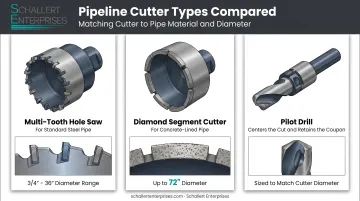
Cutter selection depends on what's being cut:
- Multi-tooth hole saws with carbide or HSS tips handle standard steel pipe
- Diamond segment cutters, available up to 72 inches in diameter, cut through concrete-lined pipe
- Pilot drills center the cut and retain the coupon so it doesn’t drop into the line
A deep tooth profile on the cutter helps clear material during the cut, instead of letting it build up and slow the job down.
Line Stop Components
Head style depends on isolation size:
- Folding heads cost less and suit smaller taps, valves, and fittings
- Pivoting heads handle larger-diameter isolations where a folding head can’t clear the bore
The rest of the equipment train includes:
- Line stop housings that contain pressure during the stop
- Hydraulic or mechanical actuators that set and retract the head
- Completion plug setters that seal the fitting after the stop
- Line stop flanges and sandwich valves that complete the temporary isolation setup
With proper use and routine maintenance, well-built, USA-made equipment can stay in reliable service for decades. Schallert Enterprises produces tapping and line stop systems spanning 3/4 inch to 84 inches in diameter, covering nearly every job a pipeline crew will encounter.
Safety Standards and Best Practices
Hot tapping and line stopping both involve cutting or drilling into a pressurized, in-service pipeline, so the margin for error stays thin. A handful of codes and recommended practices govern the work. ASME B31.3, B31.4, and B31.8 set baseline requirements depending on whether the pipe carries process fluids, liquids, or gas. API Recommended Practice 2201 covers safety specifically for hot tapping and welding on in-service petroleum and petrochemical piping.
Before any tap, crews verify pipe wall thickness with ultrasonic testing. This confirms enough base metal remains to contain pressure and hold a sound weld. API RP 2201 recommends a minimum of 3/16 inch (4.8 mm) of base metal thickness for most applications.
The actual minimum for a given job depends on pipe strength and the required safety factor, and crews must document it before work starts.
Not every line is a candidate for a welding-based hot tap. Certain contents call for extra precautions or rule the method out entirely:
- Flammable gas mixtures near their explosive range
- Oxygen-enriched atmospheres
- Hydrogen-rich streams, which require engineering review
- Corrosive chemicals such as caustics, amines, or acids
Hot tapping and line stopping should only be handled by trained, experienced crews working from a documented, job-specific procedure. This isn't a task to improvise on-site.
Why Equipment Quality Matters When Choosing a Manufacturer
Inconsistent equipment turns a routine tap into a liability. A cutter that doesn't hold tolerance, an actuator that binds under pressure, or a plugging head that doesn't seal fully can lead to leaks, a failed plug, or a dropped coupon, any of which turns a planned repair into an emergency.
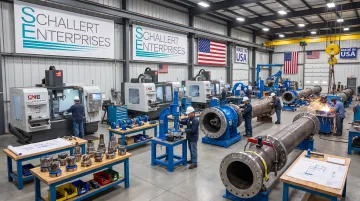
That's why sourcing decisions matter as much as crew skill. Schallert Enterprises, based in Lake Elsinore, California, builds tapping machines, cutters, hole saws, and complete line stop equipment trains in the USA. Each piece is engineered to the customer's specifications.
What sets the equipment apart:
- Cutters feature a deep tooth profile designed to clear material during the cut and prevent buildup
- Tapping adapters mount to virtually any tapping machine, not just Schallert's own lineup
- Equipment covers the full spectrum, from 3/4-inch utility taps to 84-inch industrial mains
Established pipeline service companies rely on this gear for repeated, heavy-duty work. Schallert Enterprises builds every machine and cutter to hold up under that demand.
Frequently Asked Questions
What is a stopple in piping?
A stopple is a folding or pivoting plugging head inserted into a pipe through a line stop fitting to temporarily block flow. The term started as a trademarked product name but is now used generically across the pipeline industry.
What is a stopple tee?
A stopple tee is the branch fitting welded or bolted onto the pipeline that provides the mounting point for the valve, actuator, and plugging head used during a line stop.
How large can a hot tap be made?
Hot tap sizes typically range from a half inch up to 48-72 inches, depending on the manufacturer, pipe wall thickness, and internal pressure. Schallert Enterprises' tapping machines cover 3/4 inch to 72 inches.
Is hot tapping dangerous?
Hot tapping carries inherent risk since it involves cutting or welding on a pressurized, in-service line. Trained crews keep it safe by using properly tested equipment and following codes like ASME B31 and API RP 2201.
Can line stopping be used on any pipe material?
Line stopping works on steel, ductile iron, and concrete-lined pipe, but suitability depends on pipe condition, diameter, and pressure rating. Older or degraded pipe may need engineering review before a line stop proceeds.
How long does hot tapping and line stopping equipment typically last?
Well-manufactured, USA-made equipment can stay in reliable service for decades with proper use and routine maintenance.