Introduction
Replacing a valve on a live, pressurized pipeline sounds straightforward — until you realize that shutting down the system means interrupting service to thousands of customers and triggering regulatory notice requirements before the work even starts. For water utilities, gas distributors, and industrial pipeline operators, that's often not an acceptable trade-off.
Pipeline isolation tools solve this by creating a localized, pressure-controlled work zone directly around the target valve. The rest of the system stays live. Customers stay connected. The valve gets replaced.
This guide breaks down how pipeline isolation works for valve changeout, which tools are involved, and how to determine whether isolation fits a given job. It's written for pipeline service contractors, water utilities, municipal engineers, and industrial operators making real procurement and planning decisions.
Key Takeaways
- Pipeline isolation creates a temporary, depressurized work zone around a target valve without shutting down the broader system.
- The process combines hot tapping (live pipe access) with line stop plugging heads (flow blocking) in a defined sequence.
- Tool selection depends on pipe diameter, material, and operating pressure — mismatched equipment is a primary risk factor.
- Folding head assemblies reduce tap size requirements; pivoting heads suit size-on-size applications where a smaller tap isn't feasible.
- Isolation avoids costly full shutdowns, but pipe condition and pressure limits determine whether it's a viable option.
What Is Pipeline Isolation for Valve Changeout?
Pipeline isolation is the deliberate, controlled blocking of flow within a defined section of a pressurized pipeline to create a safe, depressurized work zone — without shutting down the broader system.
Valve changeout in this context means removing and replacing a deteriorated, failed, or obsolete valve on a live pipeline where interrupting service to the full system isn't practical or permitted. The target valve stays under pressure right up until the isolation is established.
How This Differs from a Standard Valve Shutoff
A standard valve shutoff relies on existing installed valves already in the system. The problem: those installed valves may be the component being replaced, or they may be equally degraded, unmapped, or simply too far apart to isolate a small enough section.
The two approaches differ in a few critical ways:
- Standard shutoff depends on functional, correctly mapped valves already in service
- Pipeline isolation uses insertable tooling that creates a new, temporary block exactly where work needs to happen
- Isolation is independent of the pipeline's existing installed valves — making it viable even when system valves have failed or are being replaced
Research from the Journal AWWA confirms that distribution system reliability depends heavily on valve reliability, location, and quantity — and inoperable or unmapped valves can cause unexpected pressure changes that expand the affected area of any shutdown.
That's precisely the scenario pipeline isolation is built for: a targeted, tool-created block that doesn't depend on what's already (or no longer) functional in the system.
Why Pipeline Isolation Is Used for Valve Changeout
The core driver is cost — but not just the direct cost of the repair itself.
The U.S. water system experiences approximately 240,000 water main breaks per year, according to ASCE, generating roughly $2.6 billion in annual repair and maintenance costs. That's the backdrop against which every valve changeout decision gets made. Utilities are already managing aging infrastructure under budget pressure; extended shutdowns compound that stress.
Beyond direct costs, full depressurization creates specific operational risks:
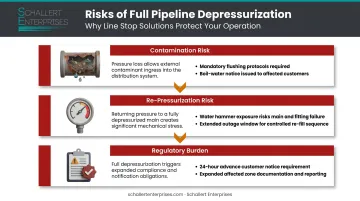
- Contamination risk: Per Iowa DNR guidance, any loss of positive pressure can allow contaminants into a distribution system. Full bleed-down typically triggers flushing, sampling, and potentially boil-water notices.
- Re-pressurization risk: Refilling large sections of main introduces water hammer risk and extends the outage window significantly.
- Regulatory burden: States including Maine and Oregon require minimum 24-hour advance notice to customers for planned service interruptions. Isolation that limits the affected zone reduces both the notice burden and the number of affected customers.
Where Isolation Gets Used
Pipeline isolation for valve changeout applies across multiple industries and pipe size ranges:
- Municipal water distribution mains (typically 4"–48" diameter, operating at 60–80 psi normal working pressure)
- Natural gas distribution networks (pressures governed by PHMSA Part 192 MAOP requirements)
- Petroleum product transmission lines
- Industrial process pipelines
In regulated water and gas utilities, isolation for live valve changeout is driven by industry best practice, operator policy, and pipeline integrity requirements — not operational preference alone.
How Pipeline Isolation Works: The Valve Changeout Process Step by Step
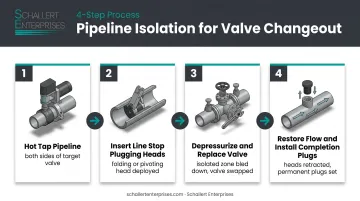
At a high level, the process combines hot tapping (cutting into the live pipe under pressure) with line stopping (inserting a plugging head to block flow), creating a dry, isolated section around the target valve. Once the replacement is complete, the process reverses: plugging heads are retracted, and permanent completion plugs seal the tap fittings.
Each stage uses a distinct set of equipment:
- Tapping machines — cut into the live pipe under pressure
- Tapping adapters and hole saws — create the precise access opening
- Line stop housings and plugging heads — seal the pipe bore to block flow
- Actuators (jackscrews) — drive and hold plugging heads in position
- Completion plug setters — permanently seal the tap fittings at closeout
Step 1: Hot Tap the Pipeline on Both Sides of the Target Valve
A hot tap fitting is welded or clamped to the pipeline at two locations — one upstream, one downstream of the valve being replaced. A tapping machine with the appropriate cutter is then used to cut an access hole through the pipe wall under full operating pressure, without releasing pipeline contents.
This access point allows line stop equipment to enter the live pipe with no flow interruption at this stage.
Step 2: Insert and Set the Line Stop Plugging Heads
Line stop equipment — folding head or pivoting head plugging assemblies — is introduced through the hot tap fittings and deployed inside the pipe to seal against the pipe wall, blocking flow in both directions around the target valve.
How the assembly works at this stage:
- The plugging head engages the pipe bore through mechanical expansion or pivoting
- The housing provides a sealed chamber around the operation
- The actuator (jackscrew) drives the head into position against the pipe wall
Schallert Enterprises' folding head and pivoting head assemblies — along with matching housings, jackscrews, and line stop flanges — cover pipelines from 5" to 84" in diameter (folding head) and from 3" upward for pivoting heads.
Step 3: Depressurize the Isolated Zone and Replace the Valve
Once both plugging heads are confirmed leak-free, the isolated section between them is bled down to atmospheric pressure. The failed valve is removed and the new valve installed — all while the pipeline upstream and downstream remains live and pressurized.
Seal verification before bleed-down is not optional. Pressure bleed-back past the seals in the isolated zone indicates an incomplete seal; work cannot proceed safely until both plugging heads hold.
Step 4: Restore Flow and Install Completion Plugs
After the new valve is installed and tested, the plugging heads are retracted and removed. A completion plug setter drives a permanent completion plug into each hot tap fitting, sealing the pipeline access points. The sandwich valves and housings used during the operation are then removed, and the pipeline returns to full-pressure service.
Schallert's completion plug setters (models PS0410, PS0616, and PS1836) cover plug sizes from 4" through 36", rated to 500 psi — and do not require a full tapping machine setup to operate.
Types of Pipeline Isolation Tools Used in Valve Changeout
Selecting the right tool for each function in the isolation sequence determines whether the job runs safely and efficiently — here's what each category does and where it fits.
Folding Head Line Stops
The folding head collapses to pass through a reduced-size branch fitting, then deploys inside the pipe to seal against the full bore. The key practical advantage: the tap, valve, and fitting installed on the main pipe only need to accommodate the folded-down head — not the full pipe diameter.
For example, Schallert's FH2012 folding head stops a 20" pipe but requires only a 12" valve and an 11.875" tap. On a 72"–84" line, the FH7248 requires only a 48" valve and fitting — a substantial cost reduction compared to full-size access.
Folding heads are rated to hold 150 psi using polyurethane sealing elements, with mid-range models (14"–66") carrying a folding head structural rating of 250 psi. They also accommodate out-of-round and mortar-lined pipes using cheater plates.
Pivoting Head Line Stops
The pivoting head uses a size-on-size approach: the access tap matches the pipe diameter being stopped. The head pivots for insertion, then rotates to engage the full bore.
Pivoting heads are available from 3" diameter and are well-suited to smaller distribution lines. Because they require a full-size access fitting, they don't offer the same cost reduction as folding heads on larger pipe. On smaller lines where full-bore access is already practical, they're the simpler, more direct choice.
Sandwich Valves and Line Stop Flanges
Sandwich valves sit between flanges during the line stop operation, providing the pressure boundary that allows plugging heads to be inserted, adjusted, or retracted without releasing line pressure. Schallert's sandwich valves are:
- Available in carbon steel or aluminum
- Sized from 4" to 36"
- Pressure-tested to 300 psi
Line stop flanges are the permanent fittings welded or clamped to the pipe — the interface between the pipe and the housing. They come standard with sealing push-style completion plugs and set pins for final closure.
Hot Tapping Machines and Cutters
Before any line stop equipment can be inserted, the pipe must be tapped. Schallert's tapping machine lineup spans six models:
| Model | Tap Size Range |
|---|---|
| TM100 | ¾" – 6" |
| TM200 | 3" – 12" |
| TM250 | 4" – 14" |
| TM300 | 12" – 30" |
| TM400 | 16" – 48" |
| TM6120 | 24" – 72" |
All machines carry a 350 psi pressure rating and are manufactured in the USA.
Cutter selection depends on pipe material:
- Carbide-tipped (red): General-purpose, the most widely used option across pipe materials
- HSS-tipped (blue): Specifically optimized for steel pipe
- Diamond segment (black): Designed for concrete-lined pipe, available up to 72" diameter
Key Factors That Affect Pipeline Isolation for Valve Changeout
Pipe Diameter and Operating Pressure
These two factors drive every other equipment decision. Municipal water systems typically operate at 60–80 psi under normal flow conditions, with a minimum working pressure of 35 psi per the Recommended Standards for Water Works. Natural gas distribution pressures are governed by MAOP under PHMSA Part 192.
Tool selection — housing design, plugging head model, cutter diameter — must be matched to both the nominal pipe size and the actual operating pressure at the time of isolation. Transient pressures and surge events need to be considered, not just the steady-state value.
Pipeline Material and Condition
Cast iron, ductile iron, steel, PVC, and concrete-lined pipe each present different requirements:
- How the hot tap fitting attaches (welded, clamped, saddled)
- Which cutter type is appropriate
- How the plugging head seals against the bore
Deteriorated or thin-walled pipe requires additional review before isolation is attempted. AIChE CCPS guidance cites approximately 5.0 mm as a recommended minimum wall thickness for hot tapping and flags corroded pipelines near minimum required thickness as requiring engineering evaluation.
Legacy cast iron in gas systems carries additional PHMSA scrutiny. Treat these pipelines as special-review candidates before any isolation work begins.
Procedure and Crew Competency
Pipeline isolation is high-consequence work. The sequence matters:
- Confirm fitting integrity before inserting the plugging head
- Verify seal before initiating bleed-down
- Confirm the new valve is tested and in service before retracting plugging heads
- Set completion plugs before removing sandwich valves
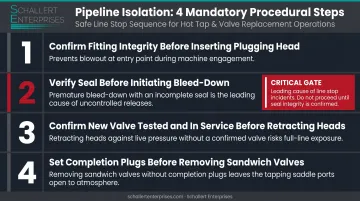
Attempting bleed-down before seal verification is confirmed is the leading cause of incidents during valve changeout. When the sequence breaks down, the consequences are severe.
API RP 2201 classifies hot tapping as hot work on in-service equipment, and OSHA records fatalities tied directly to procedural failures in this process. Crews must be trained on the full sequence — not just individual tasks — before working on live systems.
Common Issues, Misconceptions, and When Pipeline Isolation Is Not Appropriate
Misconception: Any Line Stop Will Hold Against Any Pressure
The plugging head, housing, and seals must be rated for the specific operating pressure and pipe size. Teams using undersized or mismatched equipment risk seal failure under live pressure — equipment selection is an engineering decision, not a field judgment call.
Misconception: Full Shutdown Is Simpler
For long transmission mains or pipelines serving critical facilities, this assumption underestimates the real cost. A full shutdown typically involves:
- Draining and disinfection or purging
- Refilling and repressurization
- Water hammer management
- Customer notification
- Risk of contamination ingress during pressure loss
Isolation eliminates most of those consequences.
When Isolation Is Not the Right Choice
There are legitimate scenarios where pipeline isolation is not appropriate:
- Very short, low-impact segments where a full shutdown is genuinely contained and fast
- Severely deteriorated pipe where wall thickness is below the safe hot-tap threshold and tapping would introduce wall integrity risk
- Inaccessible work zones where there isn't sufficient straight pipe run to safely install tap fittings
- Pressure too low for effective line stop sealing — manufacturer data and engineering review define the practical minimum for the specific equipment being used
- Unknown pipe condition where wall thickness and material cannot be verified before committing to the tap
Isolation reliably reduces outage footprint when pipe condition and equipment specifications are verified first. Outside those verified conditions, a full shutdown may be the safer call.
Conclusion
Pipeline isolation for valve changeout is the engineered answer to a real operational problem: valves degrade, systems age, and shutting down an entire distribution main to replace a single component is often neither practical nor acceptable.
When the equipment is properly matched to pipe diameter, material, and operating pressure — and when the isolation sequence is followed in order — valve changeout on a live pipeline is both safe and routine. The technology works because the process is disciplined.
Outcomes come down to specifics: tapping machine sized to the pipe, cutter matched to the pipe material, plugging head fitted to the bore, and a crew that knows the sequence. Get those details right, and valve changeout on a live main is a controlled, repeatable operation — not a risk.
Frequently Asked Questions
What are isolation devices used for on pipelines?
Pipeline isolation devices block flow in a targeted section of a live, pressurized pipeline so that maintenance work — valve replacement, pipe repair, or tie-in connections — can be performed safely without shutting down the entire system. The rest of the pipeline stays pressurized and in service throughout.
What is the difference between a line stop and a hot tap?
Hot tapping cuts an access hole into a pressurized pipe while it stays in service. A line stop uses that access point to insert a plugging head that blocks flow. The two are sequential steps in the same process — not alternatives to each other.
Can a valve be changed out without shutting down the pipeline?
Yes. By hot tapping the pipe on both sides of the target valve and setting line stop plugging heads at each access point, the section containing the valve can be isolated and depressurized while the upstream and downstream pipeline remains fully pressurized and in service.
What types of pipeline isolation tools are used for valve changeout?
Four core tool categories are used:
- Hot tapping machines and cutters — cut access into the live pipe
- Folding or pivoting head line stop assemblies — insert to block flow
- Sandwich valves and housings — manage pressure during the operation
- Completion plug setters — permanently seal tap fittings after work is complete
What pipe sizes can pipeline isolation tools accommodate?
Isolation tools cover a wide range. Schallert Enterprises' folding head line stop assemblies cover 8" to 84" pipe diameter; their pivoting head line starts at 3". Hot tapping machines in their lineup handle tap sizes from ¾" to 72". Tool selection must be matched to the specific diameter and operating pressure of the pipeline being worked on.
How do crews verify that the line stop seal is holding before beginning valve replacement?
Once crews set the plugging heads, they bleed down the isolated section slightly and watch for pressure bleed-back past the seals. If pressure holds steady after bleed-down, the seals are confirmed effective. Valve work doesn't begin until both plugging heads pass this check.