
This guide covers everything pipeline professionals need to know about pivoting heads: what they are, how they work mechanically, how they compare to folding heads, and what to check before deploying one in the field. Whether you're a water utility engineer, an oil and gas operator, or a pipeline service contractor, consider this your technical reference.
Key Takeaways
- A pivoting head is a line stop component that rotates 90° inside a live pipeline to block flow without a service shutdown
- Deployment requires a prior hot tap and a matched set of supporting components (housing, actuator, sandwich valve, completion plug setter)
- Pivoting heads handle higher pressures than folding heads — sealing elements rated to 450 psi at 250°F
- Folding heads are more cost-effective for most larger-diameter work; pivoting heads excel in high-pressure and hazardous-service environments
- Schallert Enterprises manufactures both head types with all supporting components for pipelines from 3" to 84" in diameter
What Is a Pivoting Head in Line Stopping?
A pivoting head is a mechanical line stop component inserted into a live, pressurized pipeline through a tapping fitting. Once deployed, it rotates perpendicular to flow, creating a pressure-tight seal that blocks the line.
Line stopping is the broader process. First, a hot tap is made into the pressurized pipe without interrupting service. Then the pivoting head assembly is deployed through that tap to isolate a section of pipe for valve replacement, repair, or maintenance. The line stays pressurized; only the isolated section goes offline.
Understanding how the assembly works starts with its components.
Physical Structure
The pivoting head assembly consists of several key elements:
- Head assembly — the core sealing component, featuring a rubberized wheel with a textured surface that seats against the pipe interior
- Actuator rod (jackscrew) — a chrome bar mechanism that drives the head into position and controls its deployment depth
- Housing — the structural enclosure that mounts to the line stop flange and guides the jackscrew and head assembly during deployment
- Line stop flange — the access and sealing point on the pipeline, accepting the assembly during the operation and the completion plug afterward
Pivoting Head Size Range
Based on jackscrew compatibility data, Schallert Enterprises' pivoting head equipment starts at 3 inches. The JS048-120 actuator supports pivoting heads for 3" to 12" pipe sizes, while the JS072-300-RC handles 14" and larger applications. For the exact upper diameter limit or non-standard configurations, contact Schallert directly.
Schallert manufactures pivoting heads as part of a complete line stop system — including housings, actuators, sandwich valves, completion plug setters, and line stop flanges — so contractors have a single source for every component the job requires.
How a Pivoting Head Works: The Mechanics Explained
Each step in a pivoting head line stop depends on the one before it. Equipment mismatches or out-of-order deployment can create serious pressure hazards — so knowing the full sequence is essential before any work begins.
Step 1 — The Hot Tap
A tapping machine drills the entry point into the live pressurized pipe first. This is done under a tapping valve or fitting, without releasing pressure or interrupting flow. The tapping machine cuts and captures the pipe coupon, then retracts it before the valve is closed. No product escapes; the line stays live throughout.
Step 2 — Insertion
Once the hot tap is complete and the valve is closed, the pivoting head assembly is prepared for entry. The head is oriented in its inline position — parallel to the pipe axis — so it fits through the tapping bore. The assembly feeds through the open valve and into the pipeline bore.
Step 3 — Pivoting Into Position
Once the head clears the valve and enters the pipe, the jackscrew drives it to the correct depth. The head then rotates 90 degrees on its pivot axis — transitioning from its inline insertion orientation to a perpendicular position that spans the full internal diameter of the pipe. The rubberized sealing element seats firmly against the pipe wall on both sides.
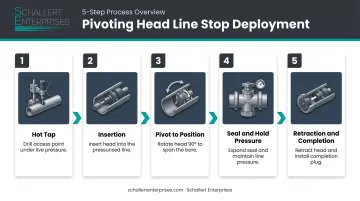
Step 4 — Sealing and Holding Pressure
The fully pivoted head forms a pressure-tight barrier. Workers can now safely access and repair the downstream section — replacing valves, cutting out damaged pipe sections, or making system additions — while the rest of the line remains fully pressurized and in service.
Schallert offers three sealing element materials to match your operating conditions:
- Buna-N (standard) — rated to 450 psi at 250°F
- EPDM — suited for chemically aggressive media
- Viton — for high-temperature or solvent-exposure environments
Step 5 — Retraction and Completion
After the repair is complete, the head pivots back to its inline orientation and the jackscrew retracts it through the valve. A completion plug setter then drives a plug into the tap point, locking it in place with set pins accessible from the outer diameter of the line stop flange. The temporary valve is removed, a blind flange is installed as secondary cover, and the pipeline returns to full operation — with no evidence of the access point beyond the permanently sealed fitting.
Schallert offers three completion plug setter models (PS0410, PS0616, PS1836) covering plug sizes from 4" to 36", all rated to 500 psi.
Pivoting Head vs. Folding Head: What's the Difference?
Both tools create a temporary flow-blocking seal inside a pressurized pipeline. How they get there — and which conditions each handles — is what sets them apart.
How a Folding Head Deploys
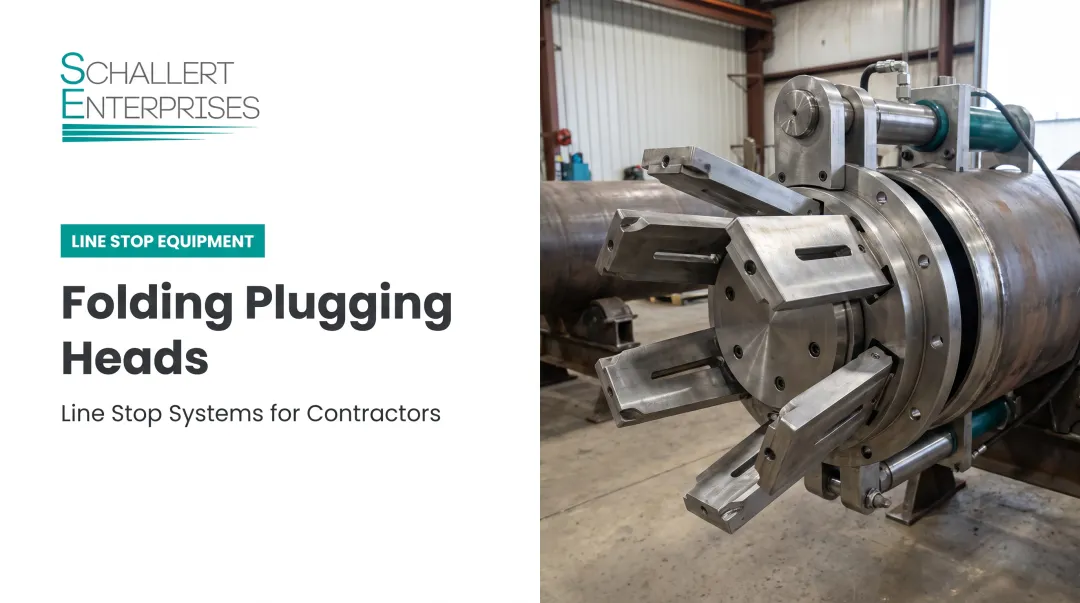
A folding head uses a hinged mechanism. The assembly folds into a compact profile for insertion, passes through a reduced branch fitting smaller than the pipe being stopped, then unfolds inside the pipe to span the full diameter. This "fold-to-insert, deploy-to-seal" design means the tap, valve, and fitting only need to match the folded insertion profile — not the full pipe size.
For a 20" pipe, a folding head (model FH2012) requires only an 11.875" access diameter. On a 42" pipe, the FH4224 needs just a 23" tap. Smaller taps mean smaller valves, smaller fittings, and lower overall job costs.
Schallert's folding head line covers 5" to 84" in pipe diameter.
Where the Pivoting Head Has the Advantage
A pivoting head is a size-on-size solution — the access fitting matches the pipe diameter being stopped. There's no reduced insertion profile. The tradeoff is higher hardware cost in exchange for significantly greater performance under demanding conditions:
| Attribute | Folding Head | Pivoting Head |
|---|---|---|
| Deployment mechanism | Hinged unfolding | Adjustable pivot/rotation |
| Tap size required | Reduced (smaller than pipe) | Size-on-size |
| Sealing element pressure | Up to 150 psi | Up to 450 psi @ 250°F |
| Primary application | Water, sewer, lower-pressure lines | High-pressure, high-temp, hazardous service |
| Pipe size range (Schallert) | 5"–84" | 3"–14"+ |
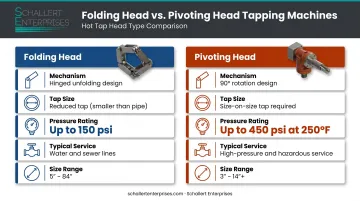
Pivoting heads are the right call for high-pressure industrial environments, hazardous gas or chemical pipelines, mills, and refineries — anywhere the folding head's 150 psi ceiling falls short of what the job demands.
Schallert manufactures both types, so operators can select based on pressure rating, pipe size, and access constraints rather than working around a single tool's limitations.
Common Applications of Pivoting Heads in Pipeline Operations
Pivoting head line stops show up wherever shutting down the full pipeline is impractical, too costly, or prohibited.
Primary use cases:
- Isolate active mains for emergency repairs — a line stop near the leak source shortens isolation time and avoids broader service disruptions or boil-water orders
- Replace failing valves by isolating only the affected section, leaving the rest of the system online
- Enable new connections and bypass installations with temporary isolation during tie-ins
- Handle high-pressure and hazardous service — the pivoting head's 450 psi rating makes it suitable for oil and gas transmission, chemical process piping, and refinery applications where folding heads fall short
Industries that rely on this approach:
- Water distribution utilities and municipal water services
- Oil and gas transmission operators
- Industrial process piping in mills and refineries
- Wastewater system operators
Because the pipeline stays pressurized until the pivoting head is deployed, there's no system drain-down and no need to notify customers or manage flow restart after a full shutdown. ASCE reports approximately 240,000 water main breaks annually in the United States — each one a case where a line stop avoids a full system shutdown.
Pivoting Head Usage Guide: Key Considerations in the Field
A pivoting head line stop requires careful equipment selection and pre-job planning to protect the crew, the pipeline, and the equipment.
Pre-Job Planning
Confirm these before selecting any equipment:
- Pipe diameter and wall thickness: determines head size, housing configuration, and tap size
- Operating pressure: must fall within the pressure rating of the selected head and sealing element material
- Pipe material — affects cutter selection for the hot tap (carbide-tipped for most lines, diamond segment for concrete-lined, HSS for steel)
- Hot tap size compatibility: the tap must match the pivoting head assembly; pivoting heads require a size-on-size tap
Under 49 CFR 192.151, any mechanical fitting used for a hot tap on a gas pipeline must be designed for at least the pipeline's operating pressure — and a branch valve must be provided where a stopper is to be used.
Equipment Pairing
A pivoting head doesn't work in isolation. The full system requires:
- Hot tapping machine (matched to tap diameter)
- Sandwich valve or tapping valve (to control access between the housing and live line)
- Housing (sized to the head and pipe)
- Jackscrew/actuator (JS048-120 for 3"–12" pivoting heads; JS072-300-RC for 14"+ pivoting heads)
- Completion plug setter (sized to the flange access diameter)
- Line stop flange (matched to the pipe and head size)
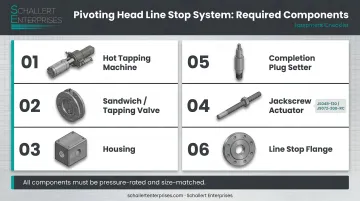
Schallert's sandwich valves — manufactured in carbon steel or aluminum, 4" to 36", tested to 300 psi — are designed specifically for this role in the line stop system.
Safe Operation and Equipment Longevity
With proper usage and maintenance, quality line stop equipment lasts decades. Before deployment, inspect:
- Sealing elements for cracking, compression set, or chemical degradation
- Actuator rod for surface damage, corrosion, or binding
- Head assembly for wear at the pivot point and rubberized sealing surfaces
- Housing connections for thread integrity and seal condition
Follow manufacturer specifications throughout. Sealing element material must match service conditions — Buna-N for standard service, EPDM or Viton for chemical or high-temperature exposure — confirmed before the head enters the pipe.
Frequently Asked Questions
What does it mean when someone is pivoting?
In general usage, "pivoting" means changing direction, strategy, or position. In pipeline work, a pivoting head refers specifically to a mechanical component that physically rotates inside a pressurized pipe to create a flow-blocking seal — describing actual rotation, not a metaphor.
What does "pivot" mean spiritually?
Spiritually, a pivot describes a meaningful turning point or moment of change. In the technical context of this guide, the term refers strictly to the physical rotation of a line stop component inside a pressurized pipeline.
What is the difference between a pivoting head and a folding head in line stopping?
Both seal off a section of pressurized pipeline, but they deploy differently. A folding head unfolds through a reduced branch fitting (smaller than the pipe being stopped), reducing tap and valve costs. A pivoting head rotates 90° in a size-on-size configuration and handles significantly higher pressures : up to 450 psi versus 150 psi for folding heads.
What pipe sizes can a pivoting head be used on?
Schallert's pivoting head equipment starts at 3 inches, with the JS048-120 actuator supporting 3"–12" heads and the JS072-300-RC supporting 14" and larger. Schallert doesn't publish a complete upper-limit size chart, so contact them directly at 951-674-6773 for specific diameter requirements.
What other equipment is needed to perform a pivoting head line stop?
The core system requires a hot tapping machine, a tapping valve or sandwich valve, a housing, a jackscrew actuator, a line stop flange, and a completion plug setter . All components must be sized and pressure-rated to match the pipeline and the pivoting head assembly being used.
Can a pivoting head line stop be performed on a live, pressurized pipeline?
Yes. The hot tap entry is made without interrupting flow, and the pivoting head is deployed through that tap to isolate only the downstream section. The rest of the system stays pressurized and in service throughout the operation.