Here's where confusion sets in. Both techniques involve working on pressurized, in-service pipe. Both require specialized equipment. And they're frequently used on the same job. But they solve fundamentally different problems — and treating them as interchangeable can lead to the wrong equipment, a failed isolation, or a job that has to be done twice.
This article covers clear definitions, a side-by-side comparison, use cases, equipment requirements, and a practical framework for choosing the right approach.
Key Takeaways
- Hot tapping creates a new branch connection on a pressurized, live pipeline without any service interruption
- Line stopping uses a mechanical plug to temporarily halt flow through a pipeline section for downstream repair or replacement
- Line stopping almost always requires a hot tap first; the two methods work in sequence, not as alternatives
- Equipment selection must match pipe diameter, material, and pressure rating — cutter type, plug head design, housing, and actuator all depend on these factors
- Choosing the wrong method wastes time, money, and creates unnecessary safety exposure
Hot Tapping vs. Line Stopping: Quick Comparison
| Factor | Hot Tapping | Line Stopping |
|---|---|---|
| Primary Objective | Create a new branch connection or access point | Temporarily isolate flow for repair or replacement |
| Key Equipment | Tapping machine, branch fitting, isolation valve, cutter, pilot drill | Line stop actuator, housing, plugging head, sandwich valve, completion plug |
| Process Outcome | Permanent new connection; service uninterrupted throughout | Temporary flow isolation; equipment removed after work is complete |
| Dependency | Standalone process | Requires a hot tap first |
| Safety Risks | Risk during drilling under pressure; requires weld and pipe condition verification | Risk centered on plug seal integrity; requires pressure equalization before removal |
What Is Hot Tapping?
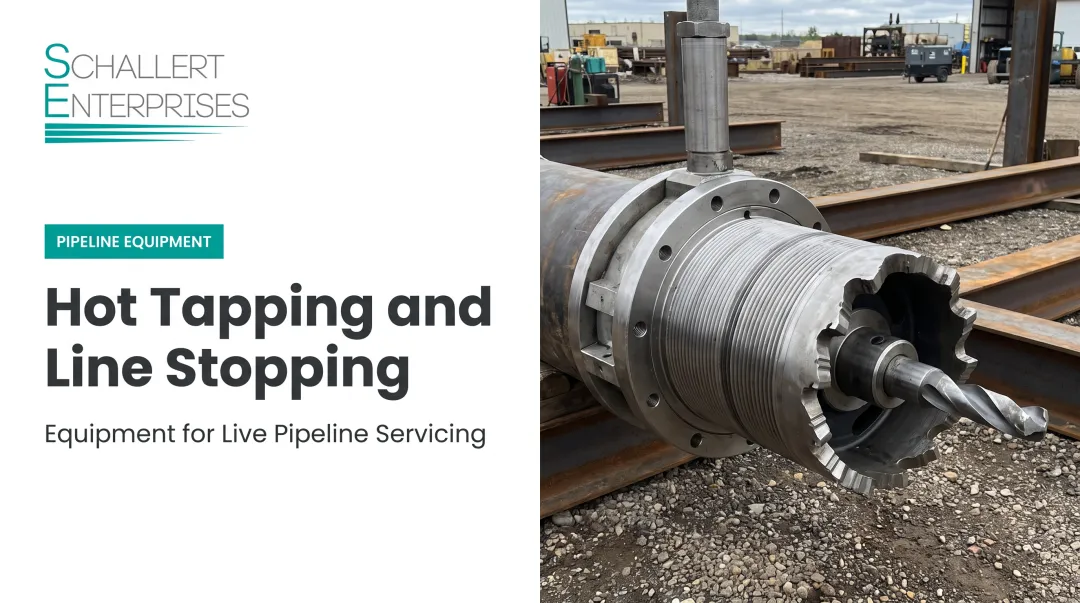
Hot tapping — also called pressure tapping, line tapping, or side cutting — is the process of making a new connection to a live, in-service pipeline while it remains under operating pressure and flowing product. No shutdown, no venting, no service interruption.
The Step-by-Step Process
- Attach a branch fitting — a weldolet or split tee — to the pipe by welding or mechanical means
- Install an isolation valve on the branch fitting
- Bolt the tapping machine onto the valve
- Drill through the pipe wall to remove the "coupon" (the cut-out section), which is retained by the pilot drill
- Retract the coupon back through the valve under pressure
- Close the valve, remove the tapping machine, and commission the new branch
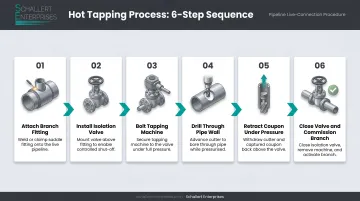
The pipeline never stops flowing. The coupon never enters the product stream.
Critical Equipment Components
Every component must be matched to the specific pipe — size, wall thickness, material, and operating pressure.
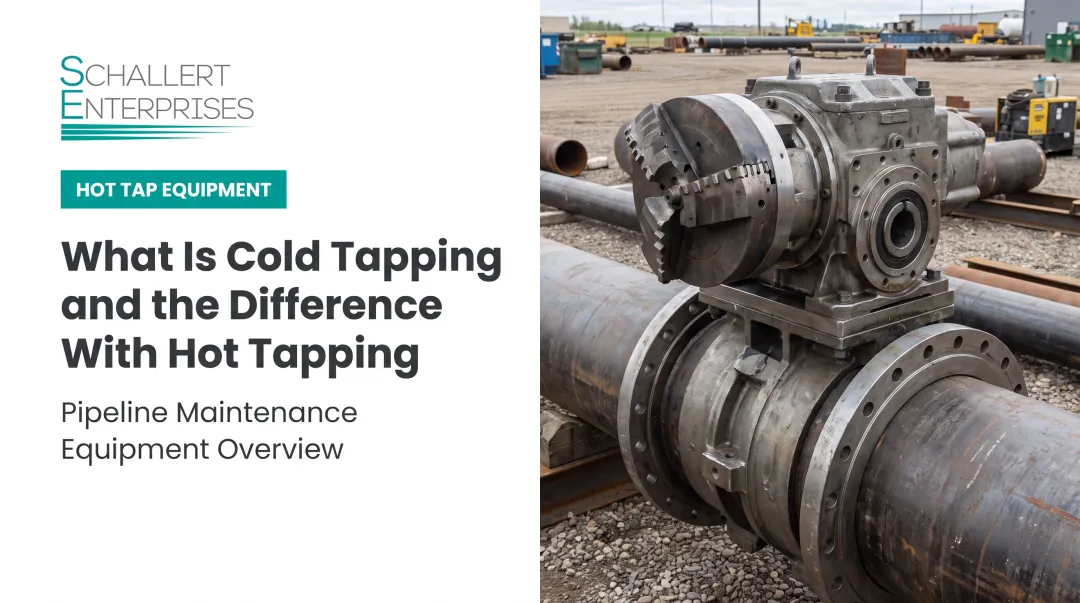
- Tapping machine: Provides the boring bar and rotary drive
- Cutter (hole saw) and pilot drill: The pilot drill retains the coupon so it doesn't fall into the flow stream
- Tapping adapter/cutter housing: Contains pressure during the cut
- Branch fitting and valve: The permanent infrastructure that remains on the pipe
Cutter selection directly affects whether the tap goes cleanly. Schallert Enterprises manufactures three styles across a full range from 3/4" to 72":
- Carbide-tipped cutters: The most widely used option, suitable for most pipe types
- HSS-tipped cutters: Optimized for steel lines
- Diamond segment cutters: Designed for concrete-lined pipe, available up to 72" in diameter
All three feature a deep tooth profile that prevents material buildup during the cut — a common cause of cutter binding on larger-diameter taps.
Preconditions and Limitations
Hot tapping is not appropriate for every pipe. Key requirements before any hot tap:
- Adequate wall thickness — no excessive corrosion, laminations, or stress corrosion cracking at the weld site
- Verified operating pressure within equipment ratings
- Sufficient flow rate to carry heat away from the weld zone
- Known valve locations upstream and downstream
- Qualified crew — 49 CFR 192.627 requires that every pressure tap on a gas pipeline be performed by a crew qualified to make hot taps
Sour gas lines require additional materials review against NACE MR0175/ISO 15156 thresholds. Governing codes vary by system type:
- ASME B31.1, B31.3, B31.4, B31.8 — depending on the pipeline classification
- API RP 2201 — petroleum and petrochemical applications
- ASME PCC-2 Article 216 — welded hot taps
Where Hot Tapping Is Standard Practice
- Installing new branch lines or tie-ins on active transmission mains
- Adding bypass piping without system downtime
- Inserting instrumentation or monitoring devices into a live flow stream
- Creating the access point needed for a subsequent line stop operation
Industries that rely on it daily: municipal water distribution, oil and gas transmission, natural gas distribution, industrial process piping, and wastewater systems.
What Is Line Stopping?
Line stopping — also called line plugging or stoppling — uses a mechanical plug head inserted through an established opening in a live pipeline to temporarily block product flow, isolating a downstream section for maintenance, repair, or replacement. The broader system stays live throughout.
How It Builds on Hot Tapping
Line stopping doesn't begin with a plug. It begins with a hot tap. The sequence:
- Perform a hot tap (typically with a larger cutter to accommodate the plug head)
- Remove the tapping machine, leaving the valve in place
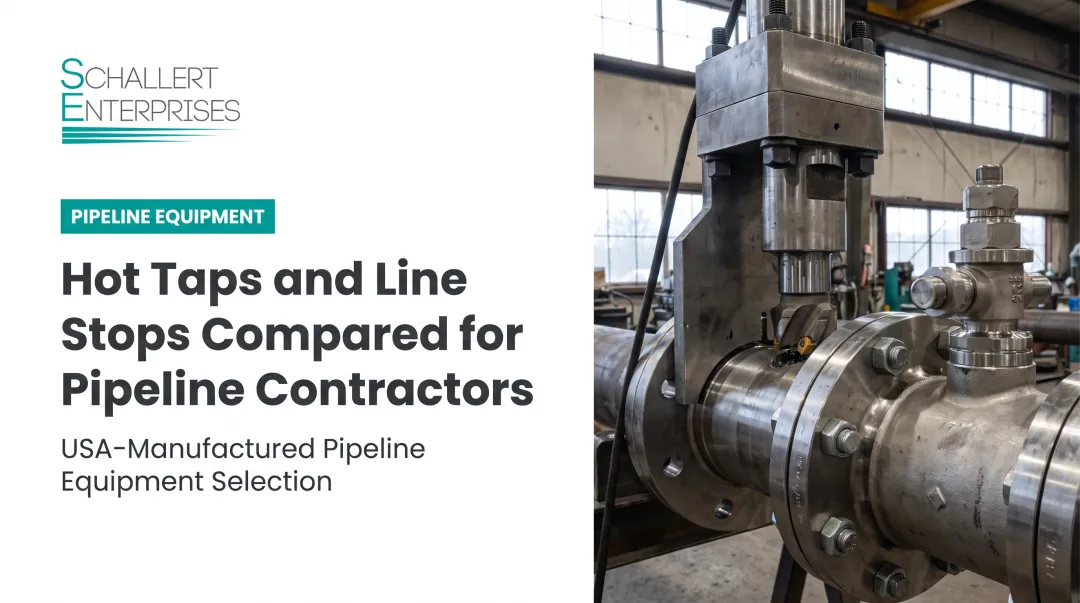
- Mount the line stop actuator on the same valve
- Deploy the plugging head — a folding or pivoting design — through the valve and into the pipe
- The plug head expands or pivots against the flow direction, sealing off the downstream section
- Perform the repair — replace the valve, cut out the damaged section, install new fittings
- Equalize pressure, retract the plug head, and install a completion plug
- Remove the valve, housing, and actuator — the fitting remains permanently on the pipe
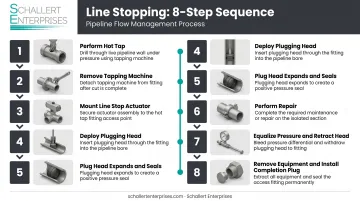
The EPA has documented that hot tapping is the preparatory stage for line plugging — the two are sequential steps in the same operational plan, not competing methods.
Equipment Stack
Schallert Enterprises manufactures every piece of equipment needed for this process:
- Folding head machines: 5" to 84" pipe diameter; heads insert through reduced branch fittings for smaller taps, smaller valves, and lower total job cost on smaller-diameter applications
- Pivoting head machines: size-on-size design with adjustable pivot points
- Housings: rated at 150 psi, sized to accommodate the retracted head position
- Jackscrews/actuators: five models from the JS048-120 (8"–12" folding heads, 350 psi) up through the JS192-1175-RG (72"–84" folding heads)
- Completion plug setters: three models covering 4" through 36" plug sizes, all rated to 500 psi
- Line stop flanges and completion plugs: standard sizes from 4" to 36", with custom configurations available
- Sandwich valves: carbon steel or aluminum, 4" to 36", tested to 300 psi
The sealing element is the pressure-limiting component across the system, rated at 150 psi regardless of pipe diameter. The folding head structural components handle up to 250 psi on most mid-range sizes (14" through 66").
After the Job Is Done
Once the repair is complete, the line stop fitting remains permanently welded or bolted to the pipe — it becomes part of the infrastructure. The valve, housing, actuator, and plug head come off and go back into service on the next job. A completion plug and blind flange seal the fitting permanently.
Where Line Stopping Delivers Critical Value
- Replacing deteriorated or failed valves without draining the system
- Isolating a pipe section for re-routing or rehabilitation
- Repairing a damaged or leaking segment while the rest of the system stays live
- Emergency isolation of a compromised pipeline section
This method is most common across:
- Municipal water utilities replacing aging gate valves on active mains
- Oil and gas operators isolating sections for valve replacement
- Industrial facilities maintaining process piping without halting production
- Wastewater operators managing live sewer force mains during infrastructure upgrades
Choosing the Right Method
The decision comes down to one question: what is the goal of the work?
Decision Guide
| Scenario | Method |
|---|---|
| Add a new branch line or tie-in to an active main | Hot tap only |
| Create an access point for future maintenance | Hot tap only |
| Replace a failed valve without draining the system | Hot tap + line stop |
| Repair or replace a section of pipe while system stays live | Hot tap + line stop |
| Isolate a section for emergency repair | Hot tap + line stop |
| Small-diameter, low-pressure temporary isolation where cutting isn't practical | Pipe freeze (provider-specific limits apply) |
Pipe freezing uses cryogenic refrigerants to form an ice plug, with no cutting and no mechanical plug. It's a viable option for water-based piping in smaller diameters where line stopping equipment isn't practical, but it has significant limitations. Most providers cap out around 24"–36" NPS and lower pressure ranges. For larger diameters or higher-pressure systems, hot tapping and line stopping are the standard approach.
A Practical Scenario: Municipal Water Main Valve Replacement
A city water utility needs to replace a failing gate valve on a 16" active water main. The main can't go out of service — customers, downstream pressure zones, and fire protection all depend on continuous flow.
The plan:
- Hot tap on each side of the failed valve to install the branch fittings
- Execute line stops at both hot tap points to isolate the valve from flow in both directions
- Cut out the old valve, install the new one
- Retract both plug heads, set completion plugs, and restore flow
The main never goes out of service. No drainage, no contamination risk from a refill cycle, no service disruption notices to customers. A 2023 study of 800+ US and Canadian water utilities documented roughly 260,000 pipe failures annually — the pressure on utilities to execute repairs without service interruption is constant.
Equipment selection drives the outcome. Pipe diameter determines the cutter size, plug head model, housing, and actuator. Pressure must be verified against the sealing element rating, and wall thickness must clear the minimum threshold before any weld is made.
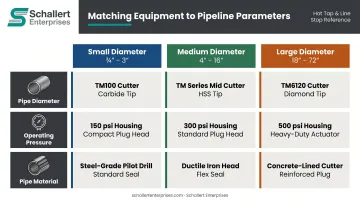
Getting these parameters right before mobilization is what separates a clean, single-mobilization job from a costly redo.
Conclusion
Hot tapping and line stopping aren't competing techniques. They're complementary tools that address different operational needs, and on many jobs they work together in sequence: hot tapping creates the access point, and line stopping provides the live isolation needed for repair or replacement.
For pipeline service companies, water utilities, and industrial operators, the choice between them depends entirely on the objective of the work, the condition of the pipe, and the system's operating parameters. Both methods require purpose-built, properly rated equipment. Investing in durable equipment matched to pipe diameter, pressure, and material pays off across decades of service. Schallert Enterprises manufactures tapping machines and line stop equipment for both methods, covering diameters from 3/4" to 84" — so operators have what they need for any job, in any configuration.
Frequently Asked Questions
What is the difference between hot tapping and line stopping?
Hot tapping creates a new connection on a pressurized, in-service pipeline without shutting it down. Line stopping uses a mechanical plug inserted through a hot-tapped opening to temporarily halt flow for downstream repair or maintenance. Line stopping always requires a hot tap to be completed first — they work in sequence, not as alternatives.
What is the difference between hot tapping and pipe freezing?
Pipe freezing uses cryogenic refrigerants to form an ice plug inside the pipe without any cutting. Hot tapping physically cuts into the pressurized pipe to add a connection. Pipe freezing is generally limited to smaller diameters and lower pressures, making hot tapping and line stopping the standard methods for larger or higher-pressure systems.
Can line stopping be performed without first doing a hot tap?
In nearly all cases, no. A hot tap must be performed first to create the opening through which the plug head is inserted. Some pre-existing tapping fittings can occasionally be reused, but the initial access point always originates from a hot tap.
What pipe sizes and materials are compatible with hot tapping and line stopping?
Both methods cover a wide range of sizes — EPA documentation references equipment from 1" to 96" at flange ratings up to 1500#. Compatible materials include carbon steel, ductile iron, cast iron, stainless steel, and plastic (provided the pipe is in adequate condition), with equipment matched specifically to pipe size, material, and pressure.
Is hot tapping safe to perform on all pipelines?
No. Pipes with excessive corrosion, inadequate wall thickness, or laminations at the weld site may not qualify, and sour gas lines require a materials review against NACE MR0175/ISO 15156. A pre-job assessment covering wall thickness measurement and pressure verification is required before any hot tap proceeds.
What industries use hot tapping and line stopping most commonly?
The primary industries are municipal water and wastewater utilities, oil and gas transmission and distribution, natural gas distribution, and industrial process piping. Any sector where pipelines must stay operational during maintenance depends on these methods.