Introduction
A valve fails. A fitting corrodes. A section of main needs an upgrade. For pipeline operators, the old fix meant shutting down the line, draining it, and leaving customers without service for hours or even days.
Live hot tapping avoids that cost. It lets crews cut into a pressurized pipeline without interrupting service. Operators skip the lost production, venting, and downtime of a full shutdown, according to T.D. Williamson's research on pipeline hot tapping.
The line stop process takes that concept a step further, temporarily blocking flow so crews can work on the pipe itself. And for smaller-diameter taps, the folding plugging head is what makes that process fast, practical, and affordable.
This guide covers what folding plugging heads are, how they work step by step, how they stack up against pivoting heads, and what to look for in a manufacturer.
Key Takeaways
- Collapses to pass a tap smaller than the pipe, then unfolds inside to stop flow
- Costs less than pivoting heads for smaller taps, valves, and fittings
- Pairs with hot tapping machines, housings, actuators, and completion plug setters as one system
- Stays in service for decades with proper use and maintenance
What Is a Folding Plugging Head?
A folding plugging head is a mechanical line-stop plug built for one job: stopping flow inside a live, pressurized pipeline carrying water, gas, or oil. It differs from a static pipe plug used to cap a dead or empty line.
The fold-to-insert design is what sets it apart. The head collapses into a compact profile, small enough to pass through a hot-tap opening that's considerably narrower than the pipe itself. Once inside, it opens back up to full size and presses against the pipe wall to create a pressure-tight seal.
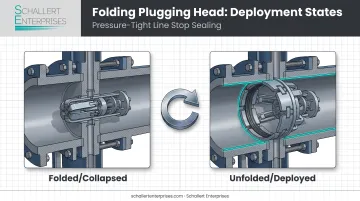
That's a very different job than a static plug faces. A static plug seals against its own housing. A folding head has to:
- Fold down small enough to clear a reduced-diameter tap
- Withstand line pressure once deployed
- Seal reliably against the pipe wall, sometimes on out-of-round or mortar-lined pipe
- Fold back down again for withdrawal once the job is done
Line stopping itself is a defined method: isolate a section of piping and provide a temporary shutoff where none currently exists, according to International Flow Technologies' hot tapping and line stopping catalog. The folding head is the component that makes this possible without cutting a full-diameter opening.
Pressure Ratings and Size Range
Manufacturers balance two things when building a folding head: structural strength in the mechanical assembly and reliable sealing at the point of contact.
Schallert Enterprises' folding heads illustrate this dual-rating approach. The folding head structure itself is typically rated at either 150 psi or 250 psi, depending on the model, while the polyurethane sealing element is rated at a consistent 150 psi across virtually every size.
That distinction matters. The metal assembly and the sealing surface aren't held to the same standard, and knowing both numbers tells you what the equipment can handle in the field.
Schallert builds these heads across the full working range, from the 8-inch FH0806 up to the 72-to-84-inch FH7248, manufactured in the USA to match each customer's exact tap and valve dimensions.
How Folding Plugging Heads Work: The Line Stop Process
A line stop isn't a single action. It's a sequence, and the folding head only does its job once several other steps have already happened correctly.
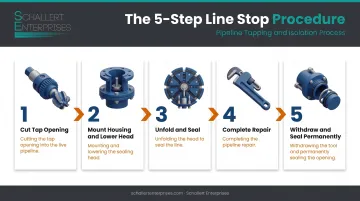
- Cut the tap opening. A hot tapping machine drills or cuts into the live, pressurized pipeline so the line stays in service—no shutdown.
- Mount the housing and lower the head. A line stop fitting and housing are installed over the tap, and the folded head is lowered through the housing and into the pipe.
- Unfold and seal. An actuator opens the head against the pipe wall, creating a pressure-tight block.
- Complete the repair. With flow isolated downstream of the stop, crews replace the corroded valve, repair the fitting, or tie in a new section without taking customers offline.
- Withdraw and seal permanently. The head folds back down, crews pull it out through the same opening, and a completion plug or sandwich valve seals the tap for good.
Picture a municipal crew replacing a corroded 16-inch gate valve. Instead of shutting off water to an entire neighborhood, they tap the line, drop in folding heads sized for the job, isolate flow on both sides of the valve, swap it out, and pull the heads back through the same access points. Service never stops.
That sequence only works when every piece around the head is built to match.
Equipment That Works Alongside the Folding Head
A folding head doesn't work in isolation. A complete line stop system includes:
- Line stop housings — support and contain the head during deployment (Schallert's HS150 series is matched to each folding head model)
- Actuators/jackscrews — drive the head into position and trigger unfolding (Schallert jackscrews range from the 120-pound JS048-200 to the 1,175-pound JS192-500)
- Completion plug setters — install the permanent plug after the stop is removed
- Line stop flanges — form the final sealing stage of the tap
- Sandwich valves — separate the pressurized fitting from tapping and stopping equipment during transitions
Schallert manufactures each of these components to work together as a matched system, so a folding head, housing, and actuator are engineered to fit rather than force-fitted on-site.
Folding Heads vs. Pivoting Heads: Which Completion Plug Do You Need?
Both folding heads and pivoting heads accomplish the same basic goal, temporarily blocking flow through a tap. The difference is in mechanism and where each one makes the most sense.
Pivoting heads use a hinged, swinging design. Inside larger pipes, that hinge has room to swing open fully, and the larger access opening required doesn't add much relative cost. That makes pivoting heads a practical choice for bigger-diameter taps.
Folding heads compress into a compact shape instead of swinging open. Because the mechanism is simpler and the required tap opening is smaller, the tooling and fittings needed cost less. That makes them the preferred option for smaller taps, valves, and fittings.
| Factor | Folding Heads | Pivoting Heads |
|---|---|---|
| Best suited for | Smaller taps and fittings | Larger-diameter taps |
| Tap opening required | Smaller relative to pipe | Larger, room for hinge swing |
| Tooling cost | Lower | Higher for equivalent size |
| Mechanism | Collapse/fold | Hinge/swing |
There's meaningful overlap in the middle of the size range, where either type can work depending on pressure, access, and pipe condition. Neither has a hard universal diameter cutoff industry-wide, so equipment fit and site conditions ultimately drive the decision.
Both hold up well over time. With proper installation and routine maintenance, either type can stay in service for years of repeated use. Choose based on tap size and budget, not durability.
Because Schallert manufactures a full range of both types with matching housings and actuators, you aren't locked into one system. Pick the head that fits the job, not the one your existing equipment happens to support.
Benefits and Applications of Folding Plugging Heads
The case for folding heads comes down to a few concrete advantages:
- Lower cost on smaller taps: smaller access openings allow smaller fittings and tooling
- Zero service disruption: downstream customers keep receiving water, gas, or product throughout the work
- Reduced project downtime: no draining, purging, or restart delays from a full shutdown
- Improved crew safety: crews avoid fully depressurized or drained environments where hazards shift unpredictably
Those advantages matter most for operators who cannot afford a full shutdown:
- Water utilities and municipal departments: replace aging valves or upgrade pipeline sections without cutting service to homes and businesses
- Oil, gas, and industrial operators: isolate a section for repair or tie-in work while the rest of the system stays online
- Pipeline service contractors: complete linestops and maintenance jobs faster with less temporary works and fewer customer notifications
Companies like Rangeline have used Schallert equipment for large-scale linestop operations, including a 30-inch stop paired with the PS1836 plug setter, showing how the equipment performs under real project conditions.
With correct installation and routine upkeep, the folding head and its supporting components handle repeated deployments for years—and with proper use, decades—so the same gear stays in the field across many jobs.

Choosing a Reliable Folding Plugging Head Manufacturer
The wrong folding head costs more than the purchase price—in failed stops, downtime, and compatibility workarounds. Before you buy, check these points:
- USA-made manufacturing for tighter tolerances and easier domestic support
- Custom sizing from small service taps through 84-inch mains, not only a mid-range catalog
- Compatibility with your existing tapping machines, housings, and actuators
Petroleum and petrochemical hot-tapping adds compliance requirements. Industry practice under API RP 2201 calls for materials and seals compatible with line contents and rated for the operating pressure and temperature. Confirm that with any manufacturer you evaluate.
Schallert Enterprises builds the full line-stop set: folding heads, pivoting heads, housings, actuators, completion plug setters, line stop flanges, and sandwich valves. Each piece is engineered to your pipeline specs rather than a generic catalog size.
Contact Schallert's sales team at sales@schallertenterprises.com or 951-674-6773 for a custom equipment quote. The equipment is field-tested by pipeline service companies and utilities nationwide, from small service taps to large transmission mains.
Frequently Asked Questions
What is a folding plugging head used for?
A folding plugging head is used in line stopping to temporarily block flow inside a live, pressurized pipeline through a hot-tap opening. This lets crews perform maintenance, repairs, or valve replacements without shutting off service.
What's the difference between a folding head and a pivoting head in line stopping?
Folding heads collapse to fit through smaller openings, making them the more cost-effective choice for smaller taps, valves, and fittings. Pivoting heads use a hinged design better suited to larger-diameter taps.
How long do folding plugging heads last?
With proper installation, use, and maintenance, a folding head can remain in service for decades. Sealing elements may need periodic replacement, but the core assembly is built for repeated deployment.
What is the difference between a line stop and a hot tap?
A hot tap creates the access opening into a live pipeline using a tapping machine. A line stop then uses that opening to insert a plugging head and temporarily block flow.
Are folding plugging heads reusable?
Yes. Properly maintained folding heads are designed for repeated use across multiple line stop projects.
What pipe sizes can folding plugging heads be used on?
Folding heads can be manufactured across a wide diameter range. Schallert builds standard models from 8-inch service taps up through 84-inch transmission mains, with custom sizing available outside that range.