The need for it isn't slowing down. The EPA's 7th Drinking Water Infrastructure Needs Survey estimates $625 billion is needed over the next 20 years for pipe replacement and system upgrades, with $422.9 billion of that tied directly to aging transmission and distribution lines. Every one of those projects eventually needs new connections tied into pipe that's already in service.
The problem is that "wet tapping," "dry tapping," and "hot tapping" get used loosely, and picking the wrong term can mean picking the wrong equipment. This guide breaks down exactly how wet tapping works, stage by stage, not just what it means.
Key Takeaways
- Wet tapping connects a new branch to a pressurized pipe without stopping flow
- Success depends on three coordinated components: sleeve, valve, and tapping machine
- Dry tapping drains the line first; wet tapping keeps service running
- Most failed taps come from mismatched components, not the wrong brand
- Wet tapping applies across water mains, force mains, gas lines, and oil pipelines
What Is Wet Tapping?
Wet tapping is the process of creating a new branch connection on an existing pipeline while it stays fully pressurized and in service. Also called pressure tapping or live tapping, it lets crews add service lines, meters, or fittings without draining a single gallon.
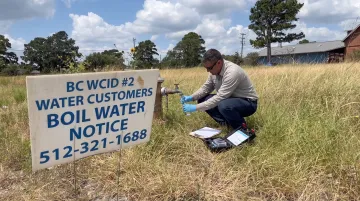
Utilities lean on it heavily because of what happens when a line goes offline. Depressurizing a water main can trigger a jurisdiction-specific boil-water response.
Florida's 2024 precautionary boil-water procedure, for example, requires restored pressure, flushing, and bacteriological sampling before service resumes. A water main break needs two consecutive days of clean samples before the notice can be lifted. Rules vary by state and primacy agency, but the pattern holds: a shutdown almost always means extra testing, paperwork, and downtime.
Wet tapping isn't an emergency fix. It's a controlled, engineered procedure planned around the pipe's material, pressure, and diameter.
What it's not: dry tapping. Dry tapping happens on a line that's already depressurized, drained, or not yet placed in service. There's no live pressure to manage, which simplifies the mechanics but doesn't avoid the outage in the first place.
Utilities and pipeline operators keep choosing wet tapping over full shutdowns because it:
- Avoids service interruption for downstream customers
- Skips the bacteriological retesting and boil-water logistics tied to a drained line
- Costs less than scheduling and coordinating a planned outage
- Works on water mains, sewer force mains, gas lines, and oil pipelines alike
In oil & gas and industrial settings, "hot tapping" often means the same pressurized-cutting principle. The name changes with the industry, but the engineering behind it doesn't.
How Does Wet Tapping Work?
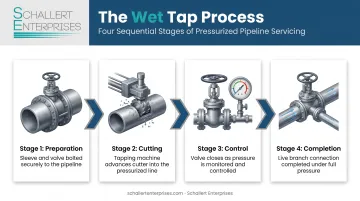
Every wet tap follows the same sequence: preparation, cutting, control, and completion. Skip a step or mismatch a component, and the whole job is at risk.
Preparing the Tap
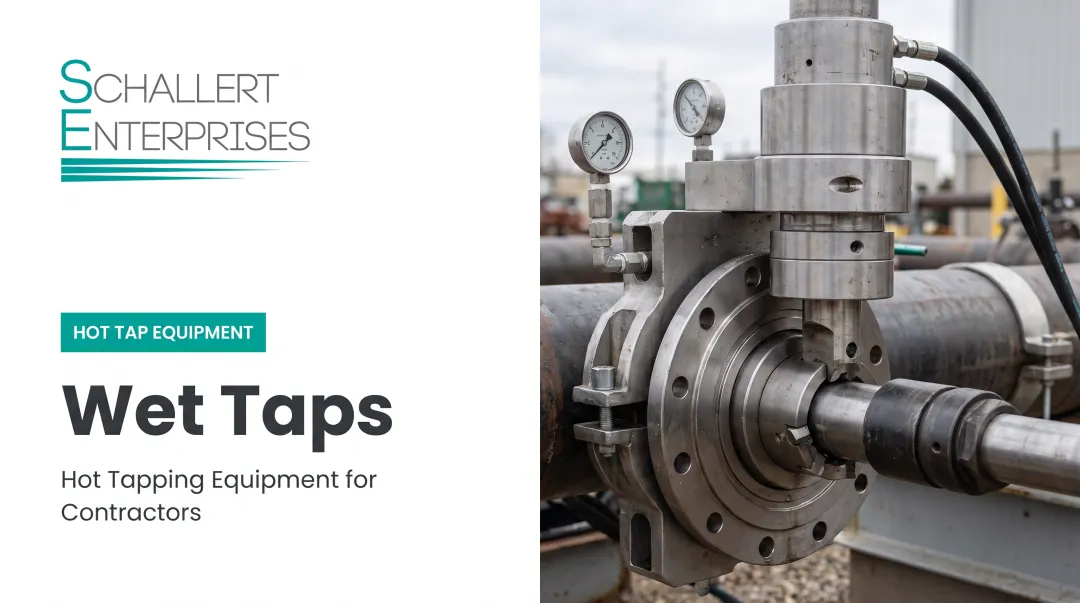
The process starts with a tapping sleeve, fitted and bolted around the pipe at the chosen location. A tapping valve then bolts onto the sleeve's outlet flange, creating the mounting point for the tapping machine.
This stage is manual and unforgiving. Technicians have to match sleeve, valve, and machine sizing to the pipe's exact material, diameter, and pressure rating. AWWA C223 requires the purchaser to specify the pipe's outer-diameter tolerance, wall class, flange dimensions, and rated pressure before a sleeve is even ordered.
Mismatched dimensions, pressure classes, or insufficient cutter clearance are a common root of failed or unsafe taps. This is where a properly fitted tapping adapter earns its keep.
Schallert Enterprises builds tapping adapters that bridge any tap size to any tapping machine. A standard ANSI 150# bolt pattern and optional double-drilling for MJ valves close the compatibility gap before the machine ever engages the pipe.
Making the Cut
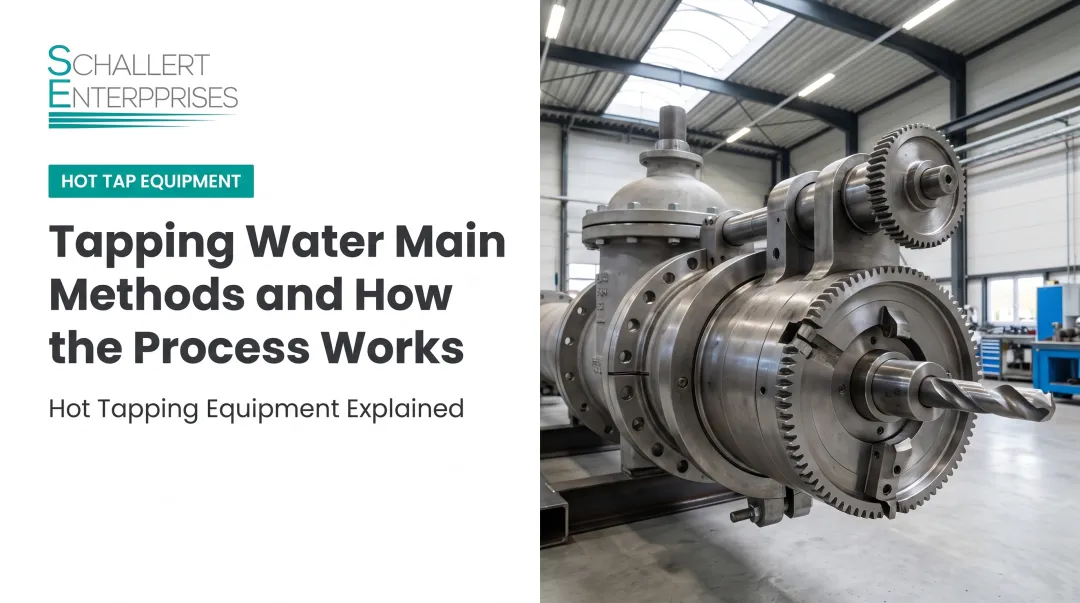
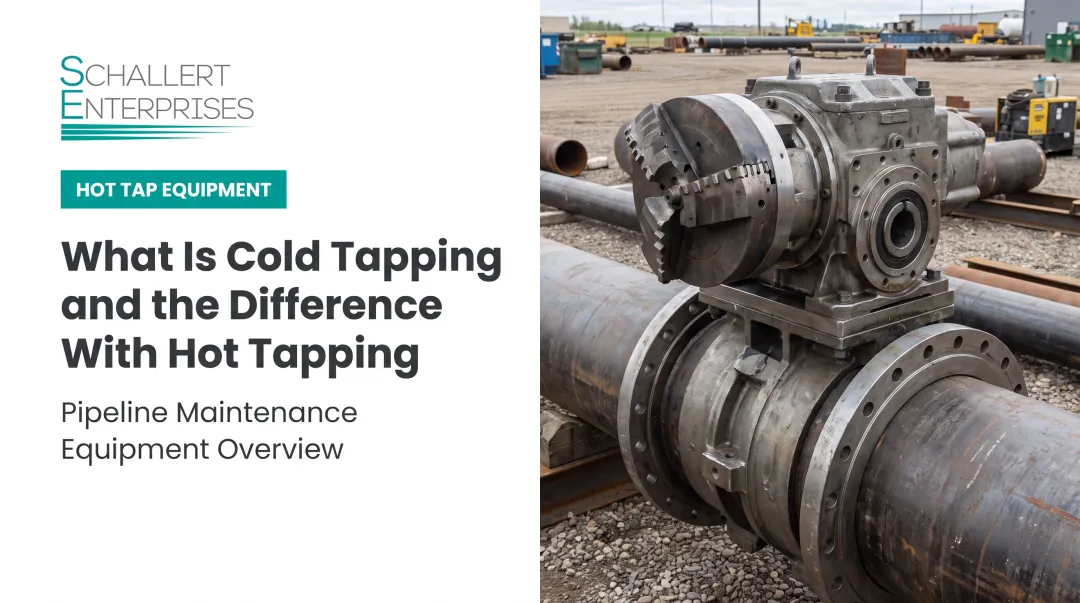
Once the valve is open, the tapping machine mounts on top of it. Its shaft advances a cutter and pilot drill through the open valve and into the pressurized pipe wall, all while the line stays in service.
Here's what happens during that pass: the cutter shears through the pipe wall while the pilot drill grips the removed section, called the coupon, so it doesn't fall into the flow. The machine housing keeps everything watertight the entire time.
Cutter tooth design and pipe material determine how clean that cut turns out. Different materials call for different tooling:
| Cutter type | Best suited for |
|---|---|
| Carbide-tipped | Most standard pipe materials (the most commonly used style) |
| HSS-tipped | Steel lines |
| Diamond segment | Concrete-lined pipe |
Schallert manufactures all three, including diamond segment cutters up to 72 inches for concrete-lined mains. The cutters use a deep tooth profile that gives material more room to clear the gullet between teeth. That design keeps chips from packing tight and stalling the cut, a common cause of incomplete separation.
Controlling the Flow
The tapping valve only stays open long enough to complete the cut. As soon as the cutter and coupon retract into the machine housing, the valve closes immediately, sealing the branch.
Technicians watch pressure readings throughout, confirm the valve seats fully, and inspect the sleeve-to-valve joint for leaks before disconnecting the machine. Skipping this check is not an option.
A valve that fails to seat can mean pressure loss, water loss, or a real safety hazard. On gas and oil lines, the stakes run higher than a wet basement.
Completing the Connection
Once the machine comes off, what's left is a live, functioning branch with the tapping valve permanently in place. That valve becomes a standing access point for a new service line, meter, or downstream fitting, no second shutdown required.
The payoff shows up in the numbers that matter to a utility's budget: zero service interruption, no boil-water notice, no bacteriological retesting. Those outcomes are the entire reason wet tapping exists.
Wet Tapping vs. Dry Tapping
The core difference is simple: dry tapping requires depressurizing, draining, or isolating the pipe first. Wet tapping keeps the line pressurized and in service from start to finish.
| Factor | Wet Tapping | Dry Tapping |
|---|---|---|
| Line status | Stays pressurized and in service | Depressurized or isolated first |
| Best fit | Continuous service is a priority | Line already out of service |
| Equipment needs | Specialized sleeve, valve, machine | Simpler direct-tap tools |
| Downtime | None | Outage required |
| Compliance testing | Not triggered | Often required after restoration |
Dry tapping still has its place. McWane Ductile notes that direct dry tapping is appropriate on new lines before they're placed in service, typically after hydrostatic testing confirms the pipe is sound. It's simpler for short, isolated jobs where live cutting isn't necessary or isn't considered safe for the pipe's condition.
Wet tapping asks more of the operator upfront: specialized equipment, trained technicians, and a tighter procedural sequence. What it buys back is service continuity—the main priority for most water utilities and pipeline operators.
Where Is Wet Tapping Used
Wet tapping shows up anywhere continuous flow matters more than the convenience of a shutdown. The most common applications include:
- Municipal water main extensions – adding new service connections without draining the distribution system
- Sewer force main branch connections – tying in new lines on pressurized wastewater mains
- Oil & gas pipeline tie-ins – connecting new segments or metering points on live transmission lines
- Industrial process piping upgrades – modifying plant piping without halting production
Pipe diameter and pressure vary widely by application. Industry equipment spans small service connections through large-diameter mains, with pressure ratings set by the specific machine. Schallert's tapping machines, for instance, cover 3/4 inch to 72 inches in diameter, with product ratings typically in the 150–500 psi range.
Wet tapping is rarely the end of the maintenance story. Valve replacements and pipe section repairs downstream of a tap often need line stop equipment, which isolates a live section using the same pressurized-work principle.
That overlap is why manufacturers like Schallert build both: tapping machines for the initial connection and folding-head line stop systems covering 5 to 84 inches for the isolation work that follows.
Conclusion
Wet tapping succeeds through a coordinated sequence of sleeve, valve, and machine. Each part does its job in order, producing a leak-free connection on a pipe that never stopped flowing.
Understanding how each stage works gives operators a real edge. They know what to check before ordering a sleeve, what to inspect before mounting a machine, and why a mismatched adapter or the wrong cutter can turn a routine tap into a failed one. That knowledge is what separates a clean tap from a callback.
For equipment sized to your exact pipe and pressure, Schallert Enterprises builds tapping machines, adapters, and cutters engineered around that same process.
Frequently Asked Questions
How does wet tapping work?
A tapping sleeve and valve are fitted to the pipe, then a tapping machine advances a cutter through the valve into the pressurized line. The pipe stays pressurized throughout the entire cut, valve closure, and machine removal.
What is the difference between dry tapping and wet tapping?
Dry tapping requires depressurizing or draining the line before cutting. Wet tapping cuts directly into a live, pressurized pipe, so there's no outage or draining involved.
What equipment is required to perform a wet tap?
The essentials are a tapping sleeve, a tapping valve, and a tapping machine fitted with a cutter and pilot drill. Matching these components to the pipe's material and pressure rating is critical.
Is wet tapping safe for older or corroded pipelines?
Severely corroded pipe is more prone to burn-through or incomplete cuts during tapping. In those cases, section replacement is usually the safer option rather than attempting a new tap.
What size range of pipes can be wet tapped?
Wet taps can be made on pipes from small service connections up to large-diameter transmission mains, depending on machine capacity. Schallert Enterprises machines, for example, cover 3/4 inch through 72 inches.
How long does a typical wet tap take to complete?
Most wet taps finish within a single work session without any service outage. Exact time depends on pipe size, material, and site access conditions.