Introduction
Every year, water utilities across the US deal with roughly 240,000 water main breaks, according to the EPA. A huge share of these failures happen on stretches of pipe with no nearby valve, forcing crews to shut down entire zones just to fix one leak.
Insertion valves and line stops solve that problem in different ways. Both let crews add, replace, or isolate valves on live water, gas, and industrial lines without draining the system. Pick the wrong one, though, and you're looking at unplanned excavation costs, longer service disruption, and equipment that wears out faster than it should.
This guide breaks down what separates an insertion valve from a line stop, where each one fits, and how to decide based on pipe diameter, operating pressure, and your long-term maintenance goals.
Key Takeaways
- Insertion valves permanently install a gate valve into a live line through one excavation.
- Line stops temporarily isolate a pipe section and leave no permanent hardware behind.
- Diameter range: insertion valves cover 4"-24"; line stops scale from 3/4" to 84" and beyond.
- Choose permanent control (insertion valve) or temporary isolation (line stop) based on the job.
Insertion Valve vs Line Stop: Quick Comparison
Here's how the two methods compare side by side:
| Factor | Insertion Valve | Line Stop |
|---|---|---|
| Cost | Higher hardware cost; one excavation for a permanent install | Lower per-job cost on large pipe; folding heads reduce cost via smaller taps and fittings |
| Pipe Size Range | About 4" to 24", depending on manufacturer and model | 3/4" to 84"+ depending on head type and equipment |
| Permanence | Permanent - the valve stays in the line for future use | Temporary - equipment comes out once the repair or tie-in is done |
| Pressure Rating | Up to about 350 psi on select models | Varies by design; folding heads ~150–250 psi; specialty systems can exceed 1,000 psi |
| Installation Complexity | One circular tap, no reaming, single excavation | Hot tap plus isolation; larger jobs may need bypass, multiple fittings, and reinforcement |
Neither option wins outright. Choose based on the job: a control point you'll use for decades, or a temporary isolation long enough to finish the repair or tie-in.
What is an Insertion Valve?
An insertion valve is a gate valve installed into a live pipeline without cutting the line or draining the system. Crews clamp a fitting onto the main, hot-tap through it, then insert a gate or cartridge that becomes a permanent shutoff point.
Utilities use this method to add isolation valves on distribution mains laid decades ago, often before codes required a valve every few hundred feet.
Two benefits drive most installations:
- Installs through a single dig site with zero downtime, cutting excavation and labor costs while customers stay in service
- Creates a permanent control point so crews can isolate the line for future repairs without digging again
Sizing and Pressure Ratings
Most insertion valves on the market are resilient-wedge gate valves, chosen for tight shutoff and straightforward bidirectional operation. Specific ranges vary by manufacturer:
- Mueller's PermaSeal line covers 4", 6", 8", 10", and 12" pipe, rated up to 350 psi.
- AVT's EZ Valve targets 16"-24" mains at 250 psi.
- Hydra-Stop's Insta-Valve family spans 4"-24" across three product tiers.
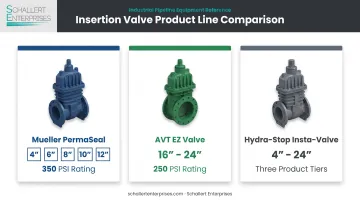
The right pick depends on flow rate, required shutoff tightness, pipe material, and how much room you have to work with at the excavation site.
Use Cases of Insertion Valves
Municipal water and wastewater utilities are the primary users, adding missing isolation points on aging mains that were never designed with adequate valve coverage. Common applications include:
- Fire hydrant isolation
- Mechanical and HVAC contractor tie-ins
- Smaller industrial process lines needing a new permanent shutoff
The City of Phoenix Water Services Department installed one on a 6-inch cast-iron main near a hospital and dialysis center to avoid the lengthy shutdown a traditional valve replacement would require.
The installation took about three hours. The utility later added 15 more PermaSeal valves across its system.
What is a Line Stop?
A line stop is a temporary isolation technique. A folding-head, pivot-head, or bag-style plug gets inserted through a hot-tapped fitting to block the pipe bore, stopping flow in one section while the rest of the system stays live. Pipeline service companies rely on this heavily for large or high-pressure lines where an insertion valve isn't pressure- or size-rated for the job.
Two benefits matter most here:
- No service disruption - maintenance, repairs, and valve tie-ins happen without shutting anything down upstream or downstream, which protects both operations and revenue.
- Long tooling life - with proper use and maintenance, line stop equipment can last decades, which lowers long-term costs compared to single-use fittings.
Folding Head, Pivot Head, and Bag Stops
Three head types cover most jobs:
- Folding head - goes in through a reduced branch fitting to cut tap, valve, and fitting cost; Schallert builds units for 5" to 84" at 150 to 250 psi by model.
- Pivot head - used for steam and higher-pressure work; requires a full-size tap. Typical coverage is 3" to 12".
- Bag or inflatable stops - lower-pressure, quick-deploy options for smaller repair jobs.
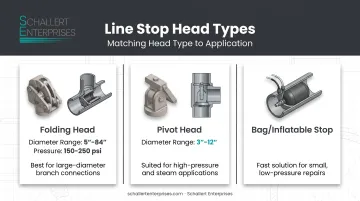
Schallert manufactures the full range needed to run these jobs end to end: folding heads, pivoting heads, housings, actuators, completion plug setters, line stop flanges, and sandwich valves, all engineered in the USA to handle pipe from 3/4 inch to 84 inches.
Use Cases of Line Stops
Line stops fit emergency repairs, system expansions, and valve replacements on lines where pipe size or pressure exceeds what an insertion valve can handle. Water utilities, oil and gas operators, and industrial pipeline crews all use the technique.
Schallert's customer base reflects that spread: Rangeline, WaterTap, Pacific Flow Control, and Garrison have run jobs from 12-inch indoor water lines to 42-inch sewer mains with bypass systems.
At the high end of the spectrum, STATS Group used dual BISEP line stops on a 30-inch CO2 transmission pipeline at roughly 2,140 psi on the Cortez Pipeline project in New Mexico.
A 24-inch bypass kept product moving while crews worked four isolation sites—more than 160 isolation days with no seal degradation and no leakage past the primary barrier.
Insertion Valve vs Line Stop: Which Is Better for Your Pipeline?
The decision usually comes down to five factors:
- Pipe diameter - insertion valves max out around 24"; line stops scale to 84" and beyond.
- Operating pressure - insertion valves top out near 350 psi; certain line stop systems handle well over 1,000 psi.
- Permanent vs. temporary need - do you want a control point you'll use again, or isolation for one job?
- Excavation budget - both methods use one dig site, but hardware costs differ.
- Future maintenance plans - will this section need isolation again in five years?
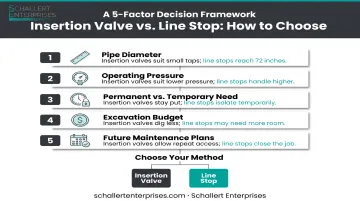
Choose an insertion valve when:
- You need a permanent, reusable shutoff on a small-to-mid-size distribution main
- Avoiding repeat excavation for future maintenance is a priority
- Diameter and pressure stay within roughly 24" and about 350 psi
Choose a line stop when:
- You're working with larger diameter pipe or higher pressures
- Isolation is only needed temporarily to finish a repair, replacement, or tie-in
- You need isolation that scales through large mains (up to 84" and beyond)
These two methods aren't mutually exclusive, either. Crews sometimes use a line stop to safely isolate a section first, then install an insertion valve inside that isolated zone for permanent control going forward.
Real-World Example: Line Stop in Action
Rangeline needed to isolate a 42-inch sewer main to complete repair and bypass work. At that diameter, no insertion valve on the market comes close. The largest verified models cap out around 24 inches.
The crew hot-tapped the line, ran a bypass to keep flow moving, and used folding-head equipment rated for pipe up to 84 inches to isolate the work zone. Pipe size alone ruled out an insertion valve, which is why crews on large-diameter municipal and industrial lines specify line stop gear matched to the full diameter and pressure range.
If you're planning a hot tap or line stop outside typical insertion valve range, reach out to Schallert Enterprises to match tapping machines, folding heads, or pivoting heads to your pipeline's exact diameter and pressure requirements.
Conclusion
Neither method wins every job. Insertion valves suit permanent control points on smaller-diameter lines. Line stops handle temporary isolation on larger or higher-pressure lines and offer a wider size range.
Choose based on permanence, diameter, and pressure, and the payoff shows up in real numbers: less downtime, lower excavation costs, and equipment you can reuse across jobs.
Frequently Asked Questions
What is the difference between a line stop and an insertion valve?
A line stop temporarily isolates flow using a removable plug or head, so you can make repairs without leaving permanent hardware in the line. An insertion valve permanently installs a new gate valve for ongoing control.
What is an insertion valve used for?
An insertion valve adds a permanent shutoff or control point to an existing pressurized line, commonly used to isolate sections during repairs, upgrades, or emergency response on municipal water mains.
What is a stop on a valve?
A "stop" usually refers to the line-stop plug or head that halts flow in a pipe section. That's different from a valve's internal stop, which limits how far it opens or closes.
How do I know if my line valve is bad?
Watch for inconsistent flow or pressure, visible leaks at the valve body, a handle or actuator that's hard to operate, or a valve that won't fully shut off flow. Any of these need a professional inspection.
Which method is more cost-effective, an insertion valve or a line stop?
It depends on job scope. Insertion valves are often cheaper for small, permanent installs since they need just one excavation. Line stops become more cost-effective for larger-diameter or temporary isolation jobs.
Can insertion valves and line stops be used on the same pipeline project?
Yes. Crews sometimes use a line stop to safely isolate a section first, then install an insertion valve within that isolated zone for permanent flow control going forward.