That scenario plays out across the pipeline industry every month. Pipeline service companies, water utilities, and industrial operators searching for a T.D. Williamson Stopple alternative are almost always facing the same problem: a maintenance job with a deadline, and an equipment source that can't move fast enough or price fairly.
TDW's STOPPLE system earned its reputation. TDW's own reporting on its STOPPLE Train configuration claims up to 50% fewer fittings and machines and roughly 50% less execution time compared to a standard double-block-and-bleed setup, according to a 2016 report in World Pipelines. But that efficiency comes wrapped in a single-brand ecosystem, and plenty of operators don't want every future plug, adapter, and housing tied to one supplier.
This guide covers how the STOPPLE system works, why operators shop around, what to evaluate in an alternative, and how Schallert Enterprises' USA-made line stop equipment measures up.
Key Takeaways
- Line stopping lets crews repair, maintain, or replace valves on live pipelines without shutdown.
- Viable alternatives to TDW's branded Stopple system exist for nearly every diameter.
- Equipment cost, proprietary parts lead time, and limited sizing flexibility drive most operators toward other suppliers.
- Strong alternatives span wide diameters, mount on existing tapping machines, and are made in the USA.
- Schallert Enterprises builds USA-made hot tapping and line stop equipment from 3/4 inch to 84 inches.
What Is the T.D. Williamson Stopple System?
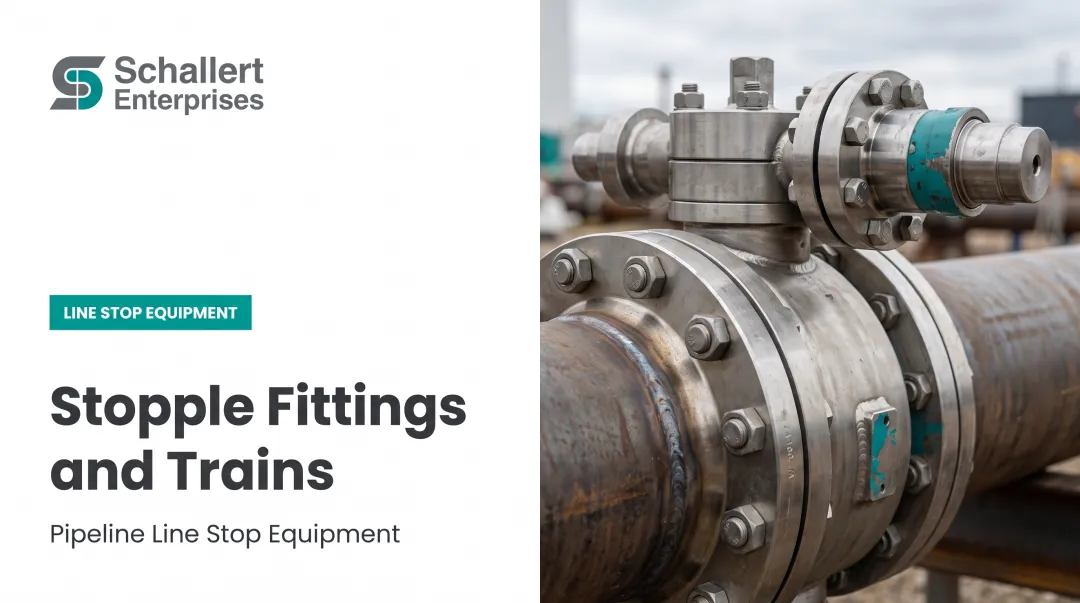
STOPPLE is T.D. Williamson's trademarked line stop and plugging system. It isolates a section of an in-service pipeline by inserting a plugging head through a hot-tapped fitting, so crews can repair, maintain, or replace pipeline components without shutting down flow.
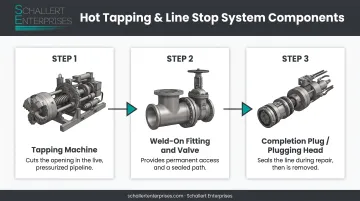
The process relies on three connected parts:
- Tapping machine: cuts the opening in the live, pressurized pipeline
- Weld-on fitting and valve: provides permanent access and a path for the tapping machine, then later the plugging head
- Completion plug or plugging head: seals the line during the work, then is removed once the repair is finished
The STOPPLE Train Configuration
TDW's STOPPLE Train setup pushes two independent plugging heads through a single fitting. That replaces the two taps normally needed for double-block-and-bleed isolation. TDW claims this configuration cuts required fittings and machines by 50% and trims execution time by a similar margin, per a 2016 World Pipelines report.
Those numbers come from TDW, not an independent study. Still, the mechanics hold up: fewer welds mean less excavation and a tighter schedule.
Here's the catch. STOPPLE Train, the LOCK-O-RING completion plug system, and the fittings engineered to accept them are proprietary to TDW. Once a fleet is built around this ecosystem, every replacement plug, adapter, or housing tends to come from the same source, at whatever price and lead time that source sets.
Why Pipeline Operators Seek TDW Stopple Alternatives
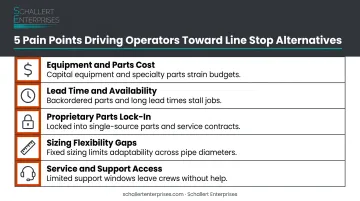
Five recurring pain points push operators toward alternatives to TDW's branded line stop equipment.
- Equipment and parts cost. Custom material grades, proprietary tooling, and brand-specific engineering inflate prices. OEM completion plugs and adapters typically cost more than functionally equivalent parts.
- Lead time and availability. Sourcing OEM-specific parts for large or unusual diameters can stall a schedule. A 2017 World Pipelines article noted that manufacturing and delivery delays disrupt project timelines—if one vendor is your only source, their delay becomes yours.
- Proprietary parts lock-in. Once a fleet standardizes on one brand's tapping machines, operators often assume every future plug and adapter has to match. That assumption limits options for years.
- Sizing flexibility gaps. OEM catalogs focus on common diameters. Very small distribution taps and oversized transmission mains sometimes fall outside standard lines entirely.
- Service and support access. Not every operator has an OEM rep nearby. Remote contractors often prefer a domestic manufacturer they can call directly for custom fabrication.
Key Features to Look for in a Line Stop Equipment Alternative
Not every supplier claiming to offer a comparable system actually delivers one. Here's what separates a genuine alternative from an imitation that lets you down mid-project.
Size Range and Customization
A worthwhile alternative covers your entire fleet's diameter range, not just the popular sizes. Schallert's folding head line stop equipment, for example, spans 5 to 84 inches in diameter, with tapping machines covering 3/4 inch to 72 inches.
One supplier can outfit a small water main repair and a 72-inch transmission line job without you juggling multiple vendors.
Build Quality and Long-Term Durability
Line stop heads and completion plugs endure repeated pressure cycles, so material grade and machining tolerance matter more than a glossy catalog photo. Look for:
- Pressure-vessel-quality steel construction
- Documented heat treatment and machining practices
- Material test reports and dimensional QA records available on request
TDW's own STOPPLE fittings specify normalized, pressure-vessel-quality plate with radiographic inspection under ASME and CSA requirements. Any credible alternative should meet a comparable standard.
Compatibility With Existing Machines
Switching suppliers shouldn't mean scrapping equipment you already own. A strong alternative builds tapping adapters and cutter housings that mount onto machines from any brand, typically using a standard ANSI 150# bolt pattern. That lets you keep your existing tapping machine and simply swap in a different cutter or housing where it makes financial sense.
Folding Head vs. Pivoting Head Options
Two head designs change job economics in different ways:
- Pivoting heads match access hardware to pipe diameter (size-on-size)
- Folding heads pass through a reduced branch fitting, so taps, valves, and fittings stay smaller
On an 8-inch line, a folding head can operate through a 6-inch valve instead of a full 8-inch one. That difference adds up fast across a multi-job contract.
Country of Manufacture and Support Turnaround
Imported OEM components can mean weeks of international shipping when a part fails mid-project. A USA-made supplier turns around replacement parts and custom fabrication faster, talks directly with your crew, and meets domestic compliance requirements without cross-border paperwork.
Schallert Enterprises: A Reliable Alternative to TDW Stopple Equipment
Schallert Enterprises manufactures hot tapping and line stop equipment in Lake Elsinore, California, built for operators who don't want every future part tied to a single OEM.
A Full Line Stop Portfolio
Schallert's line stop lineup covers every step of the isolation process:
- Folding heads and pivoting heads for lines from 5 to 84 inches in diameter
- Housings, jackscrews, and actuators sized to match
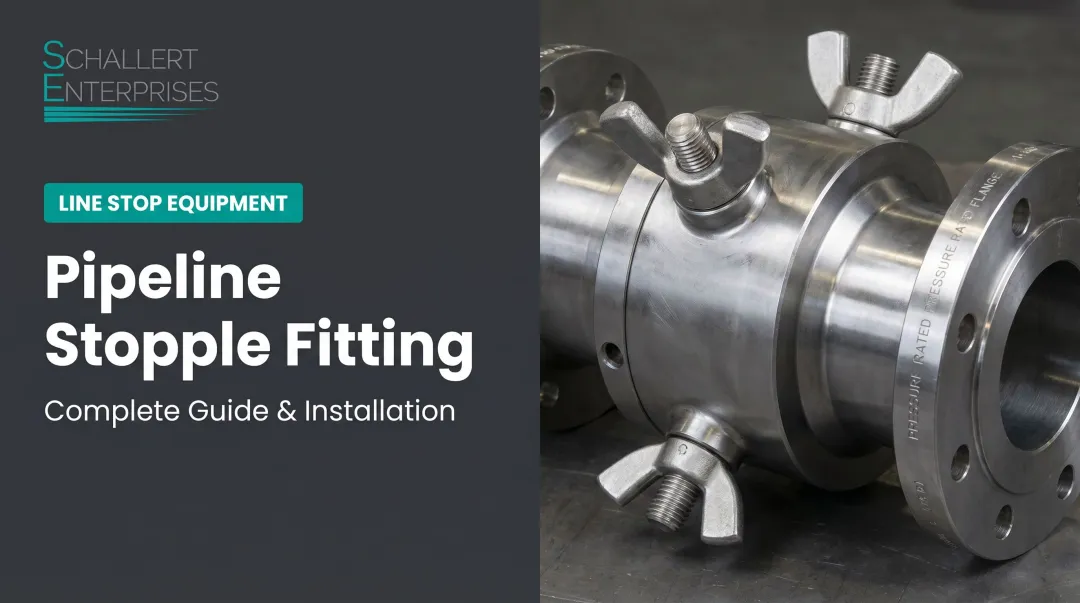
- Completion plug setters (PS0410, PS0616, PS1836), rated to 500 psi, that set plugs without a tapping machine
- Line stop flanges with sealing push-style completion plugs, standard from 4 to 36 inches and available to 48 inches by request
- Sandwich valves in carbon steel or aluminum, 4 to 36 inches, tested to 300 psi
Hot Tapping Equipment Built In-House
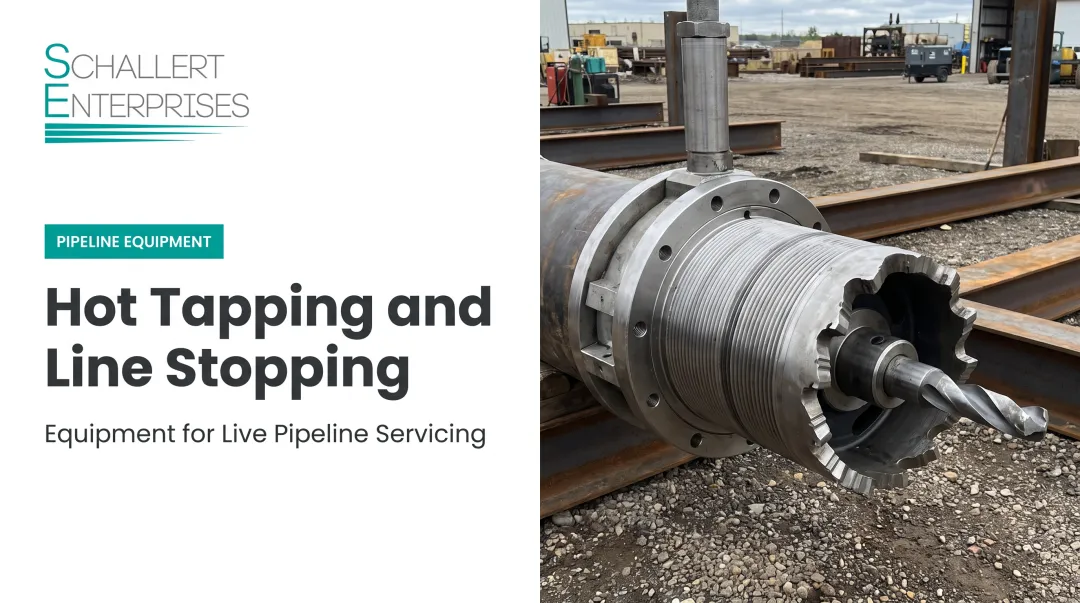
Schallert also builds its own tapping machines and cutters in-house:
- TM100 through TM6120 tapping machines (3/4 to 6-inch taps up to 24 to 72-inch taps)
- Tapping adapters and large-diameter hole saws
- Carbide-tipped and HSS-tipped multi-tooth cutters up to 48 inches
- Diamond segment cutters up to 72 inches for concrete-lined pipe
Cutters and Adapters That Fit Any Machine
Schallert's tapping adapters and cutter housings mount on any tapping machine in the world, not just its own. Operators get a practical alternative without replacing an entire fleet. A crew running TDW tapping machines can pair them with Schallert cutters, adapters, or housings and keep the machine already in the yard.
A Track Record With Working Pipeline Crews
Schallert equipment has been in the field with established pipeline service companies, including Koppl Pipeline Services, the Rangeline Group, and PipeMan Products, on jobs ranging from municipal water lines to large transmission mains. With proper use and maintenance, the equipment is built to stay in service for decades.
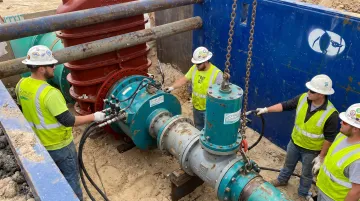
Have a shutdown window coming up and a diameter your current supplier can't cover? Contact Schallert's sales team at sales@schallertenterprises.com or 951-674-6773 for a custom quote sized to your pipeline and timeline.
TDW Stopple vs. Alternative Line Stop Equipment: What to Compare
Choosing between TDW's branded system and an alternative doesn't require guesswork. Ask any supplier the same four questions:
| Comparison factor | Question to ask |
|---|---|
| Upfront equipment cost | What's the price difference for a comparable diameter and pressure rating? |
| Parts lead time | How long for a replacement plug, adapter, or housing on this specific size? |
| Size-range flexibility | Does your catalog cover my smallest and largest diameters, or does everything need a custom quote? |
| Cross-machine compatibility | Will this cutter or adapter mount on the tapping machine I already own? |
Whatever answers you get, request these before committing, regardless of brand:
- Certified drawings
- Material certifications
- Pressure ratings
Flanged fittings should comply with ASME B16.5, which covers ratings, materials, dimensions, and testing. TDW meets it. A serious alternative supplier should too.
Switching doesn't have to be all-or-nothing. Many operators run a mixed fleet, keeping their existing tapping machines while sourcing cutters, adapters, or plugging heads from a different manufacturer wherever it saves money or solves a sizing problem.
Frequently Asked Questions
What is a hot tapping fitting?
A hot tapping fitting is the weld-on branch connection and valve assembly attached to a live, pressurized pipeline. It gives the tapping machine a sealed path to cut into the line without stopping flow.
What is the difference between hot tapping and line stopping (stoppling)?
Hot tapping creates the opening in a pressurized, in-service pipeline. Line stopping (stoppling) uses that opening to insert a plugging head that temporarily isolates a section for repair.
Is TDW's Stopple technology proprietary, and can other manufacturers make compatible equipment?
Certain components, including aspects of the LOCK-O-RING completion plug system, are patented to TDW. Functionally similar equipment, such as folding and pivoting heads and completion plugs, is manufactured independently by companies like Schallert Enterprises.
What size pipelines can line stop equipment handle?
Range varies by manufacturer. Schallert's equipment covers diameters from 3/4 inch up to 84 inches, handling everything from small distribution lines to large transmission mains.
How long does line stop equipment typically last?
With proper use and routine maintenance, quality line stop equipment can remain in service for decades. Material grade, pressure rating, and maintenance habits all affect actual service life.
Do I need to replace my existing tapping machine to use an alternative brand's cutters or fittings?
No. Reputable alternative manufacturers build tapping adapters and cutter housings designed to mount on existing machines from any brand, so you can upgrade individual components without a full fleet replacement.